In today’s fast-paced digital landscape, businesses rely on multiple software systems to manage operations, customer relationships, data analytics, and more. However, when these systems operate in silos, they create inefficiencies, data inconsistencies, and missed opportunities. This is where enterprise application integration plays a critical role in enabling true digital transformation.
At Aspire Software Consultancy, we help businesses connect their systems seamlessly to unlock efficiency, agility, and innovation through smart integration strategies.
What is Enterprise Application Integration?
Enterprise application integration (EAI) is the process of connecting different software applications, systems, and databases within an organization to work as a unified ecosystem. Instead of functioning independently, integrated systems share data and processes in real time.
This approach ensures that information flows smoothly across departments—whether it’s sales, marketing, finance, or operations—creating a more efficient and responsive business environment.
Why Integration is the Backbone of Digital Transformation
Digital transformation is not just about adopting new technologies; it’s about redefining how businesses operate and deliver value. Without integration, digital initiatives often fail to deliver expected results.
Here’s how system integration services drive transformation:
1. Eliminating Data Silos
Disconnected systems lead to fragmented data. Integration ensures a single source of truth, improving decision-making and reducing errors.
2. Enhancing Operational Efficiency
Automating workflows across systems reduces manual work, speeds up processes, and minimizes human errors.
3. Improving Customer Experience
With integrated systems like CRM, businesses gain a 360-degree view of customers, enabling personalized interactions and faster service.
4. Enabling Real-Time Insights
Integrated systems provide real-time data access, allowing businesses to respond quickly to market changes and customer needs.
The Role of Salesforce Integration in Modern Businesses
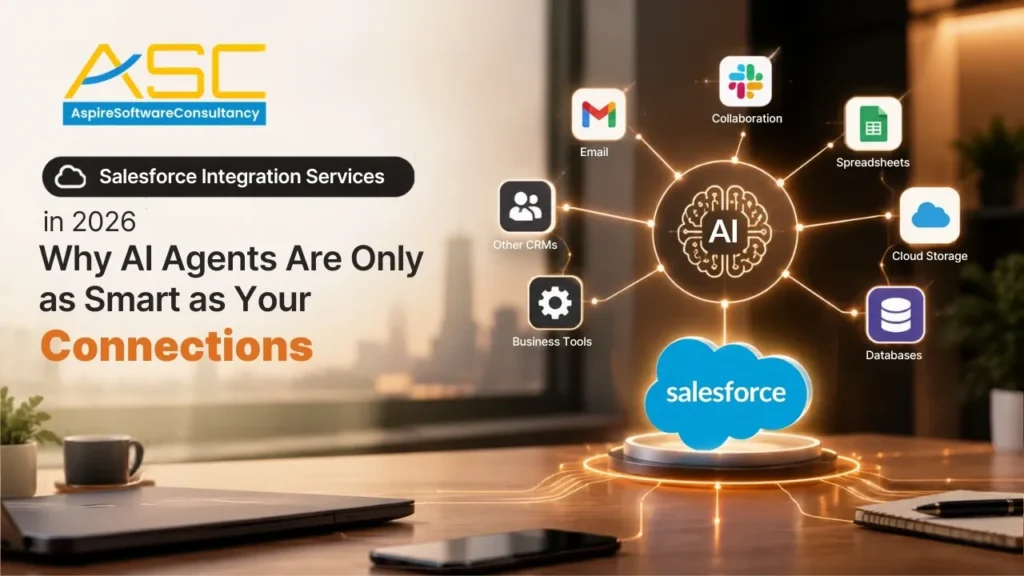
One of the most powerful ways to achieve seamless connectivity is through Salesforce integration services. Salesforce is widely used as a CRM platform, but its true potential is unlocked when integrated with other business systems.
Key Benefits of Salesforce CRM Integration Services:
- Centralized Customer Data
Sync data from multiple platforms into one unified CRM system. - Automated Sales & Marketing Workflows
Reduce manual tasks and improve productivity. - Better Forecasting & Analytics
Use integrated data for accurate predictions and insights. - Improved Collaboration
Teams across departments can access the same real-time data.
At Aspire Software Consultancy, we specialize in Salesforce CRM integration services that connect your CRM with ERP systems, marketing tools, and third-party applications.
Enterprise Application Development + Integration = Scalable Growth
Integration works best when combined with strong enterprise application development. Custom-built applications designed with integration in mind ensure scalability and flexibility.
Why Businesses Choose Custom Development:
- Tailored solutions aligned with business goals
- Easy integration with existing systems
- Better security and performance
- Future-ready architecture for scaling operations
Our software consulting services focus on designing applications that not only meet current needs but also adapt to future technological advancements.
Key Integration Approaches Businesses Use Today
To successfully implement digital transformation solutions, businesses use different integration methods:
1. API-Based Integration
APIs allow systems to communicate in real time, making them the most popular integration method.
2. Middleware Integration
Middleware acts as a bridge between different applications, simplifying complex integrations.
3. Cloud-Based Integration
Cloud platforms enable scalable and flexible integration across distributed systems.
4. Data Integration
Combines data from multiple sources into a unified view for analytics and reporting.
Choosing the right approach depends on your business requirements, existing infrastructure, and long-term goals.
Challenges in Enterprise Integration (and How to Overcome Them)
While integration offers immense benefits, it comes with challenges:
- Legacy Systems: Older systems may not support modern integration methods
- Data Security Risks: Sensitive data needs secure handling
- Complex Architecture: Multiple systems increase complexity
- High Initial Investment: Integration requires strategic planning
With the right software consulting services, these challenges can be addressed effectively. At Aspire Software Consultancy, we provide end-to-end guidance—from strategy to implementation and ongoing support.
How Aspire Software Consultancy Helps You Succeed
We provide comprehensive digital transformation solutions powered by robust integration strategies:
- End-to-end enterprise application integration
- Custom enterprise application development
- Expert Salesforce integration services
- Scalable and secure system integration services
- Strategic software consulting services
Our goal is to help businesses become more agile, data-driven, and customer-centric.
Future of Enterprise Integration
As technologies like AI, IoT, and cloud computing evolve, integration will become even more critical. Businesses that invest in strong integration frameworks today will be better positioned to innovate and compete in the future.
The shift toward hyperautomation and intelligent workflows will further emphasize the need for seamless system connectivity.
Frequently Asked Questions
Enterprise application integration is the process of connecting different business systems to enable seamless data flow and improve efficiency.
Integration eliminates data silos, improves workflows, and enables real-time insights, making digital transformation more effective.
Salesforce integration services connect Salesforce CRM with other business applications to streamline operations and improve customer management.
They improve efficiency, reduce manual work, enhance data accuracy, and enable better decision-making.
Integration connects existing systems, while development focuses on building new applications. Both work together for scalable solutions.