
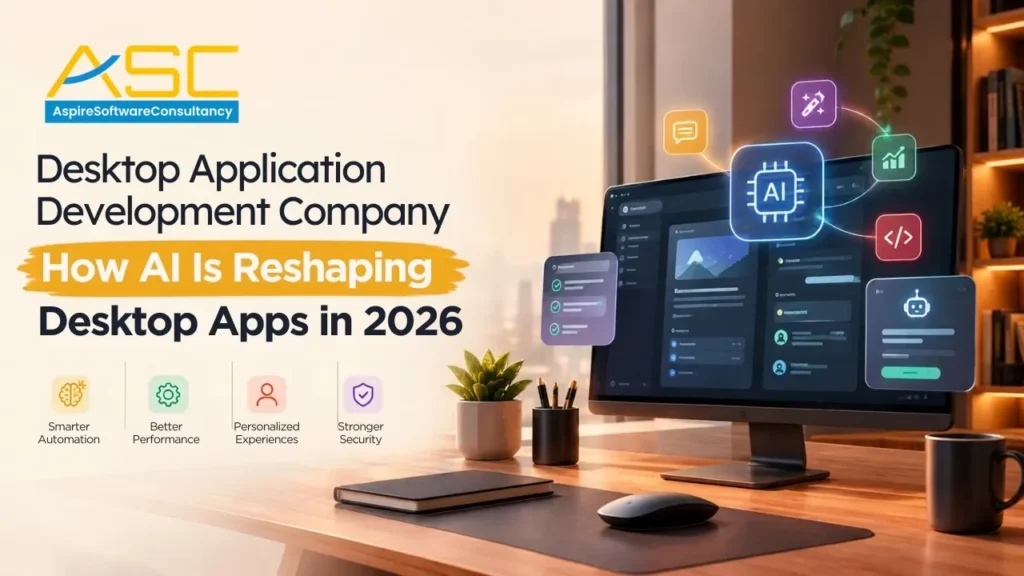
Desktop Application Development Company: How AI Is Reshaping Desktop Apps in 2026
Web and mobile get most of the headlines, but desktop software is where serious work still happens. Finance teams, healthcare providers, engineers and logistics managers all rely on fast, secure, offline-capable tools. In 2026, AI is making those tools smarter, which makes choosing the right desktop application development company more important than ever. At Aspire Software Consultancy, we have spent 18+ years building software for 300+ clients across the USA, UK, Australia and India. Here is what we see shaping desktop app development in 2026, and how to pick a partner who can build it. Why Desktop Applications Still Matter in the AI Era Desktop apps offer things a browser tab can’t match: Performance: direct access to CPU, GPU and local storage Offline reliability: work continues without a connection Security and control: sensitive data can stay on the device Deep integration: hardware, peripherals, files and legacy systems These strengths are why enterprise desktop software is still thriving, and why AI is becoming its biggest upgrade. 5 Desktop App Trends to Watch in 2026 1. On-Device AI and Local Models Instead of sending every request to the cloud, modern AI-powered desktop apps can run smaller models locally. The result is faster responses, lower API costs and better privacy, which suits healthcare, legal and finance users. 2. AI Copilots Inside Business Software Users now expect built-in assistants that summarize records, draft reports, flag anomalies and automate repetitive steps. A good custom desktop application development partner designs these features around your real workflows, not as a bolt-on chatbot. 3. Cross-Platform Desktop Apps Teams want one codebase across Windows, macOS and Linux. Frameworks such as Electron, .NET MAUI and Tauri make cross-platform desktop apps practical, and Java’s “write once, run anywhere” model still holds up for enterprise systems. See our Java development services for details. 4. Security-First Design With AI features handling more data, encryption, role-based access and compliance are baseline requirements. Secure architecture should be planned from day one, not patched in later. 5. Hybrid Desktop + Cloud Architecture The best apps combine local speed with cloud sync, remote updates and API integrations. Our web development and enterprise application development teams build both sides together. What to Look for in a Desktop Application Development Company Before signing a contract, check whether the company offers: Proven experience: case studies and client reviews you can verify, such as our portfolio Modern tech skills: .NET, Java, Angular and React, plus AI integration Transparent process: regular updates and clear milestones Post-launch support: maintenance, upgrades and security patches AI readiness: the ability to add intelligent features without a full rewrite How Aspire Software Consultancy Builds Desktop Solutions At Aspire, we deliver end-to-end desktop app development services, from discovery and UI/UX design to development, testing and long-term support. Our teams work with .NET Core, Java and modern front-end technologies. We can modernize legacy desktop software, build new products from scratch, or add AI features to your existing systems. You get daily status updates, clean maintainable code and dedicated post-launch support. That is why startups and enterprises keep choosing Aspire as their technology partner. Final Thoughts AI is turning desktop software from a static tool into an intelligent assistant. The right desktop application development company will help you adopt on-device AI, cross-platform reach and strong security without overspending. Ready to build or modernize your desktop application? Schedule a free consultation with Aspire Software Consultancy today. Frequently Asked Questions What does a desktop application development company do? A desktop application development company designs, builds, tests and maintains software that runs directly on Windows, macOS or Linux. At Aspire Software Consultancy, this includes custom desktop applications, legacy software modernization, AI feature integration and long-term support. How much does custom desktop application development cost? The cost depends on the app’s complexity, the number of features, platform support, integrations and AI capabilities. A simple internal tool costs far less than an enterprise platform with analytics and AI. Contact Aspire for a free consultation and a tailored proposal. Which technologies are best for desktop app development in 2026? The best choice depends on your goals. Popular options include .NET (including .NET MAUI), Java, Electron and Tauri. Java and .NET suit secure enterprise systems, while Electron and Tauri work well for cross-platform apps. Aspire’s team works with .NET Core and Java. Can AI be added to an existing desktop application? Yes. In most cases you don’t need a full rewrite. AI features such as smart search, automated reports, document summaries and predictive insights can be added through APIs or on-device models. This is often a cost-effective way to modernize older software. Facebook Instagram Youtube Linkedin X-twitter
Desktop Application Development Company: How AI Is Reshaping Desktop Apps in 2026 Read More »