WhatsApp Chat

May 7, 2026

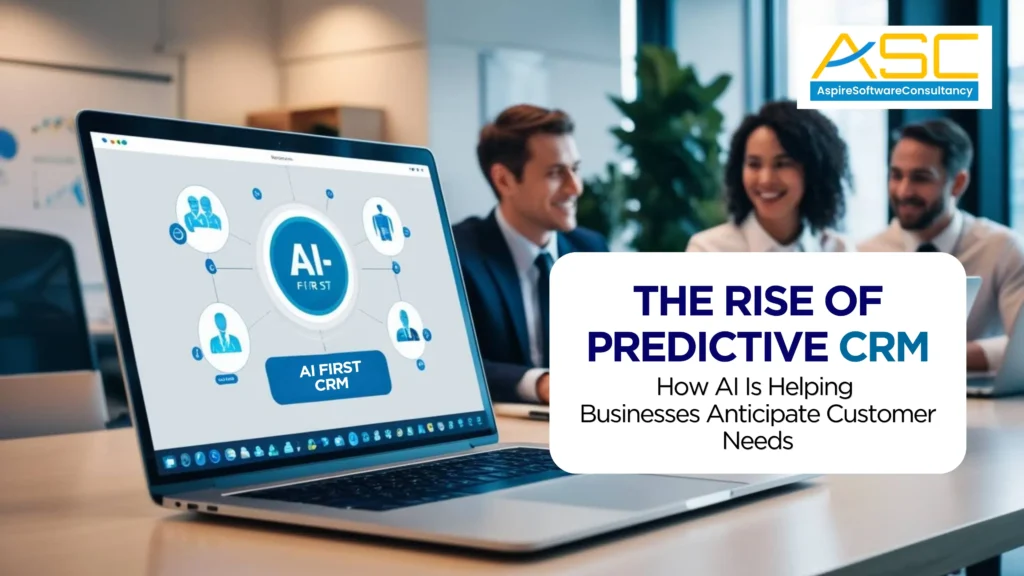
Predictive CRM dashboard with AI analytics helping businesses understand customer behavior and improve engagement

The Rise of Predictive CRM: How AI Is Helping Businesses Anticipate Customer Needs

In today’s fast moving digital economy, customer expectations are evolving faster than ever. Businesses are no longer competing only on product quality or pricing — they are competing on customer experience. Companies that can understand customer behavior, predict future needs, and deliver personalized interactions are gaining a significant competitive advantage. This is where predictive CRM powered by artificial intelligence is transforming modern business operations. Traditional CRM systems primarily focus on storing customer information and tracking interactions. However, modern businesses require more than just data storage. They need actionable insights that help sales, marketing, and customer support teams make smarter decisions in real time. With the rise of ai powered crm solutions, organizations can now forecast customer behavior, identify sales opportunities, reduce churn, and create highly personalized customer experiences. At Aspire Software Consultancy, we help businesses leverage advanced CRM technologies through expert salesforce consulting services, intelligent automation, and custom AI integrations that improve customer engagement and business performance. What Is Predictive CRM? Predictive CRM is an advanced approach to customer relationship management that uses artificial intelligence, machine learning, and analytics to predict customer actions and behaviors. Instead of simply reacting to customer activity, businesses can proactively anticipate what customers may need next. Predictive CRM systems analyze historical customer data, purchasing patterns, communication history, browsing activity, and engagement metrics to generate intelligent recommendations and forecasts. For example, predictive CRM can help businesses: Identify customers most likely to make a purchase Detect customers at risk of leaving Recommend personalized products or services Predict future sales trends Automate lead scoring and prioritization Improve customer retention strategies This intelligent use of data enables businesses to create more meaningful and personalized customer interactions. How AI Is Transforming CRM Systems Artificial intelligence is becoming a core component of modern CRM platforms. AI driven automation and analytics are helping organizations improve efficiency while delivering exceptional customer experiences. 1. Smarter Lead Scoring Sales teams often spend valuable time pursuing leads that may never convert. AI powered CRM systems automatically analyze customer behavior and assign lead scores based on conversion probability. This allows sales teams to focus on high value opportunities, improving productivity and revenue generation. A trusted salesforce crm development company can customize AI based lead scoring models according to business specific goals and customer data. 2. Personalized Customer Experiences Modern customers expect personalized interactions across every touchpoint. AI helps businesses understand customer preferences, interests, and buying behaviors to deliver targeted recommendations and communications. Using predictive analytics, businesses can send personalized product suggestions, customized offers, and timely follow ups that increase engagement and customer satisfaction. This is one of the biggest reasons companies are investing in customer intelligence platforms integrated with CRM systems. 3. Predicting Customer Churn Customer retention is often more cost effective than acquiring new customers. Predictive CRM tools can identify warning signs that indicate a customer may stop engaging with a business. AI algorithms analyze factors such as declining engagement, reduced purchases, support complaints, or inactivity to predict churn risks early. Businesses can then take proactive steps to improve customer relationships and prevent revenue loss. 4. Intelligent Sales Forecasting AI powered forecasting tools help organizations make data driven business decisions. By analyzing market trends, historical sales performance, and customer behavior, predictive CRM systems provide more accurate revenue predictions. This enables businesses to improve planning, resource allocation, and strategic decision making. Why Salesforce Is Leading the Predictive CRM Revolution Salesforce remains one of the most powerful CRM platforms for businesses seeking AI driven customer management solutions. With tools like Salesforce Einstein, businesses can integrate predictive analytics, automation, and AI powered insights directly into their workflows. As a professional salesforce development company, Aspire Software Consultancy helps businesses maximize the capabilities of Salesforce through tailored implementation and customization services. Our salesforce consulting services help organizations: Implement intelligent CRM workflows Build AI powered dashboards and reporting Automate customer engagement processes Improve sales and marketing alignment Integrate third party applications and data sources Develop scalable CRM ecosystems With the right CRM strategy, businesses can transform customer data into actionable intelligence that drives growth. The Importance of Salesforce Customization Every business has unique workflows, customer journeys, and operational requirements. A generic CRM setup often fails to meet industry specific needs. This is why salesforce customization services play a critical role in CRM success. Customized CRM solutions allow businesses to: Create tailored dashboards and reporting Automate repetitive business processes Improve team collaboration Enhance customer communication workflows Integrate AI models for predictive insights Build industry specific CRM modules A reliable salesforce crm development company can ensure that CRM platforms align perfectly with business goals while maintaining scalability and flexibility. Industries Benefiting from Predictive CRM Predictive CRM solutions are transforming industries across the globe. Businesses in multiple sectors are leveraging AI powered insights to improve customer relationships and operational efficiency. Retail and E commerce Retail businesses use predictive CRM to recommend products, personalize promotions, and forecast purchasing behavior. Healthcare Healthcare providers use predictive analytics to improve patient engagement, appointment scheduling, and communication workflows. Financial Services Banks and financial institutions use AI driven CRM systems to detect fraud risks, personalize financial products, and improve customer retention. Real Estate Real estate companies use predictive CRM to identify high potential leads and automate follow up communication. Travel and Hospitality Hospitality businesses use customer intelligence platforms to personalize guest experiences and improve loyalty programs. The Future of AI Powered CRM Solutions The future of CRM is becoming increasingly intelligent, automated, and customer centric. Businesses are moving toward systems that can predict customer needs before customers even express them. Emerging trends in predictive CRM include: Conversational AI and chatbots Real time customer sentiment analysis Hyper personalized marketing automation Voice enabled CRM interactions Predictive customer support AI driven workflow automation As AI technology continues to evolve, businesses that adopt predictive CRM early will gain a stronger competitive advantage in customer engagement and operational efficiency. Why Choose Aspire Software Consultancy At Aspire Software Consultancy, we specialize in delivering innovative CRM and AI solutions that help businesses improve customer experiences and drive

The Rise of Predictive CRM: How AI Is Helping Businesses Anticipate Customer Needs Read More »
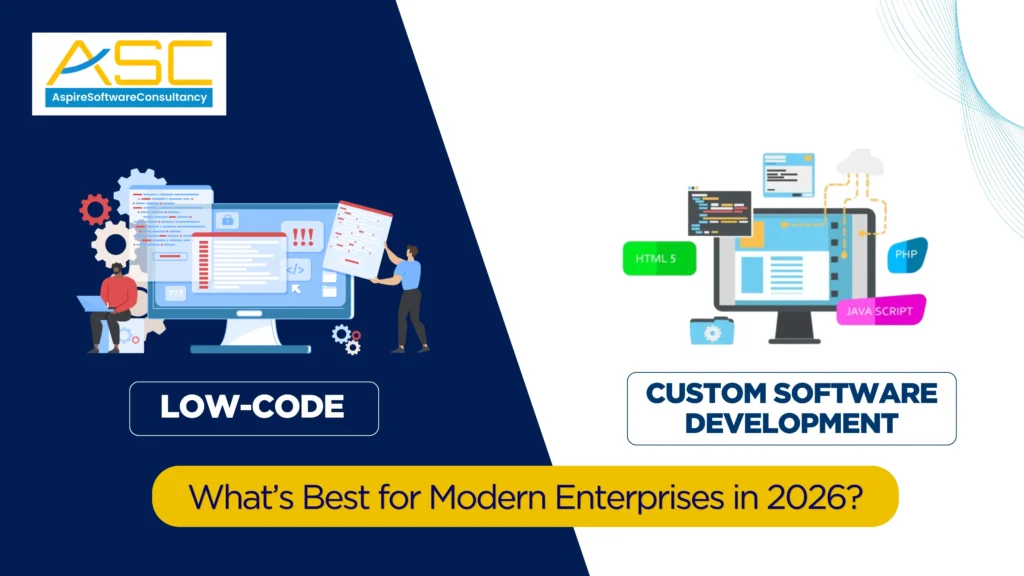
Comparison of low-code and custom software development solutions for modern enterprises in 2026

Low Code vs Custom Software Development: What’s Best for Modern Enterprises in 2026?

In 2026, businesses are under constant pressure to innovate faster, improve customer experiences, and streamline operations through technology. As organizations continue accelerating their digital transformation strategies, one important decision stands out: should they choose low code development platforms or invest in fully customized software solutions? Both approaches offer unique advantages, but selecting the right one depends on your business goals, scalability needs, budget, and long term vision. At Aspire Software Consultancy, we help enterprises evaluate the best technology approach through expert software consulting services and scalable development solutions. In this blog, we’ll explore the differences between low code and custom software development, their benefits, limitations, and which option is best suited for modern enterprises in 2026. What Is Low Code Development? Low code development is a software development approach that uses visual interfaces, drag and drop components, and pre built templates to create applications with minimal manual coding. Modern low code development platforms allow businesses to quickly build applications for workflow automation, CRM management, customer portals, reporting dashboards, and more. Popular low code platforms include: Microsoft Power Apps Salesforce Lightning Platform Mendix OutSystems Appian These platforms are gaining popularity because they significantly reduce development time and simplify deployment. What Is Custom Software Development? Custom software development involves designing and building applications specifically tailored to an organization’s business processes and goals. Unlike generic platforms, custom solutions are fully flexible and scalable. A professional custom software development company creates software that aligns with unique operational requirements, integrations, security standards, and future growth plans. Custom development is commonly used for: Enterprise ERP systems Healthcare platforms Banking and fintech applications E commerce platforms AI driven business systems Advanced CRM and ERP integrations At Aspire Software Consultancy, our team specializes in enterprise application development and scalable business software solutions designed for long term success. Key Differences Between Low Code and Custom Development Feature Low Code Development Custom Software Development Development Speed Faster Longer development cycle Flexibility Limited customization Fully customizable Scalability Moderate High scalability Cost Lower initial cost Higher upfront investment Maintenance Platform managed Fully controlled by business Integration Platform dependent Unlimited integration capabilities Security Standardized security Advanced custom security Ownership Vendor/platform controlled Full ownership Benefits of Low Code Development Platforms 1. Faster Development and Deployment One of the biggest advantages of low code solutions is speed. Businesses can launch applications within weeks instead of months. This is ideal for: MVP development Internal business tools Workflow automation Temporary business solutions For enterprises looking to quickly adapt to changing market demands, low code can be highly effective. 2. Reduced Development Costs Low code platforms reduce coding effort, which lowers initial development costs. Organizations with limited budgets can still modernize operations without hiring large engineering teams. This makes low code attractive for startups and mid sized businesses. 3. Easier Business User Participation Many low code platforms allow non technical users to contribute to application development. Business teams can: Create workflows Modify forms Automate processes Build dashboards This improves collaboration between technical and non technical departments. Limitations of Low Code Development While low code platforms offer convenience, they also come with important limitations. Limited Customization Complex business requirements may exceed platform capabilities. Enterprises often face restrictions when trying to implement advanced features. Vendor Dependency Businesses depend heavily on the platform provider for pricing, updates, and support. Scalability Challenges As business operations grow, low code applications may struggle with performance, architecture flexibility, and large scale integrations. Security and Compliance Concerns Industries like healthcare, banking, and insurance often require advanced compliance frameworks that low code platforms may not fully support. Benefits of Custom Software Development 1. Complete Flexibility Custom software is built specifically for your business requirements. A trusted software development consultancy ensures that every feature, workflow, and integration aligns with your operational goals. This flexibility becomes critical for enterprises with complex business processes. 2. Better Scalability for Enterprise Growth Custom applications can scale alongside business growth. Whether you are adding new users, expanding services, or integrating AI capabilities, custom architecture supports long term scalability. This is especially important for large enterprises investing in future ready systems. 3. Advanced Security and Compliance Security remains a top priority in 2026. Custom built solutions provide: Role based access control Advanced encryption Custom compliance frameworks Enterprise grade authentication Secure API integrations A professional custom .NET development company can build secure enterprise solutions using modern Microsoft technologies and cloud infrastructure. 4. Seamless Integration Capabilities Modern enterprises rely on multiple platforms such as Salesforce, ERP systems, HR software, payment gateways, and analytics tools. Custom development enables seamless integrations across all business systems without platform limitations. When Should Businesses Choose Low Code? Low code development works best when: Speed is the top priority Budget is limited The application is relatively simple Internal workflow automation is needed Minimal customization is required Rapid prototyping is important Examples include: Employee management tools Approval workflows Reporting dashboards Customer support portals When Should Businesses Choose Custom Software Development? Custom development is the better option when: Business processes are highly complex Scalability is essential Security and compliance are critical Long term ROI matters Advanced integrations are required Competitive differentiation is important Industries such as finance, healthcare, logistics, manufacturing, and enterprise SaaS often benefit more from custom solutions. The Hybrid Approach: The Future of Enterprise Development In 2026, many enterprises are adopting a hybrid approach that combines low code platforms with custom software development. For example: Low code for internal workflows Custom APIs for advanced integrations Custom AI modules connected to low code systems Enterprise grade backend with low code front end tools This balanced strategy allows businesses to improve speed while maintaining scalability and flexibility. At Aspire Software Consultancy, we help organizations identify the right mix of technologies based on their business objectives. How Aspire Software Consultancy Helps Enterprises As a trusted provider of software consulting services, Aspire Software Consultancy delivers tailored development strategies for modern businesses. Our expertise includes: Enterprise software architecture Salesforce development and integration Custom .NET application development Cloud based enterprise solutions CRM and ERP integrations AI powered

Low Code vs Custom Software Development: What’s Best for Modern Enterprises in 2026? Read More »

Scroll to Top