WhatsApp Chat

salesforce consulting services

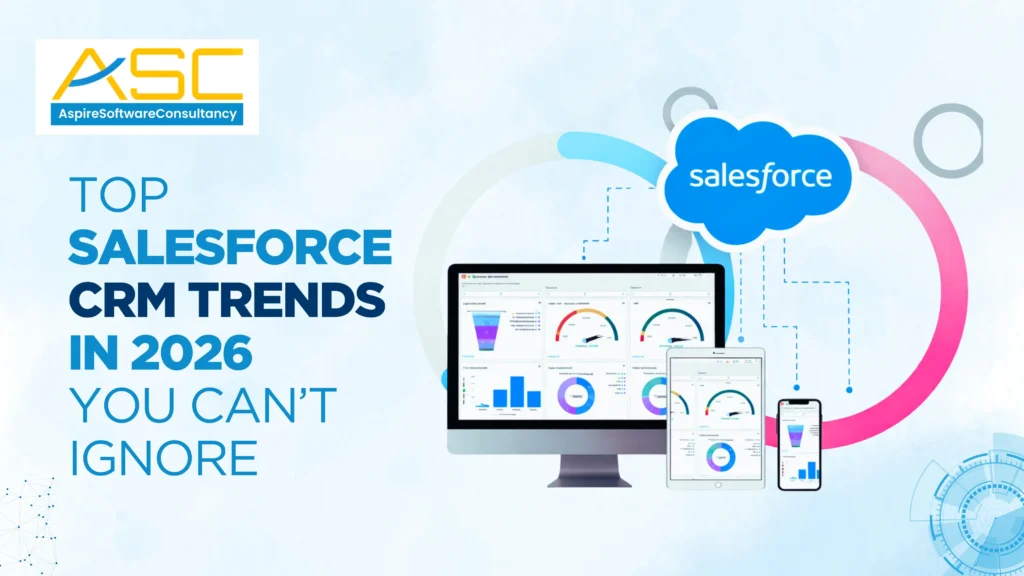
Top Salesforce CRM trends in 2026 including AI-powered CRM, automation, Salesforce integration services, and enterprise application development.

Top Salesforce CRM Trends in 2026 You Can’t Ignore

Customer expectations are evolving faster than ever, and businesses must adapt to stay competitive. In 2026, Salesforce CRM continues to lead digital transformation with advanced AI capabilities, automation, and deeper integrations. For companies looking to scale efficiently, staying updated with the latest Salesforce trends is no longer optional—it’s essential. At Aspire Software Consultancy, we help businesses leverage these innovations through expert salesforce consulting services and customized CRM solutions. Let’s explore the top Salesforce CRM trends shaping 2026. 1. AI-Powered CRM Takes Center Stage Artificial Intelligence is no longer a future concept—it’s a core component of modern CRM systems. Salesforce has significantly enhanced its AI capabilities, enabling businesses to predict customer behavior, automate workflows, and personalize interactions at scale. AI-driven insights allow sales and marketing teams to make smarter decisions in real time. From lead scoring to customer segmentation, AI improves efficiency across departments. Businesses partnering with a reliable Salesforce consulting partner can fully utilize these AI features to streamline operations and boost ROI. 2. Hyper-Personalization at Scale Customers now expect personalized experiences at every touchpoint. Salesforce CRM enables businesses to deliver tailored content, product recommendations, and communication based on real-time data. With advanced analytics and AI integration, companies can create highly targeted campaigns that resonate with their audience. This level of personalization helps improve customer engagement and retention. A trusted Salesforce implementation partner can help design and deploy personalized customer journeys aligned with your business goals. 3. Seamless Integration Across Platforms In 2026, businesses rely on multiple tools and platforms to manage operations. Salesforce integration services are becoming crucial to ensure smooth data flow between systems such as ERP, marketing automation, and eCommerce platforms. Seamless integration eliminates data silos, improves collaboration, and enhances decision-making. Whether it’s integrating third-party applications or legacy systems, having a strong integration strategy is key. Working with a professional salesforce development company ensures secure and efficient integration tailored to your business needs. 4. Low-Code and No-Code Development The demand for faster development cycles has led to the rise of low-code and no-code platforms within Salesforce. Businesses can now build applications, automate workflows, and customize CRM functionalities with minimal coding. This trend empowers non-technical users to contribute to digital transformation, reducing dependency on developers and accelerating project timelines. However, for complex requirements, partnering with a salesforce crm development company ensures scalability and performance without compromising quality. 5. Enhanced Data Security and Compliance With increasing data privacy regulations, businesses must prioritize data security. Salesforce continues to enhance its security features, offering robust data protection, compliance tools, and access controls. Organizations are focusing more on secure data management to build customer trust and avoid regulatory issues. A reliable Salesforce consulting services provider can help implement best practices for data security and ensure compliance with global standards. 6. Industry-Specific CRM Solutions Generic CRM solutions are being replaced by industry-specific Salesforce applications tailored to sectors like healthcare, finance, retail, and manufacturing. These solutions offer pre-built functionalities, reducing implementation time and improving efficiency. Businesses can address unique industry challenges more effectively with customized CRM systems. An experienced Salesforce implementation partner can deliver industry-focused solutions that align with your operational requirements. 7. Automation for Increased Productivity Automation continues to be a major trend in 2026. From sales processes to customer support, Salesforce enables businesses to automate repetitive tasks and focus on strategic activities. Automation improves productivity, reduces human errors, and enhances customer experience. Features like automated workflows, chatbots, and predictive analytics are transforming how businesses operate. By leveraging enterprise application development strategies, companies can integrate automation across their entire ecosystem for maximum efficiency. 8. Real-Time Analytics and Data-Driven Decisions Data is the backbone of modern business strategies. Salesforce provides powerful analytics tools that enable real-time reporting and insights. Businesses can monitor performance, track KPIs, and make informed decisions instantly. Real-time data helps organizations stay agile and respond quickly to market changes. A skilled Salesforce consulting partner can help you design dashboards and reporting systems tailored to your business objectives. 9. Mobile-First CRM Experience With the growing demand for remote work and on-the-go access, mobile CRM is becoming essential. Salesforce offers robust mobile capabilities that allow teams to manage tasks, access data, and communicate with customers from anywhere. Mobile-first strategies improve productivity and ensure that teams remain connected at all times. Partnering with a salesforce development company ensures optimized mobile experiences that align with your workflows. 10. Focus on Customer Experience (CX) Customer experience is now a key differentiator in competitive markets. Salesforce CRM helps businesses deliver seamless and consistent experiences across all channels. From sales to support, every interaction is tracked and optimized to improve customer satisfaction. A comprehensive approach combining Salesforce consulting services and enterprise application development ensures a unified and customer-centric strategy. Why Choose Aspire Software Consultancy? At Aspire Software Consultancy, we specialize in delivering end-to-end Salesforce solutions tailored to your business needs. As a trusted Salesforce consulting partner, we help organizations implement, customize, and optimize CRM systems for long-term success. Our expertise includes: Salesforce implementation and customization Salesforce integration services Enterprise application development Ongoing support and optimization We focus on delivering scalable, secure, and future-ready solutions that drive business growth. Frequently Asked Questions What are the key benefits of Salesforce CRM in 2026? Salesforce CRM offers AI-driven insights, automation, seamless integration, and enhanced customer experience, helping businesses improve efficiency and decision-making. Why should I hire a Salesforce consulting partner? A Salesforce consulting partner ensures proper implementation, customization, and optimization of CRM solutions tailored to your business needs. How do Salesforce integration services help businesses? They connect different systems, eliminate data silos, and enable smooth data flow, improving overall operational efficiency. Is Salesforce suitable for small businesses? Yes, Salesforce offers scalable solutions that can be customized for businesses of all sizes, including startups and SMEs. What is the role of AI in Salesforce CRM? AI helps automate processes, predict customer behavior, and provide actionable insights, enhancing overall business performance. Facebook Instagram Youtube Linkedin X-twitter

Top Salesforce CRM Trends in 2026 You Can’t Ignore Read More »

Agentforce World Tour Mumbai 2026 event guide showcasing Salesforce CRM, AI automation, and digital transformation insights

Agentforce World Tour Mumbai 2026: A Complete Guide for Businesses

The Agentforce World Tour Mumbai 2026 is set to be one of the most impactful Salesforce events in India, bringing together industry leaders, innovators, and technology experts to explore the future of AI powered CRM and enterprise digital transformation. If your business is investing in Salesforce or AI, this is not just another event, it’s a strategic opportunity you shouldn’t ignore in 2026. For businesses looking to stay competitive in a rapidly evolving digital landscape, this event offers valuable insights into Salesforce CRM solutions, AI consulting & automation, and next generation customer experience strategies. Where is the Event Happening? The Agentforce World Tour Mumbai 2026 by Salesforce will take place in Mumbai, one of India’s leading business and technology hubs. Date: Tuesday, May 19, 2026 Time: 8:30 a.m. – 6:30 p.m. IST Format: Virtual + Hybrid experience This event is ideal for organizations exploring Salesforce implementation, enterprise solutions, and digital transformation strategies. What is Agentforce World Tour All About? The Agentforce World Tour is a global initiative focused on redefining how businesses use technology to drive growth. Hosted by Salesforce, the event highlights innovations in: AI powered CRM platforms Intelligent automation Data driven decision making Customer 360 experiences In 2026, the major focus is on Agentforce implementation, where AI powered agents move beyond basic automation and actively contribute to business processes. This evolution is especially important for organizations investing in Salesforce consulting services and advanced CRM capabilities. What to Expect at the Event 1. Visionary Keynotes Hear from industry leaders and Salesforce experts about: The future of AI in business Trends in enterprise digital transformation How organizations are scaling with intelligent automation These sessions are particularly useful for decision makers planning long term IT consulting services strategies. 2. Product Deep Dive Sessions Explore Salesforce products and innovations, including: Agentforce platform Data Cloud AI powered automation tools These sessions provide practical insights for businesses working with a Salesforce implementation partner or upgrading their CRM systems. 3. Industry Use Case Sessions Discover how companies across industries are leveraging: Salesforce CRM solutions AI driven workflows Customer engagement platforms These sessions help businesses understand real world applications of enterprise digital transformation. 4. Hands On Learning & Live Demos Interactive product demonstrations Real implementation strategies Guided learning experiences Ideal for technical teams involved in software consultancy services and CRM deployment. 5. Networking Opportunities The event also offers opportunities to: Connect with Salesforce experts Engage with technology partners Build valuable industry connections For companies offering IT consulting services, this is a great platform to explore partnerships and new business opportunities. Types of Sessions You’ll Find Attendees can expect a wide range of sessions, such as: Keynotes & Leadership Talks Industry Specific Breakout Sessions Technical Workshops Product Demonstrations Partner Showcases These sessions cater to both business leaders and technical professionals working with custom software development and CRM platforms. Industry Wise Session Recommendations 1. IT & Software Companies Recommended Sessions: Agentforce implementation CRM customization & integration AI driven automation Why it matters: These sessions are highly beneficial for IT firms looking to enhance their Salesforce consulting services, strengthen CRM implementation expertise, and deliver scalable enterprise solutions. They also provide insights into using AI to improve efficiency and client outcomes. 2. Retail & E-commerce Recommended Sessions: Customer personalization strategies Omnichannel experience AI driven product recommendations Why it matters: Retail businesses can learn how to leverage Salesforce CRM solutions to improve customer engagement, increase conversions, and deliver seamless shopping experiences across channels. 3. Banking & Financial Services Recommended Sessions: AI powered risk analysis Secure CRM implementation Customer service automation Why it matters: These sessions help financial institutions adopt secure and scalable enterprise solutions, improving operational efficiency and customer trust. 4. Healthcare Recommended Sessions: Patient engagement platforms Data management systems AI based service automation Why it matters: Healthcare organizations can explore how CRM and AI technologies enhance patient experiences and streamline operations through digital transformation. 5. Manufacturing & Logistics Recommended Sessions: Supply chain automation Predictive analytics IoT integration with Salesforce Why it matters: These sessions focus on improving operational efficiency and enabling enterprise digital transformation in manufacturing and logistics sectors. Why Businesses Should Attend Attending the Agentforce World Tour Mumbai 2026 provides several benefits: Stay updated with the latest Salesforce CRM solutions Explore innovations in AI consulting & automation Learn from industry experts and real world case studies Discover advanced Salesforce implementation strategies Connect with leading Salesforce Partners How Aspire Software Consultancy Can Help As a trusted Salesforce Partner, Aspire Software Consultancy helps businesses: Implement scalable Salesforce CRM solutions Deliver tailored Salesforce consulting services Drive enterprise digital transformation Build custom software aligned with business goals By leveraging insights from events like Agentforce World Tour, Aspire ensures clients stay ahead in adopting innovative technologies. Final Thoughts The Agentforce World Tour Mumbai 2026 is more than just an event; it’s a platform for learning, innovation, and growth. Businesses looking to invest in: Salesforce implementation AI consulting & automation Enterprise solutions will find immense value in attending this event. As the digital landscape continues to evolve, staying informed and connected through such global events is key to long term success. Planning to attend the Agentforce World Tour Mumbai 2026 by Salesforce? Let’s connect and explore how you can turn these insights into real business outcomes. Facebook Instagram Youtube Linkedin X-twitter

Agentforce World Tour Mumbai 2026: A Complete Guide for Businesses Read More »

Aspire Software Consultancy providing IT consultancy services, custom software development, and Salesforce solutions for businesses

What Makes Aspire Software Consultancy the Right Technology Partner for Your Business

In today’s fast-evolving digital landscape, choosing the right technology partner is one of the most critical decisions a business can make. Whether you’re a startup aiming to scale or an enterprise seeking digital transformation, the expertise and reliability of your partner directly impact your success. Aspire Software Consultancy stands out as a trusted software development company that helps businesses innovate, scale, and stay competitive. But what truly makes Aspire the right technology partner? Let’s explore. 1. End-to-End Technology Expertise Aspire Software Consultancy offers a full spectrum of IT consultancy services, ensuring businesses receive complete support—from strategy to execution. Unlike many providers that focus on just development, Aspire takes a holistic approach: Technology consulting System architecture design Development and integration Deployment and ongoing support This comprehensive approach ensures that your business doesn’t just adopt technology—it leverages it effectively for growth. 2. Tailored Solutions with a Business-First Approach Every business is unique, and Aspire understands that one-size-fits-all solutions rarely deliver optimal results. As a leading custom software development company, Aspire focuses on: Understanding your business goals Identifying operational challenges Delivering tailored solutions that align with your vision Instead of forcing businesses to adapt to software, Aspire builds software that adapts to your business. This approach improves efficiency, reduces costs, and enhances scalability. 3. Strong Foundation in Software Development Consultancy Aspire excels as a software consultancy company by combining technical expertise with strategic insights. Their software development consultancy services help businesses: Choose the right technology stack Optimize development processes Reduce risks in project execution Improve time-to-market This advisory-driven approach ensures that businesses make informed decisions, avoiding costly mistakes and ensuring long-term success. 4. Expertise in Modern Technologies Technology evolves rapidly, and businesses need partners who stay ahead of the curve. Aspire specializes in: Cloud-based solutions Enterprise application development API integrations Scalable architecture design With strong capabilities in dot net development services, Aspire delivers robust, secure, and high-performance applications suitable for businesses of all sizes. This technical strength ensures that your systems are not only functional but also future-ready. 5. Salesforce Consulting That Drives Results Customer relationship management is at the heart of modern businesses. Aspire’s salesforce consulting services help organizations unlock the full potential of their CRM systems. Key benefits include: Seamless Salesforce implementation Customization tailored to your workflows Integration with existing systems Automation of sales and service processes By aligning Salesforce capabilities with your business goals, Aspire helps improve customer engagement, sales performance, and operational efficiency. 6. Agile and Transparent Development Process One of the major challenges businesses face with technology partners is a lack of transparency and flexibility. Aspire follows an agile methodology that ensures: Continuous collaboration Regular updates and feedback loops Faster delivery cycles Adaptability to changing requirements Clients are involved at every stage, ensuring the final product meets expectations without surprises. 7. Focus on Scalability and Long-Term Growth Technology should grow with your business, not limit it. Aspire builds solutions with scalability in mind: Modular architecture Cloud-ready systems Performance optimization Future integration capabilities As a reliable software development company, Aspire ensures your technology investment continues to deliver value as your business expands. 8. Cost-Effective Without Compromising Quality Budget constraints are a reality for most businesses. Aspire strikes the right balance between affordability and quality. Through efficient processes and smart resource allocation, they provide: High-quality development Optimized project timelines Reduced operational costs This makes Aspire a preferred software consultancy company for businesses seeking maximum ROI from their technology investments. 9. Strong Client-Centric Approach What truly sets Aspire apart is its commitment to client success. They focus on: Understanding client needs deeply Providing personalized solutions Offering continuous support and maintenance This client-first mindset ensures long-term partnerships rather than short-term projects. 10. Proven Track Record Across Industries Aspire has experience working with businesses across various industries, including: Healthcare Finance Travel & hospitality Enterprise services This diverse exposure allows them to bring industry-specific insights and best practices to every project. Why Choose Aspire Software Consultancy? Choosing Aspire means partnering with a team that combines: Technical expertise Strategic thinking Customer-focused solutions Whether you need IT consultancy services, custom software development, or Salesforce consulting, Aspire Software Consultancy delivers solutions that drive real business results. Frequently Asked Questions What does a software development company do? A software development company designs, builds, and maintains software solutions tailored to business needs, helping improve efficiency and scalability. Why should I choose a software consultancy company? A software consultancy company provides expert guidance, helping you select the right technologies, reduce risks, and ensure successful project execution. What are custom software development services? Custom software development services involve creating tailored applications specifically designed to meet unique business requirements. How can Salesforce consulting services benefit my business? Salesforce consulting services help optimize CRM processes, improve customer engagement, and automate workflows for better productivity. What industries does Aspire Software Consultancy serve? Aspire works across multiple industries, including healthcare, finance, travel, and enterprise sectors. Facebook Instagram Youtube Linkedin X-twitter

What Makes Aspire Software Consultancy the Right Technology Partner for Your Business Read More »

How to maximize ROI from Salesforce implementation using effective strategies and optimization techniques

How to Maximize ROI from Salesforce Implementation

In today’s competitive digital landscape, businesses invest heavily in CRM platforms like Salesforce to streamline operations, enhance customer relationships, and drive growth. However, simply implementing Salesforce is not enough—organizations must strategically focus on Salesforce implementation ROI to ensure they gain measurable business value. At Aspire Software Consultancy, we help businesses not just deploy Salesforce but maximize Salesforce ROI through proven strategies, optimization techniques, and continuous improvement. Why Salesforce ROI Matters Salesforce is a powerful platform, but without proper planning and execution, it can become an underutilized tool. Maximizing ROI means: Increased sales productivity Improved customer experience Better decision-making with real-time data Reduced operational costs A well-defined Salesforce implementation strategy ensures that every feature aligns with your business goals. 1. Define Clear Business Objectives Before implementation, it’s critical to identify what success looks like. Many businesses fail to achieve ROI because they don’t define measurable goals. Best practices: Set KPIs like lead conversion rate, customer retention, or sales cycle reduction Align Salesforce features with business objectives Prioritize use cases that deliver immediate value When goals are clear, it becomes easier to track and improve your Salesforce implementation ROI. 2. Choose the Right Salesforce Implementation Strategy A strong Salesforce implementation strategy lays the foundation for long-term success. Instead of a one-size-fits-all approach, businesses should adopt a tailored strategy based on their workflows and industry needs. Key elements: Phased implementation (start small, scale gradually) Customization based on business processes Integration with existing systems (ERP, marketing tools, etc.) Working with expert Salesforce consulting services ensures that your strategy is aligned with best practices and avoids costly mistakes. 3. Focus on User Adoption Even the most advanced CRM system fails if users don’t adopt it. Low adoption is one of the biggest barriers to maximize Salesforce ROI. How to improve adoption: Provide role-based training programs Simplify the user interface with relevant dashboards Encourage leadership involvement and accountability Remember, Salesforce ROI increases when employees actively use the platform to its full potential. 4. Leverage Salesforce Automation Automation is a game-changer when it comes to improving efficiency and reducing manual effort. Examples of automation: Lead assignment workflows Automated email campaigns Task reminders and follow-ups These Salesforce optimization techniques not only save time but also improve accuracy, allowing your team to focus on high-value activities. 5. Use Data-Driven Insights Salesforce provides powerful analytics and reporting capabilities. Businesses that leverage these insights effectively see higher returns. Key actions: Monitor dashboards regularly Identify trends and bottlenecks Optimize sales and marketing strategies based on data Data-driven decisions are essential for improving Salesforce ROI best practices and achieving sustainable growth. 6. Continuous Optimization and Improvement Salesforce is not a “set it and forget it” solution. Continuous improvement is necessary to maximize ROI. Optimization strategies: Regular system audits Remove unused fields and features Update workflows as business needs evolve Implementing advanced Salesforce optimization techniques ensures that your CRM remains efficient and aligned with your goals. 7. Integrate Salesforce with Other Systems Integration enhances the value of Salesforce by creating a unified ecosystem. Common integrations: Marketing automation tools Customer support platforms Financial and ERP systems Seamless integration eliminates data silos and improves overall efficiency, directly impacting your Salesforce implementation ROI. 8. Partner with Salesforce Experts Working with experienced Salesforce consulting services providers like Aspire Software Consultancy can significantly improve your ROI. Benefits of expert consulting: Faster implementation Reduced risks and errors Customized solutions tailored to your business A trusted partner ensures that your Salesforce investment delivers maximum value. 9. Measure and Track ROI Regularly To truly maximize Salesforce ROI, businesses must continuously measure performance. Metrics to track: Sales growth Customer acquisition cost (CAC) Customer lifetime value (CLV) User adoption rates Regular tracking helps identify areas for improvement and ensures that your Salesforce implementation remains aligned with business objectives. Conclusion Maximizing ROI from Salesforce implementation requires more than just deploying the platform—it demands a strategic approach, continuous optimization, and strong user adoption. By following these Salesforce ROI best practices, businesses can unlock the full potential of Salesforce and achieve measurable growth. At Aspire Software Consultancy, we specialize in delivering customized Salesforce consulting services that help businesses optimize their CRM and achieve maximum returns. Frequently Asked Questions What is Salesforce implementation ROI? Salesforce implementation ROI refers to the measurable value a business gains from implementing Salesforce, including increased sales, improved efficiency, and better customer engagement. How can I maximize Salesforce ROI? You can maximize Salesforce ROI by defining clear goals, ensuring user adoption, leveraging automation, and continuously optimizing the system. Why is user adoption important in Salesforce? User adoption is critical because the effectiveness of Salesforce depends on how actively employees use it. Higher adoption leads to better data, insights, and ROI. What are Salesforce optimization techniques? These include automation, workflow improvements, data cleanup, system integrations, and regular performance monitoring. Do I need Salesforce consulting services? Yes, expert Salesforce consulting services help ensure proper implementation, customization, and optimization, leading to higher ROI. Facebook Instagram Youtube Linkedin X-twitter

How to Maximize ROI from Salesforce Implementation Read More »

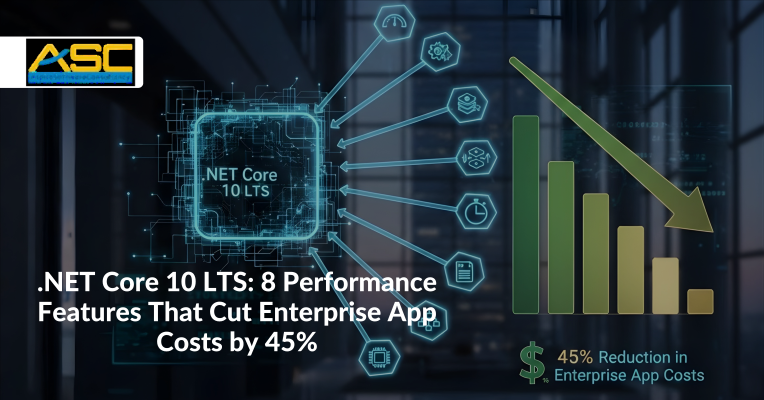
.NET Core 10 LTS: 8 Performance Features That Cut Enterprise App Costs by 45%

Enterprise software is becoming more expensive every year. Cloud bills are rising, applications are using more resources, and development timelines are getting longer. In 2026, companies are no longer focused only on building fast applications. They are focused on building applications that are fast and affordable to run and maintain. This is where .NET Core 10 LTS becomes important. With long-term support and major performance upgrades, .NET Core 10 LTS helps businesses lower infrastructure usage, reduce maintenance effort, and control development costs. When used properly, these .NET Core 10 performance features can reduce enterprise application costs by as much as 45 percent. At Aspire Software Consultancy, we help companies build efficient systems using .NET Core Development methods that focus on performance, stability, and long-term savings. Why .NET Core 10 LTS Matters for Enterprise Applications For companies running .NET Core enterprise applications, performance directly affects cost. Slower applications need more servers, more memory, and more support effort. Faster applications use fewer resources and scale more smoothly. The new .NET Core 10 improvements are designed for businesses that want scalable .NET applications without constant upgrades or unexpected system issues. At Aspire Software Consultancy, we see many enterprises struggle with frequent framework changes, which is why long-term support is a key factor in platform selection. 1. Smarter Garbage Collection Reduces Memory Usage One of the most useful .NET Core 10 performance features is better garbage collection. Garbage collection controls how memory is used and released while an application is running. In .NET Core 10 LTS, memory cleanup is smoother and more efficient, even when the system is under heavy load. This is especially helpful for large .NET Core enterprise applications that run all day and serve many users. Cost benefit: Lower memory usage means smaller cloud servers and fewer performance problems. This directly helps reduce app development costs and infrastructure spending. 2. Faster Startup Times Improve Cloud Performance .NET Core 10 LTS brings clear .NET Core app speed improvements, especially when applications start. This is very important for cloud-based systems that scale up and down automatically. When applications start faster, users face fewer delays during high traffic periods. Systems also respond better during sudden spikes in demand. Cost benefit: Better startup speed improves autoscaling and reduces wasted cloud resources, making scalable .NET applications more affordable to run. 3. Better JIT Compilation for High-performance .NET apps The Just-In-Time compiler turns application code into machine code while the app runs. With .NET Core 10 improvements, this process is now faster and more efficient. Applications run smoother without developers needing to change large parts of their code. This makes it easier to maintain performance without extra effort. Cost benefit: Applications can handle more users with the same hardware, supporting .NET Core 10 LTS for cost-effective applications. 4. Improved Async and Input/Output Handling Most modern systems rely on background tasks, APIs, and external services. One of the most valuable features in .NET Core 10 that save costs is better handling of async operations and data input/output. This allows applications to process more requests at the same time without slowing down. Cost benefit: Higher efficiency means fewer servers are needed for .NET Core enterprise applications, which lowers monthly cloud expenses. 5. Better Performance in Containers and Microservices .NET Core 10 LTS works more efficiently inside containers like Docker and platforms like Kubernetes. These .NET Core 10 improvements reduce the size and resource needs of each application instance. This is especially helpful for companies running many small services as part of a larger system. Cost benefit: More applications can run on the same infrastructure, reducing costs for scalable .NET applications. 6. Better Monitoring and Diagnostics Finding performance problems late can be very expensive. .NET Core 10 performance features include better tools for tracking memory usage, CPU load, and slow operations. These tools help teams spot problems early, before users are affected. Cost benefit: Less downtime and quicker fixes help reduce app development costs and ongoing support effort. At Aspire Software Consultancy, proactive monitoring is a core part of enterprise system design. 7. Faster Data Processing and Caching Database calls often slow down enterprise systems. With .NET Core app speed improvements, data handling, caching, and data transfer are more efficient. This reduces the number of database requests and speeds up responses for users. Cost benefit: Lower database usage saves money for .NET Core enterprise applications, especially those using paid database services. 8. Long-Term Support Reduces Upgrade Costs One of the biggest advantages of .NET Core 10 LTS is long-term support. Businesses do not need to rush into upgrades every year. This stability is one of the most important features in .NET Core 10 that save costs. Cost benefit: Fewer upgrades mean less testing, fewer risks, and lower training costs, making .NET Core 10 LTS for cost-effective applications a smart choice. How These .NET Core 10 performance features Reduce Costs by 45% When these improvements work together, companies see savings in many areas: Lower cloud and infrastructure bills Faster development using .NET Core Development best practices Fewer system failures and outages Easier scaling without high cost increases For large .NET Core enterprise applications, these savings add up quickly. Best practices for .NET Core 10 enterprise apps To get the most value from .NET Core 10 improvements, businesses should: Monitor memory and performance regularly Use async design wherever possible Deploy applications in containers when suitable Review performance during peak usage Following these best practices for .NET Core 10 enterprise apps ensures stable systems and controlled costs, a principle strongly followed at Aspire Software Consultancy. Real-World Business Impact of .NET Core 10 LTS Companies running customer platforms, internal tools, or analytics systems benefit directly from .NET Core app speed improvements. Faster systems improve employee productivity and customer satisfaction. For organizations managing multiple .NET Core enterprise applications, even small performance gains can lead to major savings over time. Planning a Smooth Move to .NET Core 10 LTS With 18+ years of experience in .NET Core Development, Aspire Software Consultancy helps enterprises plan and

.NET Core 10 LTS: 8 Performance Features That Cut Enterprise App Costs by 45% Read More »

The Rise of Multi-Agent AI in Custom Software: Why It’s the Future for Efficiency in 2026

The world of software development is changing faster than ever. Businesses today want smarter, faster, and more efficient systems. Automation, scalability, and intelligent decision-making are no longer optional-they are essential. Traditional software alone cannot meet these needs anymore. In 2026, one technology is becoming a real game-changer for businesses: multi-agent AI in custom software. This technology allows multiple AI agents to work together, making software more efficient, reliable, and adaptable. At Aspire Software Consultancy, we are seeing a big shift in how companies design and develop intelligent systems. Instead of relying on a single AI model, businesses are moving toward multi-agent systems, which are more scalable, flexible, and effective. In this blog, we’ll explore what multi-agent AI is, how it works, and why it is the future of AI-driven software automation. What Is Multi-Agent AI? Multi-agent AI is a system where multiple AI agents work together to achieve complex goals. Each agent focuses on a specific task, such as analyzing data, making decisions, monitoring processes, or optimizing workflows. These agents communicate with each other in real time, allowing the system to act as a coordinated team. Unlike traditional AI systems that depend on a single intelligence, multi-agent AI systems are decentralized, collaborative, and adaptive. This makes them ideal for building efficient and reliable custom software solutions. Here’s a simple way to understand it: One AI agent collects and analyzes data Another agent makes decisions based on the analysis A third agent executes the required actions All agents work together seamlessly This teamwork leads to faster, smarter, and more efficient software, which is why more businesses are adopting multi-agent systems in business applications. Why Multi-Agent AI Is Rising in 2026 The rise of multi-agent AI is driven by real-world business needs and advances in technology. Here’s why this approach is gaining traction in 2026: 1. Growing Demand for AI Scalability and Performance As businesses grow, their software must handle more data, users, and tasks. Single-agent AI systems often struggle to keep up, leading to slow performance and bottlenecks. Multi-agent AI solves this problem by distributing tasks among multiple agents. Each agent handles a part of the process, which results in: Faster processing times Improved AI scalability and performance Reduced risk of system failures This makes multi-agent AI a perfect choice for enterprise-level custom software where efficiency is critical. 2. Increased Complexity of Custom Software Modern businesses rely on complex software ecosystems, including: CRM and ERP systems IoT devices Cloud infrastructure Customer-facing applications Managing these interconnected systems requires adaptive AI strategies. Multi-agent AI allows software to adapt, learn, and optimize continuously. At Aspire Software Consultancy, we design AI-powered custom development solutions that leverage multi-agent systems to handle this complexity efficiently. 3. Shift Toward AI-Driven Software Automation Automation is no longer just about repetitive tasks. In 2026, businesses expect AI to handle: Decision-making Predictive analysis Workflow orchestration Customer interactions Multi-agent AI enables smarter automation. Agents collaborate to manage entire business processes rather than only performing individual tasks. This improves efficiency, reduces errors, and allows employees to focus on higher-value activities. How Multi-Agent AI Improves Efficiency in Custom Software Efficiency is the main reason companies are investing in multi-agent AI in custom software. Let’s explore how it brings real benefits. 1. Parallel Task Execution Traditional software systems handle tasks one after the other. Multi-agent systems, however, allow multiple agents to work at the same time. This approach provides several advantages: Faster response times Higher productivity Lower operational costs Parallel execution is one of the main reasons multi-agent AI improves efficiency in custom software. 2. Intelligent Decision Distribution Each agent in a multi-agent system has a specific role. For example: A forecasting agent predicts future demand A pricing agent adjusts product or service prices A monitoring agent detects anomalies or issues Because each agent specializes in a task, decisions are faster, smarter, and more accurate, improving overall business performance. 3. Resilience and Fault Tolerance In a single-agent system, failure can cause the entire process to stop. Multi-agent systems are more resilient: if one agent fails, others continue working. For businesses, this means: Less downtime Higher reliability Improved customer experience Resilience is especially important for multi-agent systems in business sectors like finance, healthcare, and logistics. Key Use Cases of Multi-Agent AI in Custom Software 1. Enterprise Workflow Automation Multi-agent AI can automate tasks across departments. For example: HR agents manage recruitment workflows Finance agents handle invoicing and compliance Operations agents optimize supply chains This creates a unified AI-powered ecosystem, improving efficiency and productivity across the organization. 2. Smart Customer Support Systems Instead of using a single chatbot, companies can deploy multiple agents: One agent answers common questions Another agent analyzes customer sentiment A third agent escalates complex issues to humans This system delivers faster, more personalized support, highlighting the benefits of AI-powered custom development. 3. Predictive Analytics and Decision Support Multi-agent AI can analyze large amounts of data in real time. Different agents focus on: Collecting and organizing data Detecting patterns Analyzing risks Making recommendations This results in smarter insights and better strategic planning, helping businesses make faster and more informed decisions. Multi-Agent AI vs Single-Agent AI Feature Single-Agent AI Multi-Agent AI Scalability Limited High Fault Tolerance Low High Task Handling Sequential Parallel Adaptability Moderate Advanced Business Efficiency Average Exceptional This comparison clearly shows why the rise of multi-agent AI is accelerating in 2026. Multi-agent systems outperform traditional AI in almost every critical area. Role of Aspire Software Consultancy in Multi-Agent AI Development At Aspire Software Consultancy, we help businesses build custom software powered by multi-agent AI. Our approach includes: Understanding your business workflows Defining the roles of each AI agent Designing scalable AI architectures Ensuring smooth communication between agents Optimizing performance, security, and reliability We focus on making AI-powered custom development practical, scalable, and aligned with business goals. Adaptive AI Strategies for the Future One of the biggest advantages of multi-agent systems is adaptability. In 2026, businesses will need software that can: Learn continuously from data and user interactions Adapt to changes in the

The Rise of Multi-Agent AI in Custom Software: Why It’s the Future for Efficiency in 2026 Read More »

Offshore vs. Onshore Development in 2026: What Saves More for Mid-Market Firms?

In 2026, mid-market firms face a familiar but more complex question: Should we choose offshore or onshore development? With rising salaries, evolving technologies, and tighter budgets, choosing the right development model can directly impact growth, efficiency, and long-term success. This decision is no longer just about hourly rates. It’s about the total cost of ownership (TCO), return on investment, speed to market, and building a sustainable mid-market firm technology strategy. At Aspire Software Consultancy, we work closely with growing businesses across industries, helping them make smart, cost-effective development decisions. In this blog, we break down offshore vs. onshore development in 2026 and explain what truly saves more for mid-market firms. Understanding Offshore vs Onshore Development Before diving into costs and savings, let’s clearly define both models. What Is Onshore Development? Onshore development means working with a software development company located in the same country as your business. Communication is easy, time zones match, and cultural alignment is strong. Common onshore locations: United States UK Australia Western Europe Onshore teams are often preferred for highly regulated industries or projects requiring frequent in-person collaboration. What Is Offshore Development? Offshore development involves partnering with a custom software development company located in another country, usually where labor costs are lower but technical expertise is high. Popular offshore locations in 2026: India Eastern Europe Southeast Asia Latin America Offshore development has evolved significantly, with better tools, improved communication, and mature delivery models. Why This Decision Matters More in 2026 Mid-market firms sit in a unique position. They are no longer startups but don’t have enterprise-level budgets either. Every investment must show clear value. In 2026, firms face: Higher onshore development costs Increased demand for digital transformation Competitive pressure from tech-enabled rivals Faster innovation cycles Choosing the right development model can directly support mid-market digital transformation and long-term scalability. Global Development Cost Analysis: Offshore vs Onshore Let’s talk numbers, because cost is often the first driver. Onshore Development Costs in 2026 Onshore rates continue to rise due to: Talent shortages Higher living costs Increased compliance requirements Average onshore rates in 2026: $80–$150 per hour (depending on region and expertise) While you get local expertise, the cost can quickly exceed mid-market budgets. Offshore Development Costs in 2026 Offshore rates remain significantly lower while maintaining high quality. Average offshore rates: $25–$50 per hour This difference allows companies to: Build larger teams Extend project timelines without budget pressure Invest more in innovation and testing This is why offshore models continue to lead in outsourcing development cost savings in 2026. Total Cost of Ownership (TCO) in Software Projects Hourly rates alone don’t tell the full story. Smart mid-market firms focus on total cost of ownership (TCO). TCO includes: Development cost Maintenance and support Rework and bug fixing Infrastructure Project management Time-to-market delays Onshore TCO Challenges While onshore teams reduce communication risks, their high rates increase long-term costs. Scaling the team becomes expensive, and delays can significantly raise the total project cost. Offshore TCO Advantages A well-managed offshore engagement often delivers: Lower long-term costs Faster scaling Better cost predictability Extended support coverage When planned properly, offshore development reduces TCO without sacrificing quality. Mid-Market IT Outsourcing Strategies That Work in 2026 Not all outsourcing models are the same. Successful firms adopt hybrid and strategic outsourcing approaches. Popular Models for Mid-Market Firms Dedicated Offshore Teams: Ideal for long-term product development and ongoing enhancements. Hybrid Offshore-Onshore Models: Strategy and leadership remain onshore, while development happens offshore. Project-Based Offshore Development: Suitable for fixed-scope projects with clear timelines. At Aspire Software Consultancy, we help businesses design outsourcing models that align with their growth stage and goals. Communication and Collaboration: A 2026 Reality Check One of the biggest concerns with offshore development used to be communication. In 2026, this concern is far less relevant. Why Offshore Communication Works Today Advanced collaboration tools (Slack, Jira, Zoom, AI assistants) Overlapping work hours Improved English proficiency Agile and DevOps practices With the right processes, offshore teams collaborate just as effectively as onshore teams. Quality and Security: Offshore vs Onshore Onshore Quality Perception Onshore development is often perceived as higher quality, mainly due to familiarity and local standards. Offshore Quality Reality In 2026, many offshore teams: Follow international coding standards Use automated testing and CI/CD pipelines Maintain strong security protocols Work with global clients regularly Choosing the right software development company matters more than location. ROI of Outsourcing Tech Development Mid-market firms measure success by return on investment (ROI), not just cost savings. Offshore Development ROI Benefits Lower upfront investment Faster product launches Ability to reinvest savings into marketing or innovation Access to specialized skills without full-time hiring These factors significantly improve the ROI of outsourcing tech development, especially for growing businesses. When Onshore Development Makes Sense Offshore is not always the answer. Onshore development is still a good fit when: Projects require constant face-to-face collaboration Regulatory or data residency laws apply The scope is very small or highly sensitive Local market expertise is critical A balanced evaluation is key. Competitive Advantage Through Outsourcing Smart outsourcing is no longer just about saving money-it’s about gaining a competitive advantage. Offshore and hybrid models help mid-market firms: Innovate faster Scale efficiently Reduce operational risk Stay ahead of larger competitors This is how firms build a sustainable competitive advantage through outsourcing in 2026. Offshore vs Onshore Development: Final Comparison   Factor Onshore Development Offshore Development Cost High Significantly Lower Scalability Limited Highly Flexible TCO Higher Lower Speed to Market Moderate Faster with larger teams ROI Moderate High Best for Small, sensitive projects Growth-focused mid-market firms What Saves More for Mid-Market Firms in 2026? For most mid-market businesses, the answer is clear: Offshore or hybrid development models save more in 2026, especially when managed by an experienced custom software development company. However, success depends on: Clear goals The right outsourcing partner Strong communication processes A long-term technology strategy How Aspire Software Consultancy Helps Mid-Market Firms At Aspire Software Consultancy, we specialize in helping mid-market firms: Choose the right offshore or hybrid model Reduce total

Offshore vs. Onshore Development in 2026: What Saves More for Mid-Market Firms? Read More »

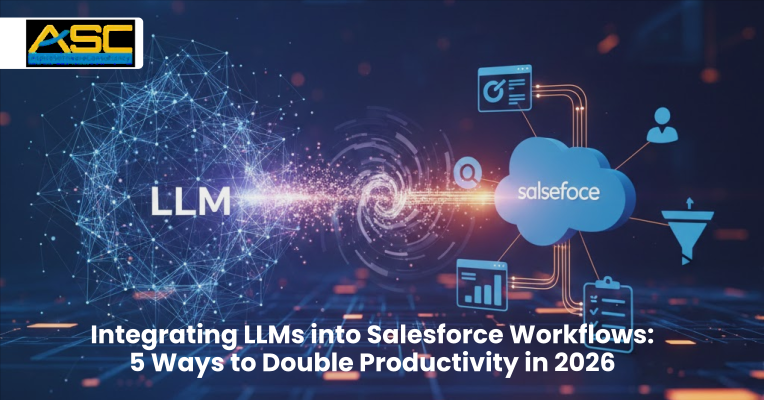
Integrating LLMs into Salesforce Workflows: 5 Ways to Double Productivity in 2026

In today’s fast-paced business world, companies always seek ways to work smarter, faster, and more efficiently. Repetitive tasks, manual processes, and slow workflows can reduce productivity and limit growth. This is where Large Language Models (LLMs) come into play. LLMs are advanced artificial intelligence systems capable of understanding and generating text that resembles human language. When added to Salesforce workflows, they can automate regular tasks. They also provide useful insights and help teams focus on more important activities. Using Salesforce App Development and Salesforce Integration Services can help businesses boost productivity. Working with a trusted partner like Aspire Software Consultancy can double team efficiency by 2026. In this blog, we’ll explain what LLMs are, how they can enhance Salesforce workflows, and five practical ways to achieve 2x productivity gains. What Are LLMs and How Can They Improve Salesforce Workflows? Large Language Models (LLMs) are AI tools trained to understand natural language. They can read, interpret, and generate human-like text. This capability makes them particularly useful for business processes that involve communication, data entry, analysis, and reporting. When integrated into Salesforce, LLMs can: Draft emails, chat responses, and proposals automatically. Summarize support cases quickly and accurately. Analyze sales leads and provide predictive insights. Assist agents in finding relevant information faster. Reduce repetitive manual work to save time and resources. By leveraging Salesforce Customization Services and Salesforce Integration Services, businesses can ensure that LLMs are tailored to their specific workflows. Working with a Salesforce Implementation Partner like Aspire Software Consultancy makes the integration process smooth, secure, and scalable. Why Businesses Should Integrate LLMs into Salesforce The benefits of integrating LLMs into Salesforce workflows are immense: Improved Productivity: Automating repetitive tasks frees employees to focus on high-value work. Faster Response Times: AI-generated responses in Service Cloud reduce wait times for customers. Enhanced Sales Performance: AI-assisted lead scoring in Sales Cloud helps sales teams prioritize effectively. Better Decision Making: LLMs provide insights based on historical data and trends. Reduced Operational Costs: Automation reduces the need for manual effort, lowering costs and increasing ROI. In 2026, companies that adopt AI-driven workflows will have a significant competitive advantage. Aspire Software Consultancy helps businesses identify the right workflows to automate and ensures that AI solutions deliver measurable results. 5 Ways LLMs Can Double Productivity in Salesforce Workflows Here are five practical ways that LLMs can transform Salesforce workflows and help companies achieve 2x productivity gains: 1. Automating Customer Support Customer support teams often spend hours answering repetitive queries and documenting cases. LLMs can automate many of these tasks, allowing agents to focus on complex issues. How it works: LLMs read incoming emails or chat messages and draft suggested responses. AI can categorize cases and assign them to the right team automatically. Historical case data is used to provide accurate and consistent answers. Benefits: Reduced response times Higher customer satisfaction Lower workload for support agents Using Salesforce Support Services and Service Cloud, businesses can integrate LLMs to handle routine support tasks effectively. Companies working with Aspire Software Consultancy can implement AI-powered automation without disrupting existing workflows. 2. Intelligent Lead Scoring and Sales Insights Sales teams often struggle to identify the most promising leads. LLMs can analyze customer interactions, past purchase behavior, and engagement data to assign priority scores to leads automatically. How it works: LLMs evaluate leads’ activities, such as email opens, website visits, and previous purchases. AI predicts which leads are most likely to convert, allowing sales teams to focus on high-potential opportunities. Insights can be delivered directly into Sales Cloud, making it easier to act quickly. Benefits: Improved conversion rates Time saved by focusing on high-value leads More informed sales decisions With Salesforce App Development and Integration Services, LLMs can easily be added to Sales Cloud workflows. This helps sales teams access useful information quickly. 3. Automating Daily Tasks and Workflows Many business tasks—like scheduling follow-ups, creating tasks, and tracking deadlines—consume valuable time. LLMs can automate these processes within Salesforce, reducing manual effort and human error. How it works: AI monitors emails, meetings, and customer interactions to create tasks automatically. Reminders and follow-ups are generated without manual input. Workflow automation ensures that important tasks are never missed. Benefits: Increased operational efficiency Fewer missed deadlines Less reliance on manual tracking Using Salesforce Customization Services and Integration Services, companies can create workflows. In these workflows, LLMs take care of repetitive tasks. This allows teams to focus on strategy and customer engagement. 4. Personalized Customer Communication Personalization is key to modern customer engagement. LLMs can draft emails, chat messages, and proposals tailored to each customer’s preferences and behavior. How it works: AI analyzes customer data in Salesforce to understand preferences and past interactions. The system generates messages in a natural, personalized tone that aligns with your brand voice. Automated communication can include recommendations, follow-ups, and promotions. Benefits: Stronger customer relationships Higher engagement rates Increased sales and repeat business Businesses that leverage Salesforce Customization Services can integrate AI communication tools across Service Cloud and Sales Cloud, ensuring consistent, personalized messaging. 5. Smart Knowledge Management Finding the right information quickly is critical for productivity. LLMs can help employees and support agents locate case histories, product information, and customer details instantly. How it works: LLMs scan Salesforce databases and provide answers to queries in seconds. Agents can search using natural language and receive relevant results. Knowledge bases are automatically updated with insights from past interactions. Benefits: Faster problem resolution Better customer service Reduced time spent searching for information Using Salesforce Integration Services, AI-powered search tools can be embedded into Salesforce, enabling teams to work smarter and faster. Steps to Implement LLMs in Salesforce Workflows Implementing LLMs requires careful planning. Here’s a practical approach recommended by Aspire Software Consultancy: Identify Key Workflows: Start with repetitive or time-consuming processes suitable for automation. Select the Right LLM: Choose an AI platform that integrates well with Salesforce and meets your business needs. Customize AI for Your Business: Tailor the AI model to handle your Leads, Contacts, Cases, and other Salesforce data. Test Thoroughly: Use a

Integrating LLMs into Salesforce Workflows: 5 Ways to Double Productivity in 2026 Read More »

Top 2026 Web Development Trends: AI-Driven Sites That Boost User Engagement by 50%

Web development is changing faster than ever. As we move closer to 2026, websites are no longer just online pages with text and images. They are becoming smarter, faster, and more interactive digital platforms. Today’s users expect websites to load quickly, work smoothly on all devices, and provide content that feels useful and relevant. To meet these expectations, businesses are adopting modern 2026 web development trends that focus on performance, design, and user experience. While AI supports many of these improvements, the real success comes from strong web development basics combined with smart technology. Businesses that follow these trends are already seeing better results, including longer visits, more interactions, and in many cases, up to a 50% increase in website engagement. At Aspire Software Consultancy, we focus on building user-friendly, high-performance websites that help businesses grow in a competitive digital world. Why Web Development Is Changing Rapidly in 2026 User behavior has changed a lot in recent years. People now browse websites on different devices, expect instant results, and leave quickly if a site feels slow or confusing. In 2026, good web development is about more than design. It is about: Speed and performance Simple and clear navigation Mobile-friendly layouts Easy access to information Websites that focus on these areas naturally perform better and keep users engaged. User Engagement Is the Real Measure of Success Earlier, website success was often measured by traffic alone. Now, businesses focus more on engagement metrics. User engagement includes: How long users stay on the site How many pages do they visit Whether they interact with buttons or forms If they return to the website A well-developed website makes users feel comfortable, confident, and interested. This leads to better engagement and stronger business results. 1. Simple and Clear UX/UI Design One of the most important 2026 web development trends is focusing on simple and easy-to-use design. Good UX/UI design means: Clean layouts with enough spacing Easy-to-read text Clear buttons and menus Logical page structure When users can quickly understand how a website works, they are more likely to stay and explore. 2. Personalized Experiences That Feel Natural Personalization is becoming a normal part of modern websites. Instead of showing the same content to everyone, websites now adjust based on user behavior. Examples include: Showing content related to user interests Displaying helpful calls-to-action Suggesting relevant services or pages This is one way AI in web development helps improve user experience, but it works best when supported by strong design and development. The goal is to make users feel guided, not overwhelmed. 3. Faster Website Speed and Better Performance Website speed is one of the biggest factors that affects user engagement. Slow websites often lose visitors within seconds. In 2026, performance-focused web development includes: Clean and optimized code Faster page loading Improved mobile performance Smooth transitions between pages Fast websites are easier to use, rank better on search engines, and keep users engaged longer. 4. Interactive and Dynamic Website Elements Modern websites are becoming more interactive. Instead of static pages, users now expect engaging features that respond to their actions. Popular next-gen web technologies include: Interactive forms Smooth animations Dynamic content loading Personalized dashboards These features make websites more interesting and encourage users to interact more. 5. Mobile-First and Responsive Web Development Mobile usage continues to grow every year. In 2026, mobile-first design is not optional. Modern web development focuses on: Responsive layouts Easy navigation on small screens Fast loading on mobile networks Touch-friendly design elements A website that works well on mobile creates a better experience for users and improves engagement across all devices. 6. No-Code and Low-Code Tools Supporting Development No-code and low-code tools are becoming helpful additions to web development. These tools allow businesses to update and manage websites faster. Benefits include: Faster feature launches Easier content updates Improved flexibility Cost-effective development At Aspire Software Consultancy, these tools are used carefully alongside custom development to ensure long-term performance and scalability. 7. Smarter User Journey and Navigation A good website guides users smoothly from one page to another. Modern web development improves user journeys by: Reducing unnecessary steps Making navigation simple Highlighting important actions Improving page flow When users can easily find what they need, they are more likely to stay, interact, and convert. 8. SEO-Friendly Web Development Practices SEO in 2026 is closely connected to how a website is built. Search engines prefer websites that offer a good user experience. SEO-friendly web development includes: Clean website structure Fast page speed Mobile responsiveness Clear headings and content layout When SEO and user experience work together, websites gain better visibility and stronger engagement. 9. Voice Search and Accessibility Improvements Websites are becoming more accessible to all users. Modern accessibility features include: Voice search readiness Clear and simple navigation Readable fonts and layouts Inclusive design practices Accessibility helps reach a wider audience and improves overall engagement. 10. Privacy-Focused and Trust-Building Web Design User trust is very important in 2026. Websites must handle user data responsibly and transparently. Trust-focused web development includes: Clear privacy policies Secure data handling Honest design choices User-first interactions When users trust a website, they are more likely to stay engaged and return. How AI Supports Modern Web Development AI plays a supportive role in modern websites by helping improve personalization, performance, and content delivery. AI helps with: Understanding user behavior Improving content relevance Supporting better engagement decisions However, AI works best when combined with strong core web development, good UX/UI design, and performance optimization. How Businesses Can Prepare for 2026 Web Development Trends To stay competitive, businesses should: Invest in modern web development Focus on user experience and engagement Improve website speed and performance Adopt future-ready technologies carefully The future of web development with artificial intelligence is about enhancing user experience, not replacing human creativity and development skills. Aspire Software Consultancy helps businesses build websites that are fast, user-friendly, secure, and ready for the future. Final Thoughts The 2026 web development trends clearly show a shift toward user-focused, performance-driven, and engagement-oriented websites.

Top 2026 Web Development Trends: AI-Driven Sites That Boost User Engagement by 50% Read More »

Custom .NET Core vs. Low-Code Platforms: What Enterprise Leaders Must Choose in 2026

In 2026, enterprise leaders face one of the most important technology decisions of the decade: Custom .NET Core vs Low-Code Platforms. This choice directly affects scalability, security, speed, cost, and long-term competitiveness. As businesses accelerate digital transformation, the pressure to deliver faster, smarter, and more reliable applications is higher than ever. Some organizations prefer the speed and simplicity of Low-Code platforms for enterprises, while others rely on the flexibility and control of .NET Core development for building robust, cloud-native enterprise applications. This blog explains both approaches in simple terms and helps enterprise leaders decide what fits their digital transformation technology stack in 2026. At Aspire Software Consultancy, we help enterprises make these decisions with clarity, not hype. Understanding Custom .NET Core Development .NET Core development is a framework from Microsoft used to build custom software applications. These applications are designed, coded, and maintained specifically for your business needs. Unlike ready-made platforms, custom development allows enterprises to build systems that fit their processes exactly, not the other way around. Why Enterprises Choose Custom .NET Core Custom .NET Core applications are ideal for organizations that need: High performance and scalability Deep integration with existing enterprise systems Strong security and compliance controls Long-term flexibility and ownership In enterprise digital transformation platforms, customization is often critical. Industries like finance, healthcare, manufacturing, and logistics rely on tailored workflows that cannot be handled by generic tools. What Are Low-Code Platforms for Enterprises? Low-Code platforms for enterprises allow applications to be built using visual tools, drag-and-drop components, and minimal coding. These platforms promise faster development and reduced dependency on traditional developers. Low-Code has grown rapidly as enterprises look for quicker ways to digitize internal processes, dashboards, and basic customer-facing applications. Why Low-Code Is Popular in 2026 Low-Code platforms attract enterprise leaders because they offer: Faster time to market Lower initial development costs Reduced need for large development teams Easy prototyping and experimentation For simple use cases, Low-Code can be effective. However, as complexity increases, limitations also become clearer. Custom .NET Core vs Low-Code Platforms: Core Differences When comparing Custom .NET Core vs Low-Code Platforms, the differences go beyond speed and cost. The real comparison lies in control, scalability, and future readiness. 1. Flexibility and Customization Custom .NET Core allows full control over application logic, architecture, and integrations. Enterprises can design exactly what they need. Low-Code platforms are limited by predefined components. When business logic becomes complex, workarounds increase technical debt. Winner for flexibility: Custom .NET Core 2. Scalability for Enterprise Growth In 2026, enterprises are building cloud-native enterprise apps that must scale globally. .NET Core is designed for cloud environments and supports microservices, containers, and multi-cloud strategies. Low-Code platforms can scale, but often at higher licensing costs and with performance constraints. Winner for scalability: Custom .NET Core 3. Speed of Development Low-Code platforms shine when speed is the priority. Internal tools, approval workflows, and MVPs can be launched quickly. Custom .NET Core takes longer initially but results in a more stable and extensible system. Winner for speed: Low-Code (short-term), .NET Core (long-term) 4. Security and Compliance Enterprise-grade security is non-negotiable in 2026. Custom .NET Core development allows full control over authentication, authorization, data encryption, and compliance standards. Low-Code platforms depend heavily on vendor security models, which may not meet strict industry regulations. Winner for security: Custom .NET Core 5. Cost Over Time Low-Code platforms often appear cheaper at first. However, licensing fees, user-based pricing, and scaling costs can grow rapidly. Custom software has a higher upfront investment but lower long-term dependency and better ROI for core systems. Winner: Depends on usage, but enterprises often benefit more from custom development How Enterprise Leaders Choose Development Platforms in 2026 Choosing between Custom .NET Core vs Low-Code Platforms depends on business goals, not trends. Enterprise leaders should ask: Is this a core business system or a supporting tool? Will this application need to scale for years? Do we require deep system integrations? Are security and compliance critical? Do we want full ownership of the technology? At Aspire Software Consultancy, we see a clear pattern in how enterprise leaders choose development platforms. Core systems lean toward custom development, while Low-Code supports experimentation and internal productivity. Role of Low-Code in Enterprise Digital Transformation The future of Low-Code in large enterprises is not replacement but support. Low-Code works well for: Internal dashboards Simple workflow automation Department-level tools Rapid prototyping However, using Low-Code as the backbone of enterprise digital transformation platforms often leads to performance and scalability challenges. Smart enterprises in 2026 use Low-Code selectively, not strategically, for core systems. Why .NET Core Remains a Strong Enterprise Choice in 2026 Despite the rise of Low-Code, .NET Core development remains a top choice for enterprises because it supports: Cloud-native enterprise apps Microservices-based architectures Long-term system evolution Integration with AI, data, and analytics platforms As digital transformation technology stacks become more complex, enterprises need platforms that grow with them, not restrict them. A Practical Hybrid Approach The most effective strategy in 2026 is often a hybrid model. Enterprises use: Custom .NET Core for core business systems Low-Code platforms for internal tools and rapid innovation This balanced approach delivers speed without sacrificing control. At Aspire Software Consultancy, we help enterprises design hybrid architectures that maximize value while minimizing risk. Final Verdict: What Should Enterprise Leaders Choose? There is no one-size-fits-all answer in the Custom .NET Core vs Low-Code Platforms debate. However, the direction is clear. For mission-critical systems, scalability, security, and long-term growth, custom .NET Core development remains the safer and smarter choice. Low-Code platforms play a supporting role, not a foundational one. Enterprise leaders who think beyond short-term convenience will build stronger digital ecosystems in 2026 and beyond. Conclusion Digital transformation in 2026 is not about choosing the fastest tool; it is about choosing the right foundation. Understanding Custom software development benefits, cloud-native architecture, and platform limitations is essential for sustainable growth. If your organization is evaluating Low-Code platforms for enterprises or planning long-term .NET Core development, Aspire Software Consultancy can guide you with clarity,

Custom .NET Core vs. Low-Code Platforms: What Enterprise Leaders Must Choose in 2026 Read More »

Scroll to Top