WhatsApp Chat

#AspireSoftwareConsultancy

AI-powered Web Development Company 2026 banner by Aspire Software Consultancy highlighting intelligent web solutions, faster delivery, secure design, scalability, and AI-driven development.

Web Development Company 2026: Why AI Is Rewriting the Rules

Mobile apps aren’t just digital brochures anymore. In 2026, a real mobile app development company builds products that think ahead. They predict what users need. They talk back in natural language. And they get smarter with every tap. So, if you’re picking a partner for your next build, here’s what’s changing. And here’s what to look for. Why 2026 Is a Turning Point for Mobile App Development Global app revenue keeps climbing every year. But the bar for “good enough” has moved higher. Users now expect apps to feel personal from the first launch. That’s thanks to on-device AI and cheaper cloud computing. In fact, according to Statista’s mobile app market data, downloads and in-app spending keep growing worldwide. As a result, businesses must invest in smarter apps. Static feature lists just don’t cut it anymore. For any custom mobile app development company, this means one thing. The old playbook no longer works. That old approach was simple: wireframe, build, ship, and forget. Instead, today’s apps need built-in intelligence from day one. Top Mobile App Development Trends for 2026 1. AI-Native Apps, Not AI-Bolted-On Apps This year’s biggest shift is clear. AI mobile app development has moved from a nice-to-have chatbot to the app’s core design. On-device language models are now common. So are smart recommendation engines and voice-first screens. Clients ask for these features from day one. They’re no longer an afterthought. 2. Cross-Platform Still Wins on Speed Speed to market still matters most for many businesses. That’s why Flutter and React Native remain popular choices. They let an Android and iOS app development company build once and launch everywhere. And they don’t sacrifice performance to do it. 3. Super Apps and Embedded Finance Many businesses want one app to do it all. Think bookings, payments, chat, and loyalty rewards, all in one place. This shift is fueling demand for enterprise mobile app development. Modular, API-first designs make this kind of flexibility possible. 4. Privacy-First, On-Device Processing Data rules keep getting stricter. So more AI processing now happens on the device, not in the cloud. This cuts delays. It also protects user privacy. Apple has made this priority clear in its ongoing privacy initiatives. 5. Hyper-Personalization at Scale Machine learning now adjusts each screen in real time. It changes content, layout, and offers for every single user. As a result, generic apps start to feel custom-built. Each person gets an experience shaped just for them. What to Look For in a Mobile App Development Company Not every agency that says “we build apps” can meet 2026 standards. So, when you choose a partner, check for these things: Real AI experience — not just app builds, but actual machine learning work Cross-platform skills in Flutter, React Native, Swift, and Kotlin Backend systems built to scale, not just an early-stage MVP Security-first development, especially for healthcare, fintech, or enterprise apps Support after launch, for updates, tuning, and smarter AI models over time At Aspire Software Consultancy, our mobile app development services blend 16+ years of hands-on engineering with modern AI tools. As a result, we help startups and enterprises ship apps that truly think, not just respond. Our AI consulting and automation services team up with our mobile developers. Together, they build apps that learn from real user behavior. A Quick Look at the Process Discovery & Strategy — First, we learn your users and goals. Then we find where AI adds real value, not just buzz. UI/UX Design — Next, we design screens that stay simple, even as the app gets smarter. Development — We build in agile sprints, using cross-platform or native code. AI/ML Integration — Then we add recommendation engines, chat tools, and predictive features. Testing & Launch — After that, we test for speed, safety, and app store rules. Post-Launch Growth — Finally, we monitor, update, and keep improving the models over time. Final Thoughts The mobile app development company you pick in 2026 matters more than ever. That choice decides whether your app feels outdated in a year, or keeps growing with your users. AI isn’t optional anymore. It’s the new baseline. So, businesses that pair strong engineering with real AI skill are the ones pulling ahead. Ready to build an app that thinks ahead? Schedule a free consultation with our team. Or, explore our full portfolio of projects to see what we’ve built for clients in 12+ countries. Frequently Asked Questions What does a mobile app development company actually do? A mobile app development company designs, builds, and maintains apps for phones and tablets. This covers strategy, design, coding, testing, and support after launch. Many companies now also add AI features, like chatbots or smart recommendations. How long does it take to build a mobile app? Most apps take three to six months to build. Simple apps can launch faster. Complex apps with AI, payments, or many integrations often take longer. Should I choose native or cross-platform app development? Cross-platform tools like Flutter work well for most businesses. They save time and cost, since one codebase runs on both iOS and Android. Native development still makes sense for apps that need top performance or deep hardware access. Do I need AI in my mobile app? Not always, but it helps. AI can boost user engagement through personalization, smart search, and chat support. A good mobile app development company will tell you honestly where AI adds real value, and where it doesn’t. How do I choose the right mobile app development company? Look for real AI experience, strong cross-platform skills, and a track record of scalable apps. Also check reviews, past projects, and how they support you after launch. A free consultation is a good first step to test the fit. Facebook Instagram Youtube Linkedin X-twitter

Web Development Company 2026: Why AI Is Rewriting the Rules Read More »
AI Product Engineering Services in 2026 banner by Aspire Software Consultancy showcasing AI-native engineering, scalable architecture, faster time-to-market, testing automation, and AI-powered product development.

AI Product Engineering Services in 2026: Building Products That Actually Ship

The AI hype cycle is over. What’s left in 2026 is a much harder question for every founder and CTO: can your product survive without a frontier API doing all the work? If a competitor can copy your entire feature set by calling the same public model, you don’t have a product, you have a wrapper. That’s why AI product engineering services have quietly become the most in-demand line item in software budgets this year. Businesses aren’t asking “should we add AI?” anymore. They’re asking who can build it in a way that’s defensible, fast, and actually profitable. Here’s what’s changed, and how a specialized AI product engineering services partner like Aspire Software Consultancy helps you build for it. What Are AI Product Engineering Services in 2026? AI product engineering services go beyond bolting a chatbot onto an existing app. They cover the full lifecycle strategy, data pipelines, model selection, fine-tuning, evaluation, deployment, and ongoing monitoring so the AI layer behaves like a real product feature, not a demo. This is different from generic AI automation consulting, which usually focuses on automating a specific workflow. Product engineering is about the system your customers pay for every month, and whether it holds up under real usage, real edge cases, and real scrutiny. The Trends Actually Shaping AI Product Engineering Services in 2026 1. Small, Specialized Models Are Beating Big, Generic Ones Instead of routing every request to one massive model, engineering teams are pairing narrow, fine-tuned models with on-device inference for speed and privacy, and reserving the frontier model only for the hardest requests. It’s cheaper, faster, and harder to copy. 2. Evaluation Is the New QA Serious AI teams now treat evaluation infrastructure golden-set tests, structured output checks, A/B comparisons across model versions with the same seriousness traditional teams give to unit testing. On some agentic projects, this now consumes a real share of total engineering spend. 3. Agentic Workflows Are Going Into Production 2026 is the year AI agents stopped being a research demo and started acting across tools completing multi-step workflows with minimal human input. That shift changes how products are architected from day one. 4. Interfaces Are Moving Inside the Conversation Instead of sending users away to a separate app, products are now rendering functional cards, charts, and forms directly inside AI conversations, a pattern already living in tools like ChatGPT and Claude. 5. Proprietary Data Is the Real Moat API access alone creates zero differentiation anymore. What separates winning products now is proprietary data, domain-specific fine-tuning, and workflows nobody else has access to. Why “Off-the-Shelf AI” Hits a Ceiling Fast Generic AI tools work for a demo. They struggle in production because: There’s no real evaluation layer, so quality regressions surface in front of users instead of before release Margins collapse the moment the underlying model provider ships a similar consumer feature Every competitor calling the same API converges on the same user experience This is exactly the gap custom AI development closes and why more product leaders are shifting engineering spend “up the stack” into proprietary data and evaluation, and “down the stack” into fine-tuning and on-device inference. How Aspire Software Consultancy Builds AI-First Products At Aspire Software Consultancy, our AI product engineering services are built around the same shift happening industry-wide: Strategy & Discovery — mapping real user pain points to where AI actually adds value, not where it looks impressive in a demo LLM integration software development — embedding reasoning, retrieval, and generation directly into your existing product and workflows Evaluation-first delivery — golden-set testing and monitoring baked in from day one, not bolted on after launch AI automation — automating the repetitive layers around your product so your team ships faster Full-cycle product engineering — from architecture and MVP to scaling, sustenance, and support We follow Google’s responsible AI principles throughout, and we ship production systems not proof-of-concepts that never leave the sandbox. Final Thought The teams winning in 2026 aren’t the ones with the flashiest AI demo. They’re the ones treating AI product engineering services as a discipline evaluation, proprietary data, and real architecture decisions rather than a feature checkbox. If you’re planning your next AI-native build, talk to Aspire Software Consultancy about what it actually takes to ship it right. Frequently Asked Questions What makes AI product engineering services different from regular software development? It adds AI-specific layers of data pipelines, model evaluation, fine-tuning, and monitoring on top of standard engineering practices, so the AI behaves reliably in production. Is custom AI product engineering expensive for startups? Not necessarily. Scoped correctly, teams can start with a narrow use case and expand as ROI proves out, rather than building everything at once. How long does it take to build an AI-native product feature? Most teams start seeing usable results within a few weeks for a well-scoped pilot, with full production rollout depending on data readiness and integration complexity. Which industries benefit most from AI product engineering in 2026? Healthcare, finance, logistics, legal, and e-commerce are seeing the fastest returns, largely because they handle high volumes of data and repetitive decision-making. Facebook Instagram Youtube Linkedin X-twitter

AI Product Engineering Services in 2026: Building Products That Actually Ship Read More »

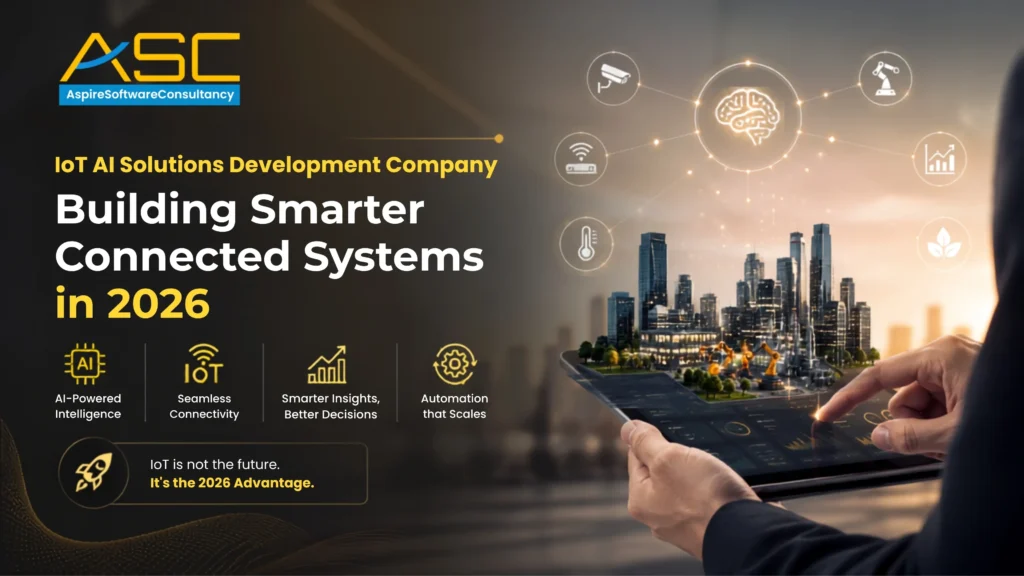
IoT AI Solutions Development Company showcasing AI-powered connected systems, smart city technology, automation, and intelligent IoT solutions for businesses in 2026.

IoT AI Solutions Development Company: Building Smarter Connected Systems in 2026

The Internet of Things has changed. Devices no longer just collect data and send it to the cloud. In 2026, connected systems must think, react, and improve on their own. That’s why more businesses now search for a trusted IoT AI solutions development company to guide this shift. Manufacturing, healthcare, retail, and logistics teams all face the same question. How do we move from basic connectivity to real intelligence at the edge? At Aspire Software Consultancy, we help answer that question every day. We build devices that detect anomalies, predict failures, and act in real time. No cloud round trip required. This blog covers what’s driving the AIoT (Artificial Intelligence of Things) boom in 2026. You’ll also see how the right IoT app development company can help you take advantage of it. Why 2026 Is the Turning Point for AIoT Industry experts call 2026 an inflection point for edge intelligence. Device makers are moving past small pilots. They’re now rolling out AI-enabled hardware at full scale. A few numbers explain why this matters: The global edge AI market will grow from about $25 billion in 2025 to nearly $120 billion by 2033. More than 80% of enterprises say AI is now core to their IoT strategy. Predictive maintenance already delivers real results. Companies report 25% higher productivity and 70% fewer unplanned breakdowns. These numbers aren’t hype. They show a real shift in how connected products get built, funded, and sold. What Makes an IoT AI Solutions Development Company Essential Right Now 1. Edge AI Is Now the Default, Not an Add-On New chips ship with built-in neural processing units. This means devices can run anomaly detection, vision models, and audio intelligence on their own. No cloud needed. A skilled edge AI development company picks the right hardware for your product. It also compresses AI models using quantization and pruning. Then it deploys them with tools like TensorFlow Lite and ONNX. 2. Subscription Models Demand Ongoing Intelligence More IoT products now run on subscription pricing. Customers expect features to keep improving over time. This only works with strong over-the-air update systems. As a result, AI models must keep learning and adapting. That’s how AI-powered IoT solutions turn into steady revenue, not just a one-time sale. 3. Security and Compliance Can’t Wait Billions of devices now connect to networks worldwide. So regulators have stepped in. The EU Cyber Resilience Act is one example. Because of rules like this, security must come first in every IoT AI development project. Teams now build in Zero Trust device authentication from day one. They also add AI-powered anomaly detection at the network level. 4. Real-Time Decisions Save Time, Money, and Sometimes Lives Picture a factory sensor that halts a machine before it fails. Or a hospital monitor that catches a dangerous vital-sign change instantly. Both depend on fast, on-device AI. This is the real promise of working with a custom IoT AI development company: turning raw sensor data into safe, automatic action. Trending IoT + AI Use Cases to Watch in 2026 Predictive maintenance. AI studies vibration, temperature, and usage patterns. It flags equipment issues before they cause downtime. Smart retail and inventory. On-device AI powers point-of-sale systems and shelf monitoring. It works without constant cloud calls. Healthcare remote monitoring. Wearables and bedside devices spot anomalies on the spot. This means faster clinical response. Digital twins. Teams build virtual models of physical assets. They use these twins to simulate performance and plan maintenance. Federated learning. Devices train AI models together without sharing raw data. This matters most in privacy-sensitive industries like healthcare and finance. How Aspire Software Consultancy Approaches IoT AI Development As an IoT AI solutions development company, we combine four core strengths: End-to-end architecture. We handle firmware, sensor integration, cloud orchestration, and dashboards together. Edge AI deployment. We compress and optimize models to fit your exact hardware limits. Predictive analytics and NLP. We turn raw device data into forecasts, alerts, and conversational tools. Security-first engineering. We build in device authentication, encrypted updates, and compliance from the start. Want to see how this works for your product? Visit our AI development services page to explore our full capability stack. You can also check our IoT development solutions page for technical details, or contact our team to scope your project. Choosing the Right IoT AI Development Partner When you evaluate an IoT software development company for 2026 projects, look for four things: Proven experience across hardware, firmware, connectivity, and cloud layers. A track record of deploying AI models on small, resource-limited devices. A security-first mindset that matches current regulations. Long-term support, not just a product launch. For more technical detail on this space, read this Edge AI and IoT report from IoT Business News. It covers deployment challenges in depth. Final Thoughts AIoT is no longer a future concept. In 2026, it’s a competitive requirement. Businesses that pair connected hardware with real AI build products that are faster, safer, and more valuable. Whether you’re prototyping your first device or scaling an existing fleet, the right partner makes all the difference. Working with an experienced IoT AI solutions development company like Aspire Software Consultancy can turn a stalled pilot into a product that scales. Ready to build your next intelligent connected product? Talk to Aspire Software Consultancy about your IoT AI roadmap today. Frequently Asked Questions What is an IoT AI solutions development company? It’s a company that builds connected devices and systems powered by artificial intelligence. This includes edge AI, predictive analytics, and automated decision-making, not just basic connectivity. How is AIoT different from regular IoT? Regular IoT collects and sends data to the cloud. AIoT adds artificial intelligence, so devices can analyze data and act on their own, often in real time and without cloud dependency. What is edge AI, and why does it matter in 2026? Edge AI means AI models run directly on a device instead of in the cloud. It cuts latency, reduces bandwidth costs, and lets devices work even without

IoT AI Solutions Development Company: Building Smarter Connected Systems in 2026 Read More »

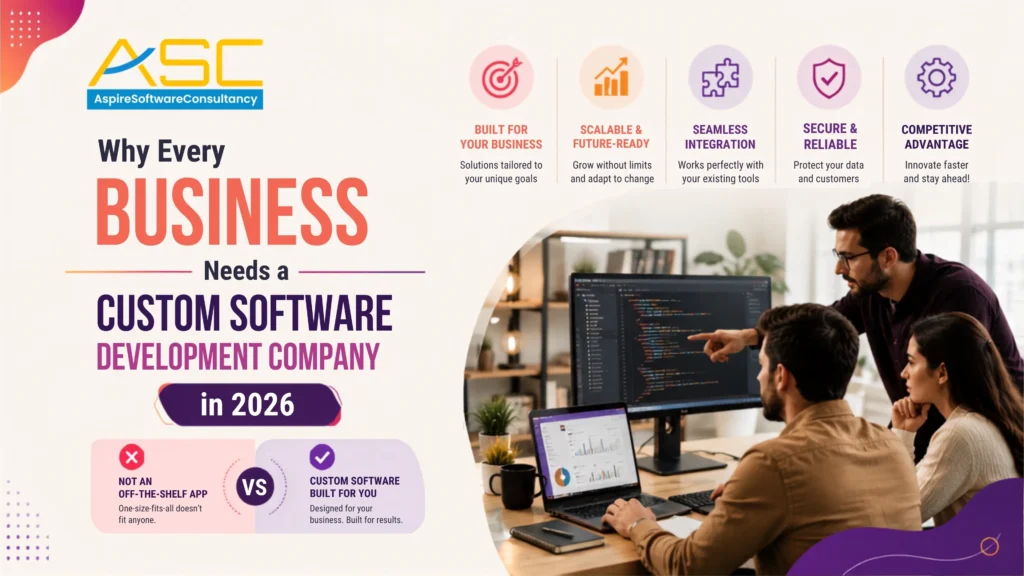
Why every business needs a custom software development company in 2026, highlighting scalable, secure, and tailored software solutions for business growth.

Why Every Business Needs a Custom Software Development Company in 2026

Off-the-shelf software was fine when “good enough” was good enough. It isn’t anymore. In 2026, businesses that win are the ones using AI-powered, purpose-built systems and that’s exactly why demand for a reliable custom software development company is exploding. Analysts project the custom software market to grow at a 22.5% CAGR, reaching roughly $146 billion by 2030, as more companies ditch generic tools for tailored platforms. If you’re evaluating whether to build custom or buy generic, here’s what’s actually shaping the decision this year.   1. AI Agents Are Now a Baseline Expectation, Not a Bonus Gartner predicts that 40% of enterprise applications will include task-specific AI agents by the end of 2026 up from under 5% just a year earlier. Customers and employees now expect software that doesn’t just store data but acts on it: flagging risks, automating approvals, and recommending next steps in real time. A trustworthy software development company builds this intelligence into the product from day one, not as a bolted on chatbot. At Aspire Software Consultancy, AI and automation are woven directly into the custom applications we design from predictive analytics in healthcare platforms to smart workflow automation in finance and CRM systems.   2. Off-the-Shelf Tools Can’t Keep Up With Niche Workflows Generic SaaS tools are built for the average user — your business isn’t average. Whether you’re running a fintech platform, an online travel booking engine, or a hospital management system, your workflows have edge cases that pre-built software simply won’t handle. This is where custom software development solutions outperform generic platforms: Tailored features mapped to your exact processes Native integration with your existing tech stack Built-in scalability as your business and data grow Stronger security and compliance controls Aspire has applied this approach across industries like healthcare, finance, and education since 2007. 3. Speed Now Matters as Much as Quality With AI-assisted development, enterprises report 30–35% productivity gains across the development lifecycle. Businesses no longer have to choose between “fast” and “well-built” a modern enterprise software development partner uses AI augmented coding, testing, and QA to ship reliable products faster than traditional timelines allowed. 4. Web and Mobile Applications Need to Be Future-Ready A custom web application development company today has to think beyond a single platform. Customers expect seamless experiences across web, mobile, and cloud built on secure architecture that can scale without a rebuild every two years. Aspire’s custom web application development services are built precisely around this future-readiness, using current frameworks and cloud-native practices. Choosing the Right Custom Software Development Company When shortlisting a software development company, look for: Proven experience across your industry Demonstrated AI/ML and automation capability Transparent, agile development process Long-term support after deployment Client testimonials and verifiable case studies Aspire Software Consultancy checks all five with nearly two decades of building scalable, secure, AI-enabled software for startups and global enterprises alike. Final Thoughts 2026 isn’t the year to settle for generic software. Between rising AI agent adoption, growing demand for tailored systems, and the productivity edge AI-assisted development now offers, partnering with the right custom software development company is one of the highest-leverage decisions a business can make this year. Ready to build software that actually fits your business? Talk to Aspire Software Consultancy today. Frequently Asked Questions What is a custom software development company? A custom software development company designs, builds, and maintains software tailored to a specific business’s workflows, rather than offering generic, one-size-fits-all products. It covers everything from requirement analysis to deployment and long-term support. How is custom software different from off-the-shelf software? Off-the-shelf software is built for the average user across many businesses, while custom software is built around your exact processes, integrations, and growth plans giving you better fit, scalability, and security. Why is AI important in custom software development in 2026? AI now powers predictive insights, automation, and intelligent agents inside business applications. Gartner projects that 40% of enterprise apps will include task-specific AI agents by the end of 2026, making AI integration a baseline expectation rather than an add-on. How much does custom software development cost? Costs vary based on project scope, complexity, integrations, and the technology stack used. A discovery call with a software development company like Aspire Software Consultancy can provide a tailored estimate based on your specific requirements. How long does it take to build custom software? Timelines depend on project size a simple MVP can take a few weeks, while enterprise-grade platforms with AI integration may take several months. AI-assisted development is helping shrink these timelines by 30–35% compared to traditional methods. Facebook Instagram Youtube Linkedin X-twitter

Why Every Business Needs a Custom Software Development Company in 2026 Read More »

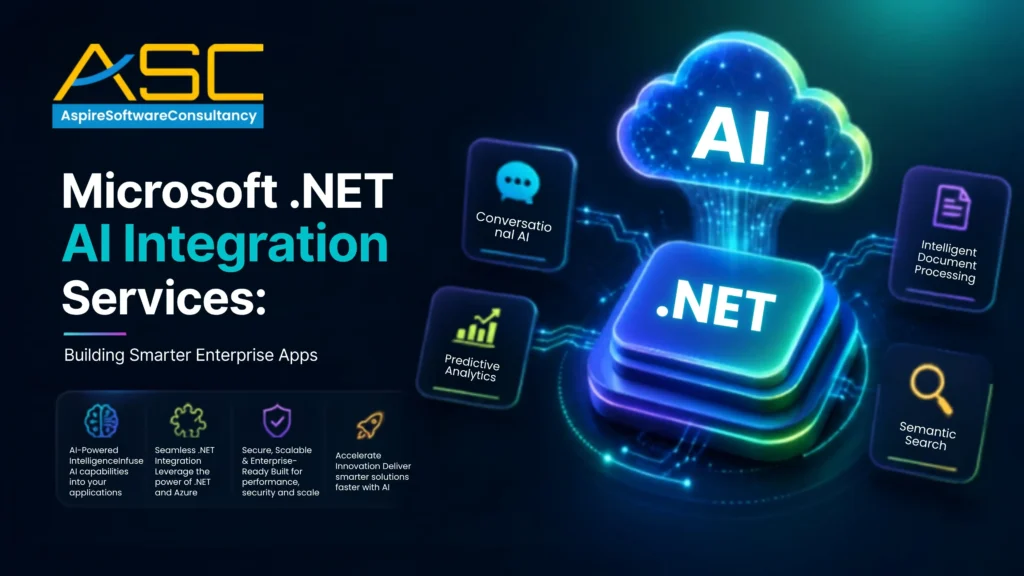
Microsoft .NET AI Integration Services banner featuring AI-powered .NET applications, conversational AI, predictive analytics, semantic search, and intelligent document processing.

Microsoft .NET AI Integration Services: Building Smarter Enterprise Apps

Why Microsoft .NET AI Integration Services Matter Now Businesses today are not just asking if they should add AI to their software. Instead, they want to know how fast they can do it safely. This is exactly where Microsoft .NET AI integration services come in. With tools like Microsoft.Extensions.AI and Semantic Kernel, .NET teams finally have a reliable way to connect AI models to their apps. As a result, developers no longer need fragile, custom-built connectors for every provider. At Aspire Software Consultancy, we help companies adopt these frameworks the right way. In other words, we turn older .NET systems into intelligent, future-ready platforms without starting from scratch. How Semantic Kernel and Microsoft.Extensions.AI Work Together What makes this trend exciting is how mature the ecosystem has become. For instance, Microsoft.Extensions.AI now offers shared interfaces like IChatClient and IEmbeddingGenerator. Because of this, teams can switch between OpenAI, Azure OpenAI, or even local models through Ollama without rewriting their core logic. Additionally, when you add Semantic Kernel on top, you unlock orchestration, plugins, memory, and multi-agent workflows. This opens the door to advanced use cases such as RAG-based chatbots, automated documentation, and AI-driven incident analysis. Therefore, .NET AI development has become a major focus for enterprises modernizing their tech stack. It blends the reliability of ASP.NET Core’s dependency injection model with the flexibility of modern generative AI tools. Real-World Benefits for Enterprise Teams So, what does this mean in practice? Enterprises gain the chance to combine enterprise AI solutions with the governance and scalability .NET already provides. For example, features like content filtering, telemetry, retry policies, and DI-based testing come built in. Moreover, these benefits apply whether you are adding a smart copilot to an internal tool or automating support workflows with RAG. Likewise, they apply if you are building AI-powered .NET applications entirely from scratch. Either way, the architecture is now stable enough to invest in for the long term. If you would like to see how this could work for your business, our case studies show real examples of AI-driven custom software development in action. Getting Started with Aspire Software Consultancy Ultimately, the right starting point depends on your existing systems and goals. That said, a short discovery conversation usually makes the path forward much clearer. If you are ready to explore Microsoft .NET AI integration services for your business, get in touch with our team for a free consultation. You can also visit our blog to read more about how other businesses are bringing AI into their .NET ecosystems. Frequently Asked Questions What are Microsoft .NET AI integration services? They refer to the tools and frameworks like Microsoft.Extensions.AI and Semantic Kernel that let .NET applications connect to AI models such as OpenAI, Azure OpenAI, or local LLMs, without building custom connectors from scratch. What is the difference between Microsoft.Extensions.AI and Semantic Kernel? Microsoft.Extensions.AI is a lightweight abstraction layer for basic AI tasks like chat and embeddings. Semantic Kernel builds on top of it, adding orchestration, plugins, memory, and multi-agent workflows for more advanced use cases. Can I add AI to an existing .NET application without rewriting it? Yes. Since these frameworks plug into the existing dependency injection model in ASP.NET Core, most teams can add AI features incrementally instead of starting over. Which AI providers work with .NET AI integration? Most major providers are supported, including OpenAI, Azure OpenAI, and local models through tools like Ollama. The abstraction layer makes switching providers easy without major code changes. Is Microsoft .NET AI integration suitable for enterprise-grade security and compliance? Yes. Features like content filtering, telemetry, logging, and retry policies are built into the .NET ecosystem, making it a strong fit for regulated or security-conscious environments. Facebook Instagram Youtube Linkedin X-twitter

Microsoft .NET AI Integration Services: Building Smarter Enterprise Apps Read More »

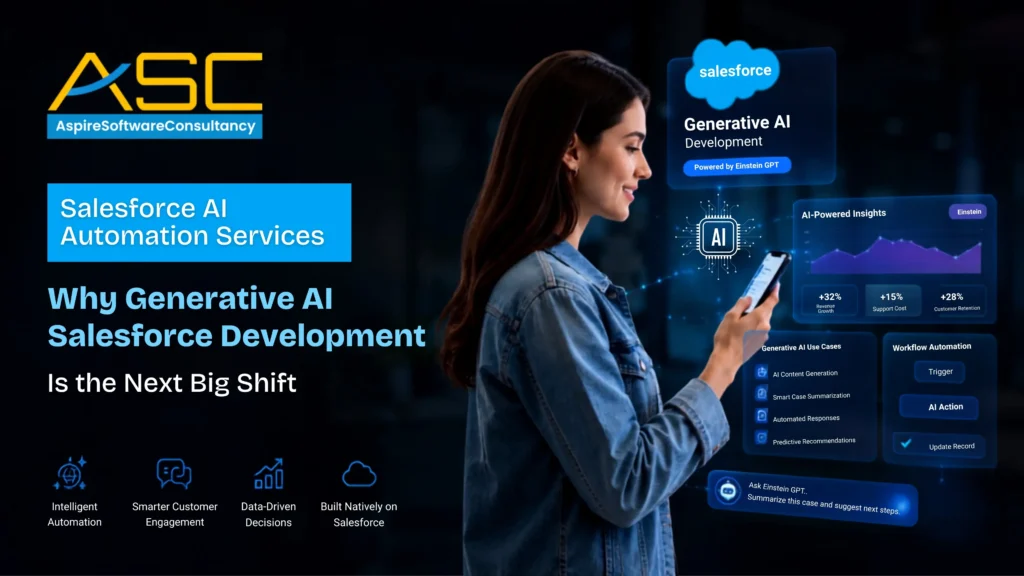
Salesforce AI Automation Services banner showcasing Generative AI Salesforce Development, Einstein GPT integration, workflow automation, AI-powered insights, and customer engagement solutions.

Salesforce AI Automation Services: Why Generative AI Salesforce Development Is the Next Big Shift

Businesses no longer ask if they need AI in their CRM. They ask how fast they can adopt it. That’s where Salesforce AI automation services come in. These services replace manual, rules-based work with smart automation. Think auto-routed cases, predictive lead scoring, and faster service resolutions across Sales Cloud and Service Cloud. AI automation does more than save time. It reduces errors, frees up your team, and gives leaders real-time visibility into performance. Companies that adopt automation early often see faster deal cycles and stronger customer retention. This makes AI automation a competitive advantage, not just a convenience. Generative AI Is Changing Salesforce Development The bigger shift goes beyond automation. Generative AI Salesforce development lets teams build custom Agentforce agents and prompt-driven flows. These agents don’t just follow rules. They reason through tasks and adapt to context. Salesforce’s own Agentforce platform is driving this shift industry-wide. Many businesses now pair this technology with a trusted Salesforce consulting partner to move from small pilots to full production systems. A skilled partner helps you avoid common mistakes, like building agents without proper data governance or skipping testing before launch. The right development approach turns generative AI from a buzzword into a working business tool. Real-World Use Cases Driving Adoption Generative AI inside Salesforce already supports several practical use cases: Smart case summarization: Agents read long support tickets and generate short, accurate summaries for faster handling. Personalized sales outreach: AI drafts tailored emails based on a prospect’s history and behavior. Predictive service routing: Cases get assigned to the right team automatically, based on urgency and skill match. Knowledge article generation: Agents create draft help articles from resolved cases, saving documentation time. These use cases show how Salesforce AI automation services apply across sales, service, and support teams, not just one department. Headless Architecture Powers Smarter Agents A clear trend is emerging across lending, real estate, manufacturing, and professional services: headless Salesforce architecture. This approach exposes business logic and data through APIs instead of locking it inside a browser screen. AI agents can then pull real-time context and act on it instantly. Your existing sharing rules and permissions still govern every action. Nothing bypasses your security model. Add Salesforce Data Cloud AI for unified customer data, and you get agents that work fast and stay trustworthy. Data no longer sits in silos across different clouds or systems. Our team at Aspire Software Consultancy builds this exact foundation for clients. We connect AI automation with secure integrations, so agents work inside your existing tools rather than a separate system. Our certified developers handle the architecture, governance, and testing needed for a safe rollout. Why Choose the Right Implementation Partner Not every Salesforce partner has deep AI experience. Generative AI development requires careful planning around data quality, prompt design, and security review. A partner without this experience can slow your rollout or create rework later. Aspire Software Consultancy combines Salesforce certification with hands-on AI implementation experience. We work across industries, including lending, manufacturing, and professional services. Our team handles everything from initial strategy to AppExchange-ready builds, so you get a system designed for your specific workflows. Start Building Your AI-Ready Salesforce Org If your team still relies on manual processes, now is the time to act. Treat generative AI Salesforce development as a growth strategy, not a future experiment. The right partner turns a stalled pilot into a scalable rollout. Explore our Salesforce integration services and Salesforce customization services to see this in action. You can also hire a certified Salesforce developer to get started today. Frequently Asked Questions What are Salesforce AI automation services? Salesforce AI automation services use built-in AI tools to handle repetitive tasks like case routing, lead scoring, and follow-up emails. They reduce manual work and speed up sales and service operations. What is generative AI Salesforce development? Generative AI Salesforce development means building custom AI agents, prompts, and workflows on Salesforce, usually through Agentforce. These agents can reason through tasks, not just follow fixed rules. Is Agentforce different from regular Salesforce automation? Yes. Regular automation, like Flow or Process Builder, follows fixed rules. Agentforce agents use generative AI to understand context, make decisions, and adapt their actions in real time. Do AI agents bypass Salesforce security and permissions? No. AI agents inherit your existing sharing rules, permission sets, and audit trails. They work within your current governance model, so security stays intact. How long does it take to implement Salesforce AI automation? Timelines vary by scope. A focused use case, like case summarization, can launch in a few weeks. Larger rollouts across multiple departments take longer and need proper planning. Facebook Instagram Youtube Linkedin X-twitter

Salesforce AI Automation Services: Why Generative AI Salesforce Development Is the Next Big Shift Read More »

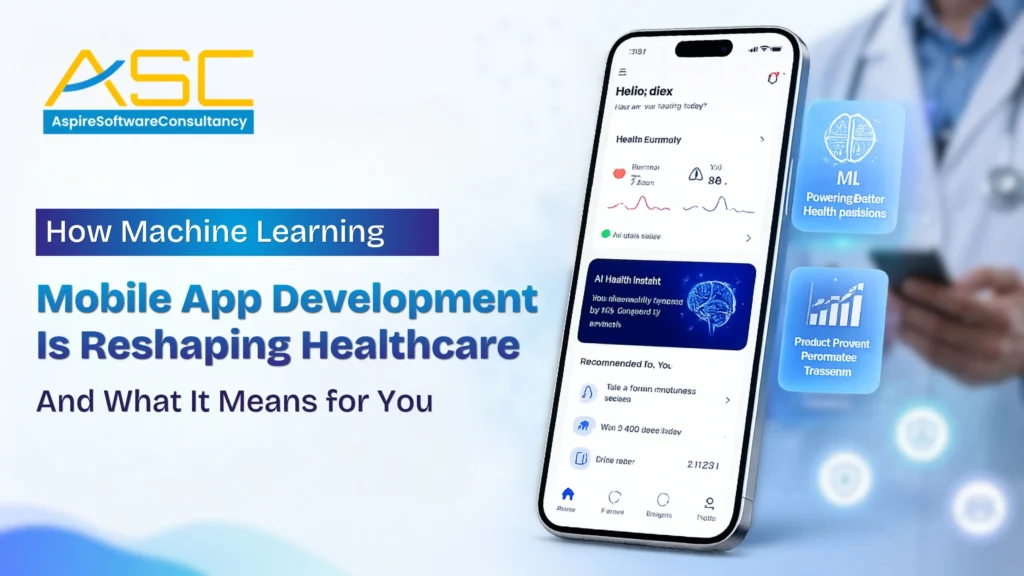
Machine Learning Mobile App Development for Healthcare by Aspire Software Consultancy

How Machine Learning Mobile App Development Is Reshaping Healthcare And What It Means for You

The Rise of AI in Healthcare Apps Healthcare is changing fast. Today, AI healthcare mobile app development is leading that change. Hospitals now use smart apps to monitor patients in real time. These apps also predict health risks before they become serious. Furthermore, doctors can make better decisions using AI-driven data. Patients benefit too. They can track symptoms, book appointments, and get personalized advice all from their phone. As a result, care becomes faster, smarter, and more accessible. According to the WHO’s digital health strategy, intelligent mobile tools are now a global healthcare priority. Why Aspire Leads in Machine Learning App Development Not all app companies deliver the same quality. However, Aspire Software Consultancy stands out as a trusted mobile app development company USA. Aspire Mobile App Development uses proven ML tools to build powerful healthcare apps. These include natural language processing, computer vision, and smart recommendation engines. In addition, every app Aspire builds follows HIPAA compliance standards. Therefore, patient data stays safe at all times. Aspire’s team works fast and delivers results. So, you get a market-ready product without delays. Explore Aspire’s custom mobile app services to learn more. Build Smarter The Future Belongs to ML-Powered Apps The time to invest is now. Machine learning mobile app development gives businesses a clear competitive edge. For example, health insurers use ML to reduce fraud. Startups build wearable companion apps with predictive features. Meanwhile, hospitals use AI to speed up triage and reduce wait times. Moreover, tools like Google’s ML Kit have made ML more accessible than ever. But implementation still requires real expertise. That’s where Aspire Software Consultancy helps most. Their AI healthcare mobile app development framework gets your product live faster and smarter. So, don’t wait. The future of healthcare is mobile, intelligent, and already being built. Frequently Asked Questions What is machine learning mobile app development? Machine learning mobile app development means building apps that learn from data. These apps improve over time without manual updates. They can predict outcomes, personalize experiences, and automate decisions making them ideal for healthcare and other industries. How is AI used in healthcare mobile apps? AI is used in many ways in healthcare apps. For example, apps can monitor heart rate, detect early disease signs, suggest medications, and schedule appointments automatically. Furthermore, AI helps doctors analyze patient data faster and more accurately. Why should I choose Aspire Software Consultancy for my healthcare app? Aspire Software Consultancy is a leading mobile app development company in the USA. They specialize in AI and ML-powered apps. Moreover, they follow HIPAA compliance standards, ensuring your patient data stays fully secure. Their team delivers fast, scalable, and market-ready solutions. How much does it cost to build an AI healthcare mobile app? The cost depends on features, complexity, and platform. A basic AI healthcare app starts at a few thousand dollars. However, advanced apps with ML models, real-time monitoring, and EHR integration cost more. Contact Aspire Software Consultancy for a free custom quote. How long does it take to develop a machine learning mobile app? A simple ML mobile app takes around 3 to 6 months to build. More complex healthcare apps may take 6 to 12 months. Therefore, planning early is important. Aspire’s agile process helps reduce development time without compromising quality. Facebook Instagram Youtube Linkedin X-twitter

How Machine Learning Mobile App Development Is Reshaping Healthcare And What It Means for You Read More »

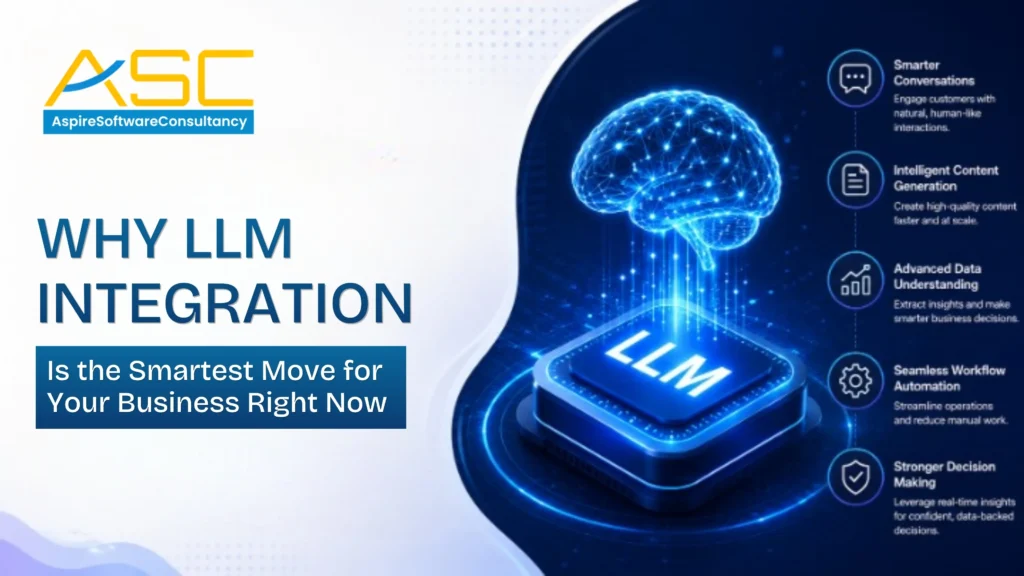
LLM integration software development services by Aspire Software Consultancy

Why LLM Integration Is the Smartest Move for Your Business Right Now

Businesses today need smarter digital products. The key is AI built right into your systems. Aspire Software Consultancy is a trusted AI automation software development company. We help businesses go beyond basic chatbots. Our focus is LLM integration software development embedding large language models into your real workflows. Think document automation, semantic search, and internal AI copilots. These tools save time and cut costs. McKinsey research shows that companies using AI in core operations grow faster and decide smarter. Good AI products need strong engineering behind them. Aspire delivers expert AI product engineering services that go from idea to live deployment. We pick the right model for your use case. We design prompts, build RAG pipelines, and add safety layers. Our team works with LangChain, LlamaIndex, and OpenAI APIs. We build for real production loads not just demos. Want to see what we build? Visit our AI development services page. Choosing the right AI software development company in the USA matters. You need a partner who knows both tech and your industry. Aspire combines ML engineering, cloud infrastructure, and product thinking. We serve startups and enterprises alike. Our AI product engineering services cut your time-to-value without sacrificing quality. We follow responsible AI practices. Google’s AI principles guide how we build. Learn more at aspiresoftwareconsultancy.com. Frequently Asked Questions What is LLM integration software development? LLM integration software development means embedding large language models into your business applications. It connects AI capabilities like text understanding, generation, and reasoning directly into your workflows, tools, and products. How can LLM integration benefit my business? It saves time by automating repetitive tasks. It improves customer experience with smarter conversations. It also helps teams make faster, data-backed decisions. What industries can use LLM integration? Almost every industry benefits. Healthcare, finance, legal, e-commerce, logistics, and education are top sectors. Any business that handles large volumes of text or data can gain from it. How is Aspire Software Consultancy different from other AI companies? Aspire is a specialized AI product engineering services provider. We don’t just build demos we ship production-ready AI systems. Our team handles everything from model selection to deployment and monitoring. Is LLM integration expensive for small businesses? Not necessarily. We offer scalable solutions for startups and growing teams. You only build what you need and expand as your business grows. Facebook Instagram Youtube Linkedin X-twitter

Why LLM Integration Is the Smartest Move for Your Business Right Now Read More »

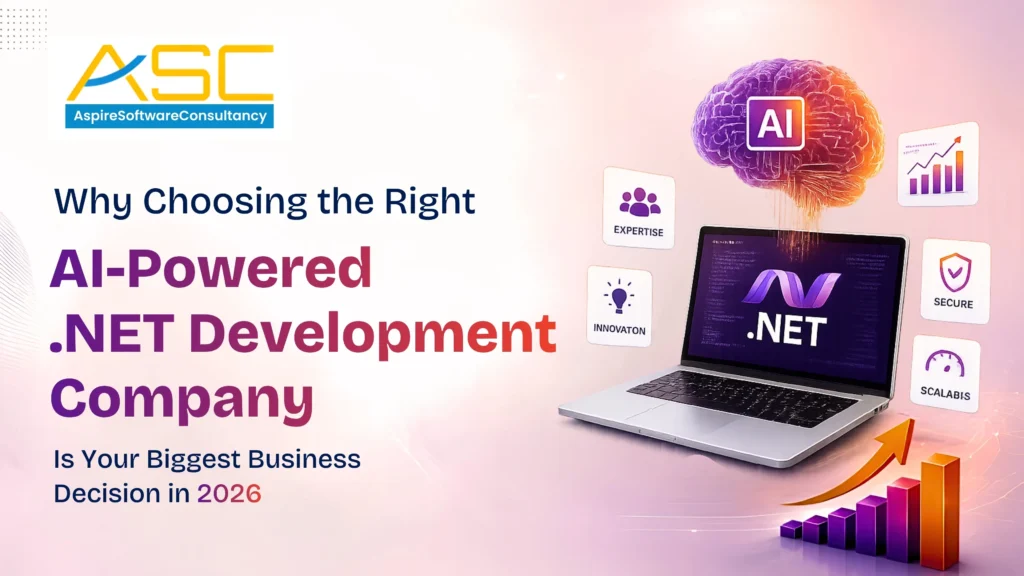
AI-powered .NET development company banner featuring a laptop with .NET logo, AI graphics, and business growth elements.

Why Choosing the Right AI-Powered .NET Development Company Is Your Biggest Business Decision in 2026

AI Is No Longer Optional in 2026 In 2026, AI is the baseline not a future plan. Businesses without intelligent systems are already falling behind. That’s why more companies are turning to an AI-powered .NET development company like Aspire Software Consultancy. We deliver Microsoft .NET AI integration services built for today’s demands. For example, our solutions include real-time analytics, AI-driven APIs, and smart workflows. Moreover, these are built natively into the .NET 9 ecosystem. As a result, your business thinks faster, responds smarter, and scales with confidence. See how Microsoft powers AI with .NET. Transform Operations with Microsoft Dynamics 365 The enterprise world has changed. Therefore, AI Microsoft Dynamics 365 implementation is now at the heart of every smart business strategy. In addition, Microsoft’s Dynamics 365 Copilot has grown into a fully autonomous business assistant. It handles customer queries automatically. Furthermore, it generates financial forecasts and triggers supply chain decisions all without human input. At Aspire Software Consultancy, we implement these capabilities into your workflows. Consequently, you get faster deal cycles, leaner operations, and smarter leadership decisions. Explore Dynamics 365 Copilot features. Build a Smarter ERP for 2026 and Beyond Operational efficiency is the top priority for global businesses this year. Therefore, choosing the right AI ERP software development company matters more than ever. Fortunately, Aspire Software Consultancy is here to help. We build AI-powered ERP platforms on the .NET stack. For instance, our solutions cover real-time inventory tracking, automated compliance, and AI-driven cash flow forecasting. Additionally, they integrate across cloud and on-premise environments. Unlike off-the-shelf software, we build systems trained on your data. As a result, every feature aligns with your KPIs and business goals. So, whether you’re modernizing a legacy ERP or starting fresh, our team is ready. In 2026, intelligent ERP isn’t optional it’s the engine of every high-performing enterprise. Get in touch with Aspire Software Consultancy today because in 2026, intelligent ERP isn’t optional, it’s the engine of every high-performing enterprise. Frequently Asked Questions What is an AI-powered .NET development company? An AI-powered .NET development company builds smart software using Microsoft’s .NET framework combined with artificial intelligence. These solutions include automation, predictive analytics, and intelligent workflows. Aspire Software Consultancy specializes in exactly this helping businesses grow faster with AI-driven .NET applications. Why should I choose Aspire Software Consultancy for Microsoft .NET AI integration services? Aspire Software Consultancy has deep expertise in Microsoft technologies. Moreover, we customize every solution to your business needs. As a result, you get faster deployment, better ROI, and systems that truly work for your team not just generic software. What is Microsoft Dynamics 365 AI implementation? It is the process of embedding AI capabilities like Copilot, predictive forecasting, and automation into your Dynamics 365 platform. Furthermore, it helps your sales, finance, and operations teams make smarter decisions with less manual effort. How long does an AI ERP software development project take? Project timelines vary based on complexity. However, most mid-sized ERP implementations take between 3 to 6 months. Additionally, Aspire Software Consultancy provides a detailed roadmap before development begins so there are no surprises. Is AI ERP software suitable for small and mid-sized businesses? Absolutely. In fact, SMEs benefit the most from AI ERP software. It reduces operational costs, automates repetitive tasks, and gives smaller teams the power of enterprise-level insights all at a scalable price point. How do I get started with Aspire Software Consultancy? Getting started is simple. Just visit www.aspiresoftwareconsultancy.com and connect with our team. We offer a free consultation to understand your goals and recommend the best AI-powered solution for your business. Facebook Instagram Youtube Linkedin X-twitter

Why Choosing the Right AI-Powered .NET Development Company Is Your Biggest Business Decision in 2026 Read More »

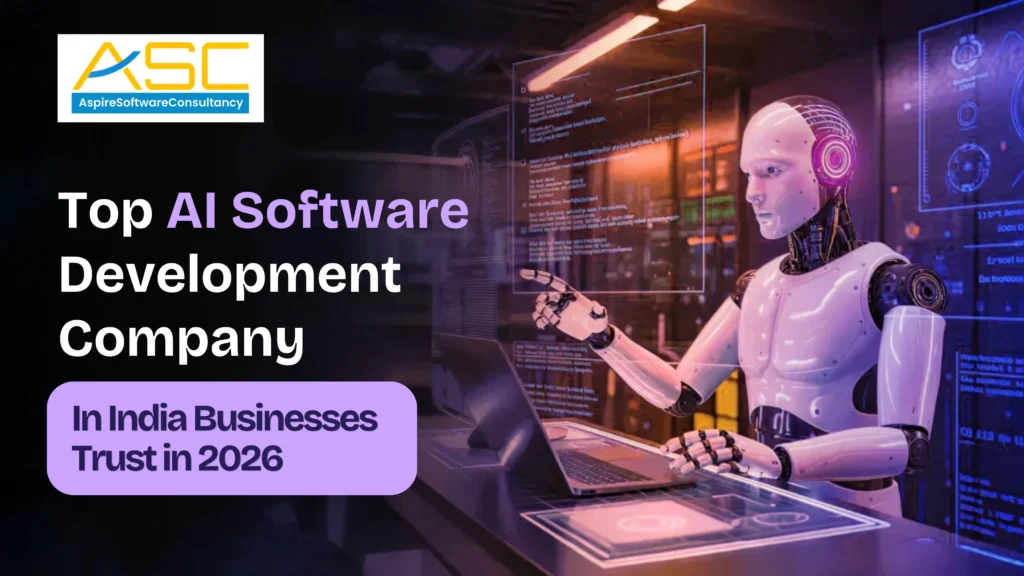
Futuristic AI robot working on a laptop with digital screens, promoting Aspire Software Consultancy as a top AI software development company trusted by Indian businesses in 2026.

Top AI Software Development Company in India Businesses Trust in 2026

India Is the World’s AI Engineering Hub   Global businesses in 2026 want more than just code. They want a strategic AI partner. They need someone who builds intelligent systems that actually scale. That’s why so many of them turn to an AI software development company in India. India has earned its place as the world’s top AI engineering hub. It is home to skilled AI architects, LLM engineers, and data scientists. Furthermore, Aspire Software Consultancy sits at the top of that ecosystem. We are a leading AI custom software development company. We deliver Custom Software AI solutions built for your industry and your goals — not recycled templates dressed up with AI labels. According to Nasscom’s 2026 Tech Report, India’s AI software export market will cross $28 billion this year. As a result, it is now the fastest-growing AI delivery market globally. What Sets a World-Class AI Company Apart   Not every AI company delivers enterprise-grade results. Many offer experiments. We offer production-ready systems. At Aspire, our AI-driven enterprise software development includes: Agentic AI systems that handle end-to-end workflows RAG-powered knowledge bases for smarter enterprise search Multimodal AI applications for voice, text, and vision LLM-integrated ERP and CRM platforms for real business impact Moreover, our generative AI software development services use the latest models. These include OpenAI GPT-4o, Anthropic Claude, and Google Gemini. Therefore, enterprises in the USA, UK, Australia, and the Middle East can automate smarter and scale faster. Do you need a full AI platform built from scratch? Or a smart AI layer added to your existing product? Either way, we bring the depth and expertise to get it done. You can also explore how generative AI is reshaping enterprise software through IBM’s 2026 AI insights hub. Your Search for the Right AI Partner Ends Here   Have you been searching for a trusted AI software development company in India? One that understands global standards? Then you are in the right place. Aspire Software Consultancy brings together India’s best AI talent and a global delivery mindset. We align every solution with EU AI Act compliance and US data privacy regulations. So you can move fast without cutting corners. Custom Software AI is not a future investment. It is your competitive edge right now. In addition, the businesses winning in 2026 have already operationalized AI. Don’t get left behind. Ready to build smarter? Claim your free consultation with Aspire’s AI experts today zero commitment, 100% clarity on your next move. Frequently Asked Questions Why should I choose an AI software development company in India for my business in 2026?  India is the world’s fastest-growing AI delivery market in 2026. Companies like Aspire Software Consultancy offer world-class AI engineers, cost-effective delivery, and global compliance standards making India the smartest choice for building Custom Software AI solutions. What services does an AI custom software development company provide? A leading AI custom software development company like Aspire offers agentic AI systems, RAG-powered knowledge bases, LLM-integrated ERP and CRM platforms, generative AI software development services, and multimodal AI applications all built specifically for your business needs. How is Custom Software AI different from off-the-shelf AI tools? Off-the-shelf tools are built for everyone meaning they’re perfect for no one. Custom Software AI is designed around your specific workflows, data, and goals. It gives your business a measurable edge, integrates with your existing systems, and scales as you grow. Does Aspire Software Consultancy serve businesses outside India, such as in the USA or UK? Yes. As both an AI software development company in India and a recognized AI software development company in the USA, Aspire serves enterprises across the USA, UK, Australia, and the Middle East with full compliance to EU AI Act and US data privacy regulations. Facebook Instagram Youtube Linkedin X-twitter

Top AI Software Development Company in India Businesses Trust in 2026 Read More »

Scroll to Top