WhatsApp Chat

#AspireSoftwareConsultancy

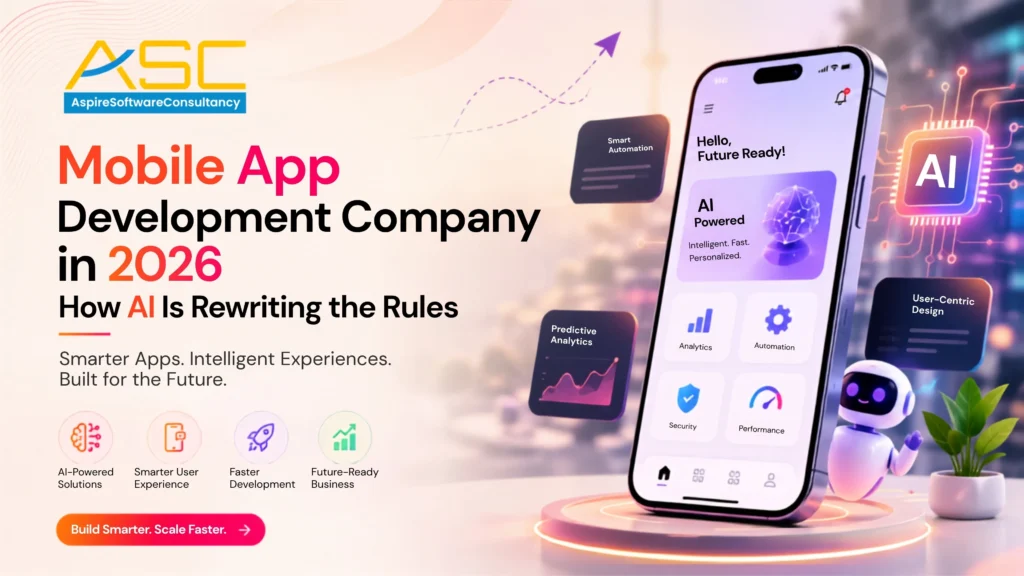
A high-tech digital interface showing a mobile business application with Agentic AI features, representing business growth and digital transformation in 2026.

Why Businesses Are Rapidly Adopting Mobile Apps in 2026 (And How It Impacts Growth)

In the rapidly shifting digital landscape of 2026, the question for most enterprises is no longer if they need a mobile presence, but how fast they can deploy an intelligent one. With over 9.4 billion mobile subscriptions globally and a mobile app market projected to hit $378 billion this year alone, the smartphone has evolved from a communication tool into the primary “command hub” for both consumers and business operations. For forward-thinking organizations, partnering with a specialized firm like Aspire Software Consultancy has become a strategic necessity to navigate these advancements. The shift we are seeing in 2026 isn’t just about “having an app”—it’s about building a scalable, AI-native ecosystem that drives measurable growth. The Catalysts: Why 2026 is the Year of the App Several technological and behavioral shifts have converged to make mobile apps the backbone of modern business: The Dawn of Agentic AI: Unlike the static chatbots of the past, 2026 has ushered in Agentic AI. These are autonomous agents embedded within apps that can plan, execute tasks, and make decisions. Gartner projects that 40% of enterprise applications now feature task-specific AI agents. Ubiquitous 5G and 6G Prep: The rollout of high-speed 5G networks (and the early whispers of 6G) has eliminated latency. Apps can now handle heavy data processing, real-time 3D rendering, and instant cloud synchronization without a glitch. The “Super App” Revolution: Businesses are consolidating services. Instead of separate apps for loyalty, shopping, and support, companies are building “Super Apps” that keep the user within their ecosystem for every need. Hyper-Personalization: Today’s users expect an app to “know” them. In 2026, apps use first-party behavioral data to adjust interfaces and recommendations in real-time, creating a tailor-made experience for every individual. How Mobile Apps Directly Impact Business Growth The rapid adoption of mobile technology isn’t just a trend; it’s a high-impact growth lever. When Aspire Software Consultancy helps a brand transition to a mobile-first strategy, the benefits manifest across several key performance indicators: 1. Radical Operational Efficiency Mobile apps in 2026 are no longer just for customers; they are for employees too. Enterprise mobile apps are now operational infrastructure. By automating internal workflows—such as inventory tracking, real-time logistics, and AI-driven document processing—businesses are seeing a reduction in manual workloads by 40% to 60%. This allows teams to focus on strategy rather than administrative bottlenecks. 2. Unparalleled Customer Retention It is a well-known fact in 2026 that retaining a customer is significantly cheaper than acquiring a new one. Mobile apps foster this loyalty through: Predictive Push Notifications: Using AI to send a nudge exactly when a user is likely to need a service. Frictionless Transactions: One-click biometric payments and saved preferences reduce the “bounce rate” during checkout. Direct Communication: Bypassing noisy email inboxes and social media algorithms to speak directly to the user. 3. Data-Driven Decision Velocity In a saturated market, speed is everything. Mobile apps collect high-fidelity data on user behavior that websites simply cannot match. This “Zero-Party Data”—information users intentionally share—allows businesses to refine their offerings instantly. At Aspire Software Consultancy, we emphasize the importance of building robust analytics into the app’s foundation, turning raw data into actionable growth strategies. 4. New Revenue Streams Apps open doors to monetization models that were previously complex to manage, such as: In-App Marketplaces: Enabling third-party vendors to sell within your ecosystem. Subscription Ecosystems: Providing recurring revenue through premium mobile-only features. AR-Driven Sales: Especially in retail and real-estate, Augmented Reality allows users to “try before they buy,” significantly increasing conversion rates. The Role of Specialized Consulting Building an app that thrives in 2026 requires more than just coding skills; it requires a deep understanding of Agentic AI, Cloud-Native Architecture, and Cross-Platform Frameworks like Flutter or React Native. Aspire Software Consultancy works as a strategic partner to ensure that your mobile solution is not just a digital storefront, but a growth engine. Whether it’s integrating Salesforce Agentforce for autonomous customer service or developing a custom .NET Core backend for high-performance enterprise mobility, the focus is always on scalability and security. Security: The Non-Negotiable Pillar As apps handle more sensitive data in 2026, from biometric IDs to financial records, security has become a brand differentiator. A mobile app must implement: Zero-Trust Security Frameworks: Ensuring every access request is verified. On-Device Edge AI: Processing sensitive data locally on the user’s device rather than the cloud to enhance privacy. Blockchain Integration: For secure, transparent transactions and identity verification. Future-Proofing for 2027 and Beyond The businesses that are leading their industries today are those that recognized the shift early. They didn’t just build an app; they built a mobile-first philosophy. By adopting technologies like Spatial Computing and Predictive UX now, these companies are ensuring they stay relevant as consumer expectations continue to climb. Conclusion: Is Your Business Ready? The rapid adoption of mobile apps in 2026 is driven by a simple truth: the most successful businesses are those that live in their customers’ pockets. A well-designed app increases brand visibility, streamlines operations, and provides the data necessary to stay ahead of the competition. If you are ready to transform your digital presence and drive measurable growth, Aspire Software Consultancy is here to turn your vision into a high-performance reality. From initial discovery to post-launch AI optimization, we ensure your mobile strategy is built for the future. Frequently asked questions Why is mobile app adoption accelerating for businesses in 2026? Businesses are adopting mobile apps in 2026 to leverage Agentic AI and 5G connectivity, which allow for autonomous task execution and zero-latency user experiences. Apps provide a direct, “always-on” channel that bypasses noisy social algorithms, ensuring higher customer retention and 3x more engagement than mobile websites. How does a mobile app impact business growth and ROI? Mobile apps drive growth by increasing conversion rates by up to 200% compared to mobile web. They streamline operations through automated workflows and provide “Zero-Party Data,” allowing brands like Aspire Software Consultancy to help clients implement hyper-personalized marketing that reduces customer acquisition costs (CAC). What are the top mobile

Why Businesses Are Rapidly Adopting Mobile Apps in 2026 (And How It Impacts Growth) Read More »

AWS vs Azure vs Google Cloud

AWS vs Azure vs Google Cloud: Which Cloud Platform Is Right for You?

In the fast-evolving landscape of 2026, the question is no longer whether organizations should move to the cloud, but rather: “Which cloud ecosystem will power our autonomous future?” As the digital world shifts toward “Agentic AI” and multi-cloud resilience, the choice between AWS vs Azure vs Google Cloud has become a strategic pivot point for every modern enterprise. At Aspire Software Consultancy, we believe that selecting a cloud provider is like choosing an engine for a high-performance vehicle—the right choice depends entirely on the terrain you plan to cover. This comprehensive 2026 guide will help you navigate the strengths, costs, and innovative frontiers of the “Big Three.” 1. The 2026 Cloud Market Snapshot Before diving into technicalities, it is essential to understand the current market dynamics. As of early 2026, Amazon Web Services (AWS) maintains its position as the global leader, but the gap is narrowing as Microsoft Azure dominates the enterprise AI sector and Google Cloud Platform (GCP) captures the data-centric innovation market. Strategic Comparison Matrix Feature AWS (The Scale King) Microsoft Azure (The Enterprise Giant) Google Cloud (The Data Specialist) Market Share (2026) ~31% ~25% ~11% Primary Strength Maturity & Service Depth Enterprise & Hybrid Integration AI, Data Analytics & K8s Flagship AI Tool Amazon Bedrock Azure OpenAI Service Vertex AI (Gemini) Best For Massive Global Scale Microsoft-Centric Workloads Data-Native & AI Startups 2. AWS: The Pioneer of Limitless Versatility AWS remains the “Switzerland of Cloud.” Its philosophy revolves around offering the widest possible choice of services and hardware. For a software development company looking for specialized tools, AWS offers over 240 services ranging from satellite ground stations to high-performance ARM-based Graviton processors. The AI Edge: Amazon Bedrock In 2026, AWS has solidified Amazon Bedrock as the premier platform for model diversity. Instead of locking you into one provider, Bedrock gives you a single API to swap between Anthropic’s Claude 3.5, Meta’s Llama, and Amazon’s own Titan models. The Benefit: No vendor lock-in. You can choose the most cost-effective model for every specific task. Why Aspire Recommends AWS for Scale: Reliability: With the largest number of Availability Zones (AZs) globally, AWS is the gold standard for disaster recovery. Developer Ecosystem: Finding certified AWS talent is easier than any other platform, reducing your recruitment overhead. 3. Microsoft Azure: The Sovereign of Enterprise AI Azure has transformed from a “Microsoft shop” into a powerhouse of Responsible AI. By leveraging its exclusive partnership with OpenAI, Azure provides the most stable and compliant way to deploy GPT-4o and advanced “Small Language Models” (SLMs) within an enterprise framework. The Hybrid Advantage: Azure Arc For many of our clients at Aspire Software Consultancy, a total cloud migration isn’t feasible due to data residency laws. Azure Arc allows you to manage on-premises servers as if they were in the cloud, creating a seamless hybrid environment that competitors still struggle to match. The “Hidden Weapon”: Azure Hybrid Benefit If your organization already uses Windows Server or SQL Server, Azure is often the most cost-effective choice. The Azure Hybrid Benefit allows you to repurpose existing licenses to save up to 40% on cloud costs compared to AWS. 4. Google Cloud: The Deep-Tech Leader While GCP holds a smaller market share, it stands as the undisputed leader in Data Intelligence. Notably, Google’s “Data-to-AI” pipeline is now the fastest in the industry for 2026. If your business relies on real-time processing, GCP acts as your primary innovation engine. In addition, Vertex AI allows applications to process massive code libraries using a 2M token context window. Because of their Zero-Copy architecture, you can run AI training without the high cost of moving datasets. Vertex AI and Gemini 1.5 Pro Google Cloud’s Vertex AI is arguably the most cohesive AI platform today. With Gemini 1.5 Pro’s massive context window (up to 2M tokens), your applications can process entire libraries of code or hours of video in a single prompt. The “Data Gravity” Play: By keeping your data in BigQuery, you can run AI training and inference without the cost of moving massive datasets (Zero-Copy architecture). Kubernetes Mastery (GKE) As the original creators of Kubernetes, Google’s GKE (Google Kubernetes Engine) remains the most mature managed K8s service. It offers significantly less operational overhead, making it the favorite for web application development teams focused on microservices. 5. The FinOps Battle: Pricing in 2026 In 2026, cloud pricing is no longer just about hourly rates; it’s about Governance. Aspire Software Consultancy helps businesses implement FinOps strategies through strategic IT consulting and infrastructure planning across all three providers. AWS (Savings Plans): You commit to a dollar amount per hour ($/hr) for 1–3 years. It’s flexible across different regions and services but requires deep planning. Azure (Reservations): Best for predictable workloads. You lock in specific virtual machine sizes for long-term discounts. Google Cloud (Sustained Use): The most “customer-friendly.” Google automatically applies discounts when you run resources for more than 25% of a month—no upfront contract required. (watch More Info) 6. How to Choose: The Aspire Decision Framework Selecting the right cloud isn’t about which is “best”—it’s about which is “right” for your current architecture. Choose AWS if: You need massive global reach, a “model-agnostic” AI strategy, or are building a platform that requires the widest variety of specialized services. Choose Azure if: You are already invested in the Microsoft 365 ecosystem, require strict enterprise compliance (HIPAA/GDPR), or need a robust hybrid cloud strategy. Choose Google Cloud if: You are a data-driven startup, a research-heavy organization, or a company looking for the best-managed Kubernetes and Big Data experience. 7. Why Aspire Software Consultancy is Your Strategic Partner As a leading web development service provider and cloud architect, we don’t just provide “advice”—we provide results. Cloud Maturity Audits: We analyze your current stack to find “zombie resources” that are draining your budget. Multi-Cloud Orchestration: We specialize in the “Best of Breed” approach—using AWS for scale, Azure for AI, and GCP for analytics—all connected through a secure, high-speed mesh. Security-First Architecture: In 2026, cyber threats are autonomous. We

AWS vs Azure vs Google Cloud: Which Cloud Platform Is Right for You? Read More »

Scroll to Top