

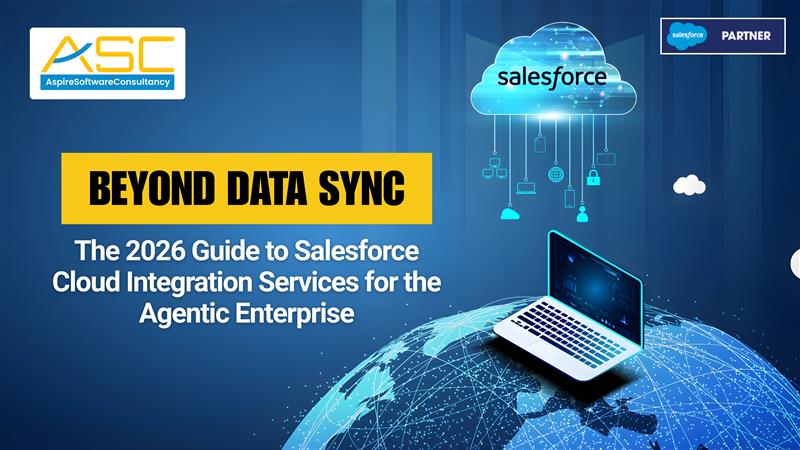
In 2026, the concept of Salesforce integration has fundamentally changed. If your business is still using custom, point-to-point connections just to copy data from an ERP to Salesforce once a night, you’re not integrating—you’re just treading water.
We have officially entered the era of the Agentic Enterprise.
Integration is no longer about just moving data; it is about empowering autonomous AI agents to perform complex, multi-step actions on behalf of your customers and employees. In this new landscape, the right Salesforce cloud integration services are the absolute backbone of success. Businesses that ignore this shift are seeing their AI initiatives fail before they begin, burdened by data that is trapped, static, and too slow to be useful.
At Aspire Software Consultancy, we’ve guided countless organizations through this evolution. We know that the modern Salesforce ecosystem requires a fresh perspective. Here is the 2026 definitive guide to what your Salesforce integration strategy should look like.
The Three Pillars of Modern Salesforce Cloud Integration
In 2026, a world-class integration framework rests on three equally critical pillars: Data, Process, and AI.
1. The Revolution: Data Integration and “Zero-Copy”
For years, integration meant building pipelines to copy huge datasets from one cloud (like an ERP) into Salesforce. This created data duplication, latency issues, and massive security risks.
The game-changer is Salesforce Data Cloud.
Today, the most trending aspect of integration is Zero-Copy integration. Utilizing “Bring Your Own Lake” (BYOL) capabilities, we can now connect Salesforce Data Cloud to data warehouses like Snowflake, BigQuery, or Databricks without physically moving any data. This creates a “federated” view. When a sales rep views a “Last Order Status” field, they are seeing real-time, live data from the ERP, displayed securely within Salesforce. This ensures complete data integrity and a single version of the truth.
2. The Engine: Real-Time Process Integration
“Good enough” is no longer acceptable for process automation. Your customers expect instant responses. This requires a shift from batch processing to real-time, event-driven integration.
This is where technologies like GraphQL and the Salesforce Pub/Sub API dominate. Instead of Salesforce constantly asking an external database, “Has something changed?”, the external system immediately publishes an “event” to Salesforce when an action occurs (like a shipment being created). Salesforce instantly subscribes to that event and triggers the next step of the workflow. This results in incredibly responsive, sub-second automation.
3. The Future: Agentic AI Integration (Agentforce)
The defining feature of 2026 is Agentforce—Salesforce’s suite of autonomous AI agents. An AI agent is useless if it cannot access knowledge, systems of record, and take actions across platforms.
Modern integration services are what bridge that gap. Integration is now about creating “Actions”—defined MuleSoft endpoints or Salesforce Flows—that an Agentforce agent can call upon. For example, when an AI agent resolves a customer dispute, it needs to access their order history (ERP), check their warranty status (Service Cloud), and update their support ticket—all in one seamless, automated flow. Without modern integration, that AI agent is blind and impotent.
Tools of the Trade in 2026: Why MuleSoft is Essential
While there are many integration platforms (iPaaS) available, MuleSoft remains the gold standard for Salesforce ecosystems. But the way it’s used has changed.
Previously seen as a tool for connecting legacy on-premise systems, MuleSoft is now the “control plane” for all API connections and AI automation.
A robust 2026 integration strategy requires:
- MuleSoft Anypoint Platform: To design, build, and manage reusable APIs that connect Salesforce to any legacy or third-party cloud.
- MuleSoft Composer: For non-technical “citizen integrators” to quickly build simple integrations between Salesforce, Slack, and third-party tools (like Jira or NetSuite) without coding.
This “clicks-not-code” approach to integration allows organizations to be agile and responsive.
Industry Use Cases: Integration in Action
To understand the 2026 impact, let’s look at two industry examples where modern integration changes everything.
1. Healthcare (Health Cloud + EHR)
A healthcare provider uses Aspire Software Consultancy’s guidance to integrate Salesforce Health Cloud with their EHR system (e.g., Epic) using HL7 or FHIR standards. The AI patient coordinator (Agentforce) can access real-time clinical data from the EHR, intelligently schedule an appointment based on the doctor’s real-time Outlook calendar, and automatically send a personalized preparation checklist to the patient via SMS.
2. Manufacturing (Sales Cloud + ERP)
A manufacturer connects their Salesforce Manufacturing Cloud to their NetSuite ERP. An order placed in Salesforce is instantly synced with inventory data, triggering a production demand planning workflow in the ERP. An AI agent can now proactively inform a client of a 24-hour delay because the integrated systems have detected a supply chain bottleneck in the ERP. This level of synchronization is only possible with real-time, bidirectional integration.
The Path Forward: Best Practices and Partnerships
As you build or refine your Salesforce cloud integration strategy, keep these core principles in mind:
- API-Led Connectivity: Don’t build single-use, point-to-point connections. Build modular, reusable APIs that can be leveraged for future projects (a principle Aspire Software Consultancy champions).
- Security by Design: Integration is a major threat vector. Ensure you have robust OAuth authentication, data masking, and compliance checks (GDPR, HIPAA) baked into every connection.
- Embrace the New Normal: Stop thinking about “syncing.” Start thinking about “actionable visibility.”
How Aspire Software Consultancy Can Help
Achieving true agentic automation is not a product you can simply buy; it’s a strategic roadmap you must navigate.
At Aspire Software Consultancy, we specialize in this complex territory. We don’t just “install” integrations. We help you design a comprehensive integration architecture that is secure, scalable, and—most importantly—ready to unlock the full potential of your AI investments like Data Cloud and Agentforce.
Whether you are just beginning to move away from legacy systems or are looking to future-proof your Salesforce ecosystem, our expert team is ready to assist.
Ready to move beyond simple data sync? Contact Aspire Software Consultancy today for a complimentary consultation on your Salesforce integration strategy. Let’s build the foundation for your agentic enterprise.
Frequently asked questions
Modern Salesforce cloud integration services break down data silos, allowing real-time synchronization between your CRM, ERP, and marketing tools. By partnering with Aspire Software Consultancy, businesses can automate complex workflows, improve data accuracy, and provide AI agents with the live data they need to function autonomously.
Unlike traditional chatbots, Agentforce requires “Agentic Integration.” This means your systems must be connected via real-time APIs so the AI can take actions—like processing a return or checking warehouse stock—on its own. We specialize in building the secure API-led connectivity required to make these AI agents effective.
Zero-Copy integration allows Salesforce to access data from external platforms (like Snowflake or BigQuery) without physically moving or duplicating the data. This reduces storage costs and security risks. Aspire Software Consultancy implements this using Salesforce Data Cloud to ensure your team always sees the most current information.
Integration is more than just connecting two apps; it requires a strategic data model and secure architecture. A partner like Aspire Software Consultancy ensures your integration is scalable, follows Salesforce best practices, and avoids common pitfalls like data duplication or slow system performance.