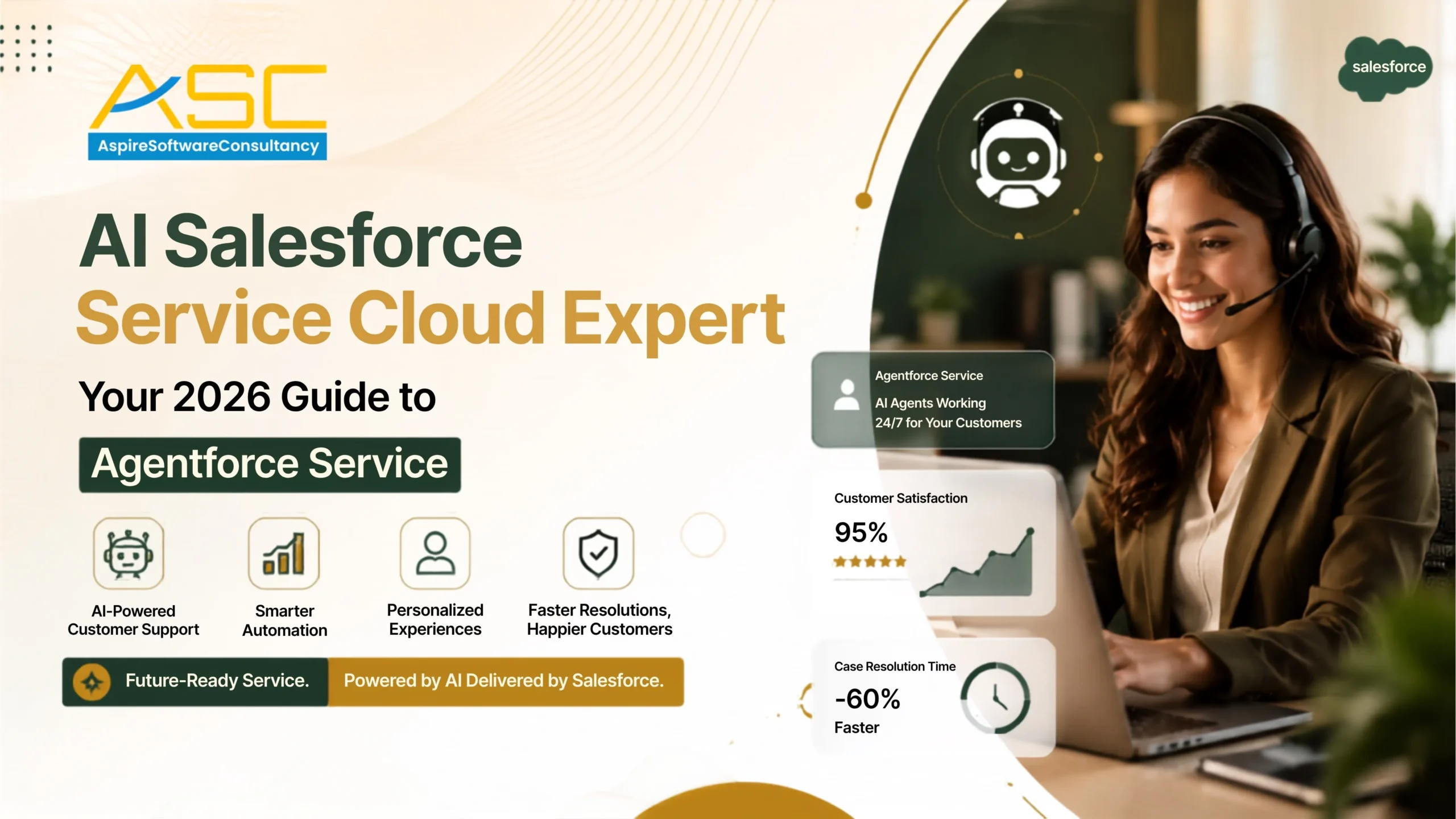
Customer service teams no longer use AI just to draft replies. Instead, they hand entire cases to autonomous agents. So if you’re exploring this shift, an AI Salesforce Service Cloud expert can make all the difference. In fact, the right expert is often what separates a stalled pilot from a support desk that runs itself. Here’s what changed in 2026, and how to get it right.
What Is an AI Salesforce Service Cloud Expert?
An AI Salesforce Service Cloud expert is a certified consultant. They configure, train, and govern the AI layer built into Salesforce’s service platform. Salesforce now calls this platform Agentforce Service, following its 2025–2026 rebrand away from the old “Cloud” naming. This role goes beyond basic Salesforce admin work. It also demands real experience with autonomous agent design, Data 360 architecture, permission governance, and the Trust Layer that keeps every AI action safe and auditable.
At Aspire Software Consultancy, we work at this exact intersection. We combine deep Salesforce platform knowledge with applied AI engineering. As a result, we help businesses move past “AI as a chatbot” and toward AI as a real digital case-handling workforce. You can see more of our approach on our Salesforce services page.
Why 2026 Is the Turning Point for Service Cloud AI
Service teams are moving faster than any other department on agentic AI. Why? Because the results are easy to measure. Handle time, resolution rate, CSAT, and deflection all show up clearly on a dashboard. A few key shifts are driving this change:
- From assistive to autonomous. In 2025, AI mostly summarized cases and suggested replies. Now, in 2026, Agentforce Service agents resolve full cases on their own. They verify identity, check order status, issue refunds, and update records without a human clicking through each step.
- Data 360 as the intelligence layer. This platform, formerly called Data Cloud, unifies customer data from every system into one profile. So agents respond with full context, instead of guessing from a single case record.
- Headless AI. Agents no longer need a browser tab to work. Through APIs and CLI access, they can act on Salesforce data directly from Slack, a website widget, or another app entirely.
- Deterministic guardrails. New tools like Agent Script let consultants set strict if/then logic for sensitive steps. This matters because identity verification, for example, is not something a language model alone should handle.
Core Benefits of Hiring an AI Salesforce Service Cloud Expert
1. Faster, Safer Agentforce Service Rollouts
An experienced partner has already made the early mistakes, so you don’t have to. That means proper permission sets, a clean knowledge base, and correct Trust Layer setup from day one.
2. Higher Case Deflection Without Losing Quality
Self-service works best when it’s backed by accurate knowledge articles and real Data 360 context. As a result, agents resolve more tickets without giving customers vague, generic answers.
3. Governance You Can Explain to Leadership
AI adoption now ties directly to compliance and security reviews. So an expert builds clear audit trails and escalation paths that satisfy legal, security, and customer trust requirements.
4. Employee Productivity Gains
Agents don’t only serve customers. They also assist your reps by drafting responses, surfacing relevant knowledge, and handling routine backend tasks. This frees your team to focus on complex, high-value cases.
How Aspire Software Consultancy Helps
As an AI Salesforce Service Cloud expert, our team at Aspire supports the full Agentforce Service journey, including:
- Readiness audits to assess your data quality, knowledge base, and case history before any agent goes live
- Agentforce Service implementation with autonomous case-handling agents built around your real support workflows
- Data 360 integration to connect CRM, support, and third-party data into one governed customer profile
- Trust Layer and governance setup, including permission scoping, audit trails, and clear escalation paths
- Ongoing optimization to monitor agent performance and refine logic as your case volume grows
Want to know where your current setup stands? Talk to our Salesforce AI consulting team for a free readiness assessment. You can also browse more insights on our blog, or learn more about Aspire and our approach to AI-driven CRM.
Final Thoughts
The businesses pulling ahead in 2026 aren’t chasing every new AI feature. Instead, they’re building disciplined, well-governed Agentforce Service deployments with the right partner. And that’s exactly where an experienced AI Salesforce Service Cloud expert makes the difference. With the right guidance, your support desk can shift from reactive to genuinely self-sufficient.
Ready to start? Reach out to Aspire Software Consultancy today and let’s map your Agentforce Service roadmap together.
Further reading: Salesforce — 8 Ways AI Agents Are Evolving in 2026 | Salesforce Admins — 2026 Roadmap for Admins
Frequently Asked Questions
Salesforce has rebranded much of its product line under the Agentforce umbrella, so Service Cloud is increasingly referred to as Agentforce Service though the underlying platform capabilities continue to expand.
It’s not mandatory, but it’s strongly recommended. Governance, data readiness, and permission architecture are complex enough that most successful 2026 deployments involve an experienced implementation partner.
Treating model selection as the hard part. In practice, data access, permissions, and knowledge base quality determine whether an agent succeeds a well-governed agent with clean data consistently outperforms a “smarter” model with poor context.
Agentforce Service scales down well. Smaller support teams often start with a single use case, like order-status lookups or refund processing, before expanding the agent’s scope as trust builds.
This is exactly what the Trust Layer and escalation paths are for. A well-governed setup routes uncertain or sensitive cases to a human agent automatically, rather than letting the AI guess.