

Salesforce is no longer just a CRM. It’s becoming an agentic enterprise platform. In the Spring ’26 and Summer ’26 releases, Salesforce rebranded core clouds around Agentforce. It also rolled out Multi-Agent Orchestration and pushed Agentforce Voice and Agentforce Builder to general availability. So if your business still runs on static workflows and manual dashboards, 2026 is the year to change that. A proper Salesforce Agentforce implementation is no longer optional. It’s now a competitive necessity.
This guide covers what Agentforce does today. It also explains why timing matters right now. And it walks through the step-by-step roadmap our team uses when rolling it out for clients.
What Is Salesforce Agentforce? (2026 Update)
Agentforce is Salesforce’s autonomous AI agent layer. The Atlas Reasoning Engine powers it. Unlike a simple chatbot or copilot, Agentforce agents work differently. They read intent on their own. They pull the right data. And they complete multi-step actions instead of just suggesting a reply.
Agentforce 360 added four major building blocks. First, Agentforce Builder lets teams create agents with low code. Second, Agent Script adds deterministic, rule-based control. Third, Agentforce Voice enables natural phone-based conversations. Finally, Intelligent Context grounds agents in your unstructured business data.
In short, Agentforce changes your CRM’s role. It moves from a passive system of record to an active team member that takes action.
Why a Salesforce Agentforce Implementation Matters in 2026
Three shifts set this year apart from past AI hype cycles. First, Multi-Agent Orchestration is now generally available. Because of this, agents can work together across sales, service, and marketing. As a result, they can resolve one customer request end-to-end.
Second, Experience Cloud now supports Generative Engine Optimization (GEO). This means AI engines like ChatGPT and Gemini can read your help center content directly. In fact, this is quickly becoming a real ranking factor for 2026 SEO.
Third, Agentforce now offers model flexibility. It supports Anthropic, OpenAI, and Google Gemini through the Atlas Reasoning Engine. So businesses are no longer locked into one AI vendor.
Given these shifts, delay carries real risk. Companies that wait on an Agentforce implementation strategy may fall behind. Meanwhile, competitors already use AI agents for 24/7 service resolution, automated pipeline management, and predictive sales insights.
Key Features to Plan Around
- Agentforce Builder & Knowledge Libraries – Build and test agents visually. Ground them in RAG-powered documentation.
- Agentforce Voice – Now generally available for contact centers. It integrates with Amazon Connect, Genesys, Five9, and Vonage.
- Sales Workspace & Agentforce Sales – Brings agents, analytics, and next-best-action insights together for reps.
- Agentforce Self-Service – A Help Agent you can set up in just a few clicks for websites and portals.
- Trust Layer & My Trust Center – Keeps every agent action auditable and compliant at enterprise scale.
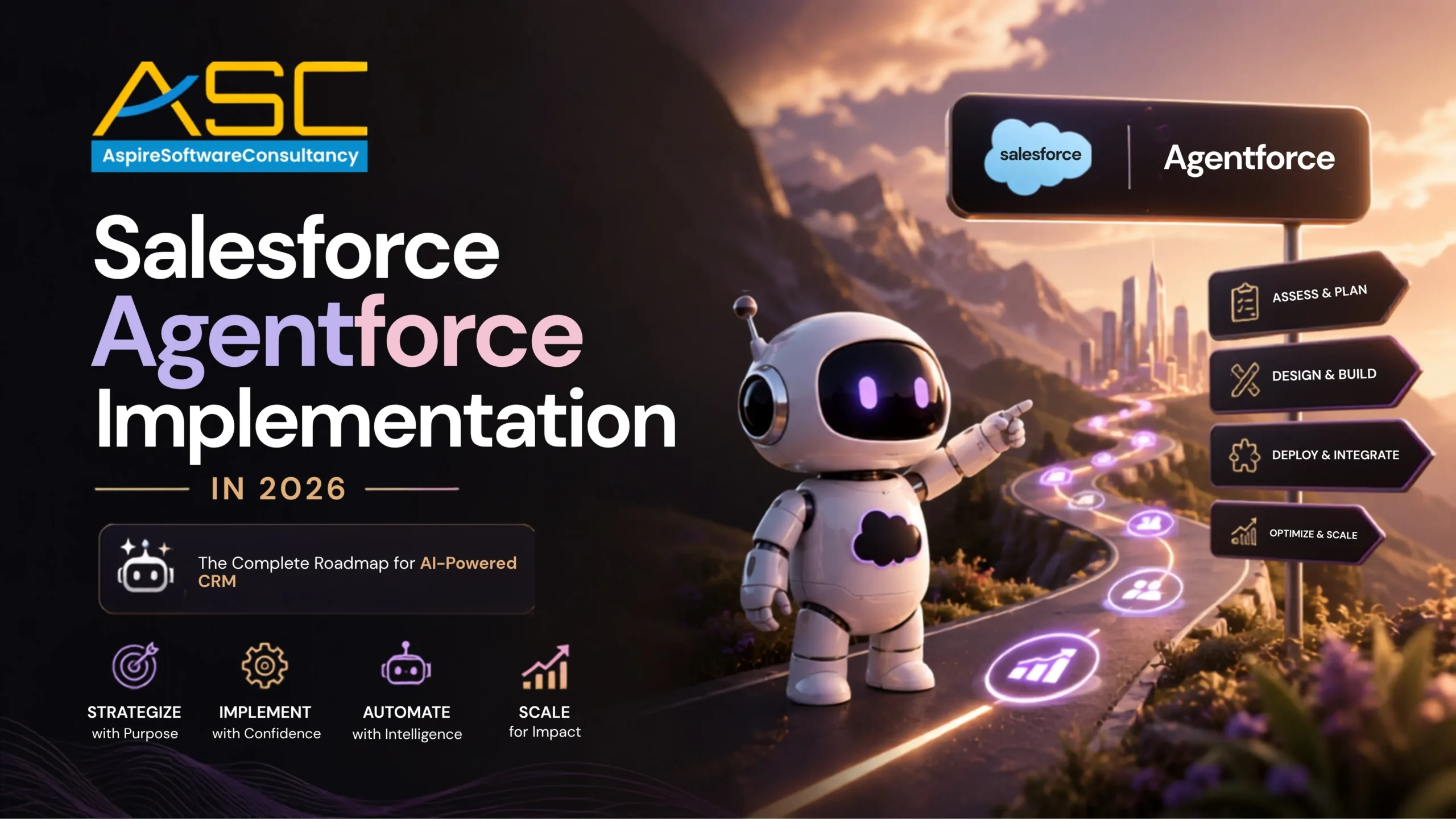
Step-by-Step Salesforce Agentforce Implementation Roadmap
1. Audit your data and org readiness. Agentforce only performs as well as the data behind it. So clean up your Knowledge Libraries, permissions, and legacy Connected Apps first.
2. Define agent use cases. Start narrow. Pick one service topic, one sales workflow, or one internal IT ticketing flow. Don’t launch a full agent army on day one.
3. Build in Agentforce Builder. Use Canvas View to map out conversation flows. Then apply Agent Script wherever you need predictable, rule-bound behavior.
4. Test with the Agentforce Testing Center. Simulate real conversations and edge cases first. Do this before anything goes customer-facing.
5. Deploy with governance. Configure the Trust Layer. Set clear escalation paths to human reps. Then monitor everything through Data 360 dashboards.
6. Iterate and expand. Once one agent proves its ROI, expand further. Move into Multi-Agent Orchestration so agents can hand off work across departments smoothly.
Common Implementation Challenges (and How to Avoid Them)
- Messy or siloed data. Agentforce’s accuracy depends on clean, structured knowledge. So invest in Data 360 hygiene early.
- Underestimating governance. Skipping Trust Layer configuration raises compliance risk at scale.
- No clear ownership. Agentforce evolves with every seasonal release. So assign a dedicated admin or partner to manage performance after launch.
A certified Salesforce Agentforce implementation partner can help you avoid most of these pitfalls. Instead of trial and error, they bring release-tested playbooks.
How Aspire Software Consultancy Helps
As a Salesforce consulting partner, we guide businesses through the entire process. Our Salesforce development team plans, builds, and governs Agentforce rollouts. This includes everything from early data readiness audits to Multi-Agent Orchestration at scale.
If you’re still comparing options, start with our detailed guide on Salesforce CRM Development in 2026. It explains how AI-powered CRM fits into a broader modernization strategy. You can also hire dedicated Salesforce developers to speed up your build.
For the official product roadmap, check Salesforce’s own Agentforce 360 announcement and the Spring ’26 Release notes.
Final Thoughts
A successful Salesforce Agentforce implementation in 2026 isn’t about switching on every feature at once. Instead, it’s about grounding agents in clean data. Start with one high-value use case. Then scale governance as adoption grows. Done right, Agentforce becomes an always-on teammate. It resolves tickets, qualifies leads, and frees your human team for higher-value work.
Ready to plan your rollout? Schedule a free consultation with our Salesforce team.
Frequently Asked Questions
It’s the process of setting up, configuring, and deploying Salesforce’s AI agents inside your org. This includes data readiness, agent building, testing, and governance. The goal is to get autonomous agents handling real sales, service, or IT tasks safely.
Most single-use-case rollouts take four to eight weeks. Timelines depend on data readiness, org complexity, and how many agents you plan to launch. A phased approach is usually faster and safer than a big-bang launch.
No. Agentforce scales down well for small and mid-size teams too. Many businesses start with one agent, like a self-service Help Agent, before expanding further.
You need clean, structured knowledge sources. This includes support articles, product data, and clear permission rules. Agentforce grounds its answers in this data using RAG, so quality matters more than volume.
No. Agentforce handles repetitive, well-defined tasks and frees up your team for higher-value work. Most implementations keep a clear escalation path to human reps for complex or sensitive cases.