WhatsApp Chat

enterprise application development

API integration services connecting business systems for improved efficiency, automation, and seamless data flow

API Integration Services: How to Connect Your Business Systems for Better Efficiency

In today’s fast-paced digital landscape, businesses rely on multiple software tools to manage operations—CRM systems, accounting platforms, marketing tools, and more. While each system serves a purpose, disconnected applications often lead to inefficiencies, data silos, and missed opportunities. This is where API integration services play a critical role. At Aspire Software Consultancy, we help businesses seamlessly connect their systems to improve efficiency, automate workflows, and unlock real-time insights. What Are API Integration Services? API (Application Programming Interface) integration allows different software systems to communicate and share data with each other in real time. Instead of manually transferring data between platforms, APIs automate the process, ensuring accuracy and speed. For example, integrating your CRM with your marketing platform ensures that customer data flows seamlessly, helping your team make better decisions faster. Businesses today increasingly rely on software consulting services to design and implement robust API integrations tailored to their unique needs. Why API Integration Matters for Businesses Disconnected systems create operational bottlenecks. Employees waste time switching between platforms, duplicating data, and correcting errors. With the right API integration strategy, businesses can: Eliminate manual data entry Improve data accuracy Enhance team productivity Enable real-time reporting Deliver better customer experiences Modern organizations investing in IT consultancy services are prioritizing integration as a key step toward digital transformation. Key Benefits of API Integration 1. Improved Operational Efficiency API integration automates repetitive tasks, reducing manual effort and saving time. This allows teams to focus on strategic activities rather than administrative work. 2. Real-Time Data Synchronization Integrated systems ensure that data is updated across all platforms instantly. This is especially valuable for sales, marketing, and customer support teams. 3. Better Decision-Making With accurate and centralized data, businesses can generate meaningful insights and make informed decisions quickly. 4. Scalability for Growth As your business grows, integrated systems can easily adapt to new tools and technologies. This flexibility is crucial in modern enterprise application development. 5. Enhanced Customer Experience API integrations enable personalized customer interactions by providing a unified view of customer data across platforms. Salesforce Integration: A Powerful Use Case One of the most common and impactful integrations involves CRM systems like Salesforce. Businesses leveraging salesforce integration services can connect their CRM with marketing automation tools, ERP systems, customer support platforms, and more. Why Salesforce Integration? Centralizes customer data Automates lead management Improves sales pipeline visibility Enhances customer engagement With salesforce crm integration services, businesses can ensure seamless communication between sales, marketing, and service teams. Additionally, salesforce cloud integration services allow organizations to connect cloud-based applications, making operations more agile and scalable. Common API Integration Scenarios Here are some practical examples of how businesses use API integration: CRM + Email Marketing Tools ERP + Inventory Management Systems Payment Gateways + E-commerce Platforms HR Systems + Payroll Software Customer Support Tools + CRM These integrations eliminate redundancies and create a unified workflow across departments. Challenges in API Integration While API integration offers numerous benefits, it also comes with challenges: Compatibility issues between systems Data security concerns Complex implementation processes Maintenance and updates This is why working with an experienced software development consultancy is essential. Experts ensure that integrations are secure, scalable, and aligned with business goals. How Aspire Software Consultancy Can Help At Aspire Software Consultancy, we specialize in delivering tailored API integration solutions that align with your business objectives. Our approach includes: 1. Requirement Analysis We understand your existing systems, workflows, and business goals. 2. Custom Integration Strategy We design a solution that ensures seamless communication between your applications. 3. Secure Implementation Our team ensures that all integrations follow best practices for data security and compliance. 4. Testing & Optimization We rigorously test integrations to ensure performance and reliability. 5. Ongoing Support We provide continuous support to keep your systems running smoothly. With expertise in software consulting services and enterprise application development, we help businesses build connected ecosystems that drive efficiency and growth. Best Practices for Successful API Integration To get the most out of API integration, businesses should follow these best practices: Choose scalable and flexible APIs Prioritize data security and compliance Use standardized data formats Monitor performance regularly Work with experienced integration partners Investing in professional IT consultancy services ensures that your integration strategy is future-ready. The Future of API Integration As businesses continue to adopt cloud technologies and digital platforms, API integration will become even more critical. Emerging trends include: AI-powered integrations Low-code and no-code integration platforms Increased focus on real-time data processing Expansion of cloud-based integrations Organizations that embrace these trends will gain a competitive edge in efficiency and innovation. Conclusion API integration is no longer a luxury—it’s a necessity for businesses looking to scale and stay competitive. By connecting your systems, you can streamline operations, improve data accuracy, and deliver better customer experiences. At Aspire Software Consultancy, we provide expert-driven API integration solutions that empower your business to operate smarter and grow faster. Frequently Asked Questions What is API integration in simple terms? API integration connects different software systems so they can share data automatically, reducing manual work and improving efficiency. Why is API integration important for businesses? It improves productivity, ensures real-time data flow, reduces errors, and enhances decision-making. What are Salesforce integration services? These services connect Salesforce with other business applications to streamline operations and improve customer relationship management. How long does API integration take? The timeline depends on the complexity of systems involved, but it can range from a few days to several weeks. Is API integration secure? Yes, when implemented correctly with proper authentication, encryption, and monitoring, API integration is highly secure. Facebook Instagram Youtube Linkedin X-twitter

API Integration Services: How to Connect Your Business Systems for Better Efficiency Read More »

Illustration showing how custom software development helps businesses scale faster through automation, integration, and enterprise application development

How Custom Software Development Helps Businesses Scale Faster

In today’s competitive digital landscape, businesses are under constant pressure to grow faster, operate smarter, and deliver better customer experiences. While off-the-shelf tools may offer quick solutions, they often fall short when it comes to scalability and flexibility. This is where a custom software development company plays a critical role. At Aspire Software Consultancy, we help businesses build scalable, future-ready solutions tailored to their unique needs. Let’s explore how custom software development empowers businesses to scale faster and more efficiently. 1. Tailored Solutions for Business Growth Every business operates differently, with its own workflows, goals, and challenges. Off-the-shelf software often forces companies to adapt to rigid systems, limiting growth potential. Custom solutions, on the other hand, are designed specifically for your business. A reliable software development consultancy ensures that every feature aligns with your operational needs, enabling smoother workflows and improved productivity. This level of customization eliminates unnecessary features and focuses on what truly matters—growth. 2. Scalability Without Limitations One of the biggest advantages of custom software is scalability. As your business grows, your software should evolve with it. With enterprise application development, you can: Add new features as needed Handle increased user traffic Integrate with new technologies Unlike generic tools, custom-built systems are designed with scalability in mind from the start. This means you won’t outgrow your software as your business expands. 3. Seamless Integration with Existing Systems Businesses often rely on multiple tools—CRM, ERP, marketing platforms, and more. Managing disconnected systems can slow down operations and create inefficiencies. Custom software enables seamless integration between different systems, ensuring smooth data flow and better decision-making. With professional software consulting services, businesses can unify their technology stack and eliminate data silos. This integration improves operational efficiency and supports faster scaling. 4. Enhanced Performance and Efficiency Off-the-shelf solutions often come with unnecessary features that can slow down performance. Custom software is built with only the required functionalities, ensuring optimal speed and efficiency. For example, businesses leveraging .net application development services benefit from: High performance Robust architecture Secure and scalable frameworks A trusted custom .net development company can build applications that handle complex operations without compromising performance. 5. Better Security and Data Protection As businesses grow, they handle more sensitive data—customer information, financial records, and operational data. Security becomes a top priority. Custom software offers enhanced security features tailored to your business needs. Unlike widely used off-the-shelf tools, custom solutions are less vulnerable to common cyber threats. With expert software consultancy services, businesses can implement: Advanced encryption Role-based access control Regular security updates This ensures your data remains protected as you scale. 6. Competitive Advantage in the Market In a crowded market, differentiation is key. Custom software allows businesses to create unique features and deliver better user experiences. Instead of relying on generic tools, companies can innovate and stand out. Whether it’s a unique customer portal or an automated workflow system, custom solutions provide a significant competitive edge. A strategic software development consultancy helps identify opportunities for innovation and builds solutions that drive business growth. 7. Cost Efficiency in the Long Run While custom software may require a higher initial investment, it proves cost-effective over time. Off-the-shelf tools often come with: Recurring subscription fees Licensing costs Limited customization Custom solutions eliminate these recurring expenses and reduce dependency on third-party tools. Additionally, improved efficiency and automation lead to significant cost savings. 8. Flexibility and Future-Readiness Technology evolves rapidly, and businesses need to stay ahead. Custom software provides the flexibility to adapt to changing market trends and customer demands. With the support of software consulting services, businesses can continuously upgrade and optimize their systems. This ensures long-term sustainability and growth. 9. Improved Customer Experience Customer expectations are higher than ever. Businesses need to deliver personalized and seamless experiences. Custom software enables: Faster response times Personalized interactions Efficient service delivery By leveraging enterprise application development, businesses can create customer-centric solutions that improve satisfaction and loyalty. 10. Data-Driven Decision Making Scaling a business requires informed decision-making. Custom software can include advanced analytics and reporting features tailored to your needs. With real-time insights, businesses can: Identify growth opportunities Optimize operations Make strategic decisions This data-driven approach is essential for sustainable scaling. Conclusion Custom software development is no longer a luxury—it’s a necessity for businesses aiming to scale quickly and efficiently. From improved performance and security to seamless integration and flexibility, the benefits are undeniable. At Aspire Software Consultancy, we specialize in delivering scalable, high-performance solutions tailored to your business goals. Whether you need .net application development services or end-to-end software consultancy services, our team is here to help you grow faster and smarter. Frequently Asked Questions What is custom software development? Custom software development is the process of designing and building software tailored specifically to a business’s unique needs and workflows. How does custom software help in business scaling? It enables automation, improves efficiency, supports integration, and allows systems to grow alongside the business without limitations. Is custom software more expensive than off-the-shelf solutions? Initially, yes. However, it is more cost-effective in the long run due to reduced licensing fees and improved efficiency. Why choose .NET for custom software development? .NET offers high performance, scalability, and security, making it ideal for enterprise-level applications. How long does it take to develop custom software? The timeline depends on the complexity of the project, but it typically ranges from a few weeks to several months. Facebook Instagram Youtube Linkedin X-twitter

How Custom Software Development Helps Businesses Scale Faster Read More »

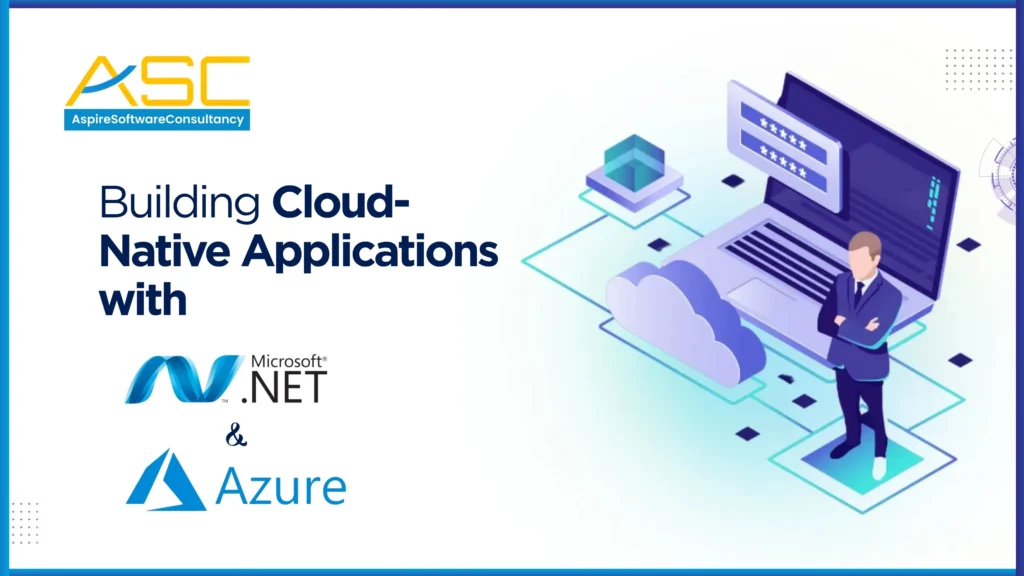
Cloud-native application development using .NET and Azure for scalable enterprise solutions

Building Cloud-Native Applications with .NET and Azure

In today’s fast-paced digital landscape, businesses are rapidly shifting toward cloud-native architectures to stay competitive, scalable, and resilient. Cloud-native applications are designed specifically to leverage the power of cloud platforms, enabling faster deployment, better performance, and seamless scalability. At Aspire Software Consultancy, we help businesses unlock the true potential of cloud technologies through advanced microsoft .net development services and Azure-based solutions tailored to modern enterprise needs. What Are Cloud-Native Applications? Cloud-native applications are built and deployed using cloud computing principles such as microservices, containerization, DevOps, and continuous delivery. Unlike traditional monolithic applications, cloud-native systems are modular, scalable, and resilient by design. With .net application development services, businesses can build applications that are: Highly scalable Fault-tolerant Easily maintainable Faster to deploy Why Choose .NET for Cloud-Native Development? Microsoft’s .NET ecosystem has evolved into a powerful platform for building modern applications. Combined with Azure, it offers a robust foundation for enterprise-grade solutions. Key Benefits of .NET: Cross-Platform Capabilities .NET enables development across Windows, Linux, and macOS, making it ideal for cloud-native environments. High Performance Optimized runtime and efficient memory management ensure faster application performance. Strong Security Built-in security features help protect applications from vulnerabilities. Microservices Support .NET supports microservices architecture, allowing businesses to scale individual components independently. This makes dot net development services a preferred choice for businesses aiming to modernize their infrastructure. Why Azure Is the Perfect Cloud Partner Microsoft Azure provides a comprehensive cloud ecosystem that perfectly complements .NET development. Key Azure Services for Cloud-Native Apps: Azure Kubernetes Service (AKS) for container orchestration Azure App Services for hosting applications Azure DevOps for CI/CD pipelines Azure Functions for serverless computing Azure SQL Database for scalable data storage By leveraging Azure, a .net development company can deliver applications that are globally available, secure, and highly scalable. Key Components of Cloud-Native Architecture To build efficient cloud-native applications, the following components are essential: 1. Microservices Architecture Applications are broken into smaller, independent services that can be developed and deployed separately.  2. Containerization To ensure consistency across environments, tools like Docker are widely used.  3. DevOps & CI/CD Additionally, automated pipelines enable faster delivery and continuous improvement.  4. API-First Design APIs further support seamless communication between services and external systems.  At Aspire Software Consultancy, our software consulting services ensure that each of these components is implemented strategically for maximum efficiency. Benefits of Cloud-Native Applications for Enterprises Adopting cloud-native development offers significant advantages for modern businesses: ✔ Scalability on Demand Applications can scale automatically based on user demand.  ✔ Faster Time-to-Market At the same time, continuous integration and deployment accelerate release cycles.  ✔ Cost Efficiency This approach also reduces infrastructure costs through pay-as-you-go models.  ✔ Improved Resilience As a result, fault isolation improves overall system stability.  ✔ Enhanced Innovation Moreover, teams can experiment and innovate without affecting the entire system.  These benefits make cloud-native solutions a critical part of enterprise application development strategies. How Aspire Software Consultancy Can Help As a trusted custom .net development company, Aspire Software Consultancy specializes in building tailored cloud-native solutions that align with your business goals. Our Expertise Includes: End-to-end .net application development services Cloud migration and modernization Azure architecture design and implementation Microservices and API development DevOps and CI/CD setup We focus on delivering scalable, secure, and high-performance solutions that empower businesses to grow in a digital-first world. Best Practices for Building Cloud-Native Applications To ensure success, businesses should follow these best practices: Design for Scalability Build applications that can handle growth without major redesign. Use Managed Services Leverage Azure’s managed services to reduce operational overhead. Implement Security Early Integrate security practices from the development stage. Monitor and Optimize Use monitoring tools to track performance and improve continuously. Choose the Right Partner Working with an experienced .net development company ensures smooth implementation and long-term success. Conclusion Building cloud-native applications with .NET and Azure is no longer optional—it’s essential for businesses aiming to stay competitive in today’s digital ecosystem. With the right tools, architecture, and expertise, organizations can achieve unmatched scalability, performance, and innovation. At Aspire Software Consultancy, we combine cutting-edge technology with industry expertise to deliver reliable and future-ready solutions. Whether you’re starting from scratch or modernizing existing systems, our microsoft .net development services are designed to help you succeed in the cloud. Frequently Asked Questions What is a cloud-native application? A cloud-native application is designed to run in cloud environments using microservices, containers, and scalable infrastructure. Why use .NET for cloud-native development? .NET offers high performance, cross-platform support, and strong integration with Azure, making it ideal for modern applications. What are the benefits of Azure for application development? Azure provides scalability, security, global availability, and a wide range of tools for building and managing applications. How do microservices improve application performance? Microservices allow independent scaling and faster updates, improving overall system efficiency. Why choose a custom .NET development company? A custom partner ensures tailored solutions, better performance, and alignment with business goals. Facebook Instagram Youtube Linkedin X-twitter

Building Cloud-Native Applications with .NET and Azure Read More »

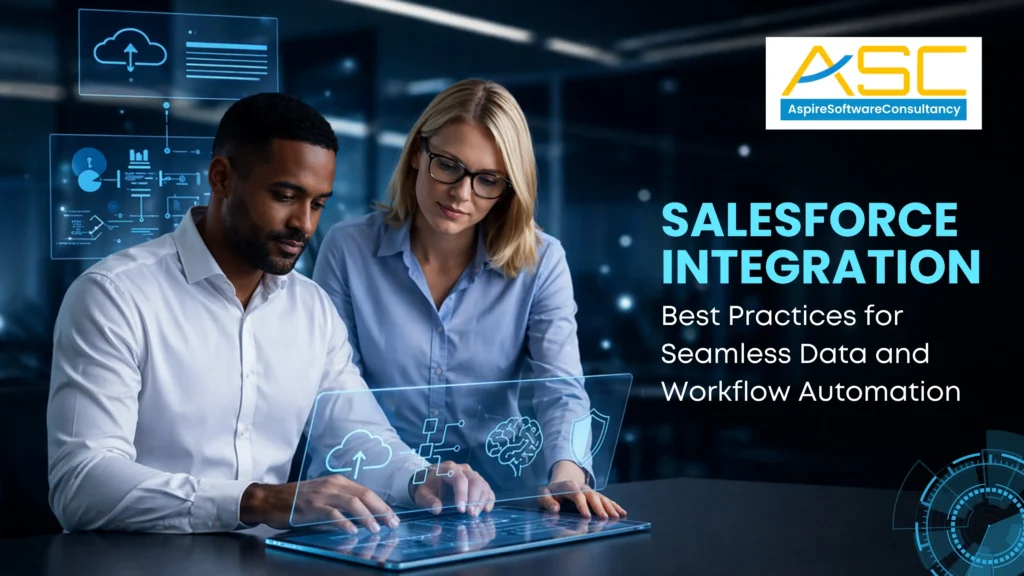
Salesforce integration best practices for seamless data synchronization and automated workflows in business systems

Salesforce Integration Best Practices for Seamless Data and Workflow Automation

Integrating Salesforce with your business systems is only the first step. The real value lies in how effectively that integration is executed and maintained. Many businesses invest in integration but still struggle with data inconsistencies, workflow delays, and system inefficiencies. At Aspire Software Consultancy, we focus on helping organizations not just integrate Salesforce, but optimize it for seamless data flow and intelligent workflow automation. By following proven best practices, businesses can unlock the full potential of their CRM and drive measurable efficiency. Why Best Practices Matter in Salesforce Integration While salesforce integration services connect systems, poor execution can lead to: Data duplication and inconsistencies Delayed or failed workflows Security vulnerabilities Increased maintenance costs Adopting the right best practices ensures that your salesforce CRM integration services deliver reliable, scalable, and high-performing results. Key Salesforce Integration Best Practices 1. Design Integration with a Clear Data Flow Architecture Before implementing integration, define how data will move between systems. Key considerations: Identify source and destination systems Define data ownership (which system is the “source of truth”) Map data fields accurately A well-planned architecture ensures consistency and avoids conflicts across systems. 2. Prioritize Data Quality from the Start No integration can succeed with poor data. Clean, structured, and standardized data is essential. Best practices: Remove duplicate records before integration Standardize formats (dates, currencies, naming conventions) Use validation rules in Salesforce High-quality data improves reporting accuracy and customer insights. 3. Use API-Based and Scalable Integration Methods Modern integrations rely heavily on APIs for flexibility and scalability. Benefits of API-based integration: Real-time data synchronization Faster communication between systems Easier scalability as your business grows An experienced salesforce development company can help design API-driven integrations that align with your long-term goals. 4. Enable Real-Time Data Synchronization Where Needed Not all processes require real-time updates, but critical workflows do. Use real-time integration for: Customer data updates Sales pipeline tracking Order and inventory synchronization For less critical operations, batch processing can reduce system load and improve efficiency. 5. Automate Workflows for Maximum Efficiency One of the biggest advantages of integration is automation. With proper setup, businesses can eliminate repetitive manual tasks. Examples of workflow automation: Automatically creating leads from web forms Syncing invoices between CRM and accounting systems Triggering notifications for sales or support teams Using enterprise application development strategies, businesses can create intelligent workflows that save time and reduce errors. 6. Implement Strong Error Handling and Logging Integration failures are inevitable, but how you handle them makes the difference. Best practices: Set up automated error notifications Maintain detailed logs for troubleshooting Use retry mechanisms for failed processes This ensures minimal disruption and faster issue resolution. 7. Focus on Security and Compliance Data security is critical when integrating multiple systems. Security measures to follow: Use secure authentication methods like OAuth Encrypt sensitive data during transmission Implement role-based access control A trusted IT consulting company ensures your integration meets industry standards and compliance requirements. 8. Test Thoroughly Before and After Deployment Testing is a crucial step that should never be skipped. Types of testing: Functional testing Integration testing User acceptance testing (UAT) Even after deployment, continuous testing helps identify issues early and maintain system performance. 9. Monitor Integration Performance Continuously Integration is not a one-time setup—it requires ongoing monitoring. Track key metrics like: API response time Data synchronization accuracy Workflow execution success rate With proper monitoring, businesses can optimize performance and prevent bottlenecks. 10. Plan for Scalability and Future Growth Your integration should grow with your business. Ensure: Systems can handle increasing data volume New applications can be easily integrated Workflows can be modified without major disruptions This is where expert salesforce consulting services play a vital role in future-proofing your integration. Common Mistakes to Avoid Even with the right tools, businesses often make avoidable mistakes: Ignoring data quality issues Overcomplicating integration architecture Lack of proper testing Not planning for scalability Poor documentation Avoiding these pitfalls ensures smoother implementation and long-term success. How Aspire Software Consultancy Can Help At Aspire Software Consultancy, we go beyond basic integration. As a leading salesforce development company, we provide end-to-end solutions designed for performance, scalability, and security. Our services include: Custom salesforce integration services Advanced workflow automation Scalable enterprise solutions Continuous monitoring and optimization As a trusted IT consulting company, we help businesses transform their Salesforce ecosystem into a powerful engine for growth. Conclusion Salesforce integration is not just about connecting systems—it’s about creating a seamless ecosystem where data flows effortlessly and workflows run automatically. By following these best practices, businesses can maximize efficiency, improve decision-making, and deliver better customer experiences. With the right approach and expert support from Aspire Software Consultancy, your Salesforce integration can become a strategic advantage that drives long-term business success. Frequently Asked Questions What are Salesforce integration best practices? They are proven methods to ensure seamless data flow, secure connections, and efficient workflow automation when integrating Salesforce with other systems. How do Salesforce CRM integration services improve workflows? They automate repetitive tasks, reduce manual errors, and ensure real-time data availability across departments. What is the role of APIs in Salesforce integration? APIs enable real-time communication between Salesforce and other applications, making integrations faster and more scalable. How can I ensure data security during integration? Use secure authentication, encryption, and access control mechanisms to protect sensitive business data. Why should I hire a Salesforce development company? An experienced partner ensures proper implementation, scalability, and long-term optimization of your integration. Facebook Instagram Youtube Linkedin X-twitter

Salesforce Integration Best Practices for Seamless Data and Workflow Automation Read More »

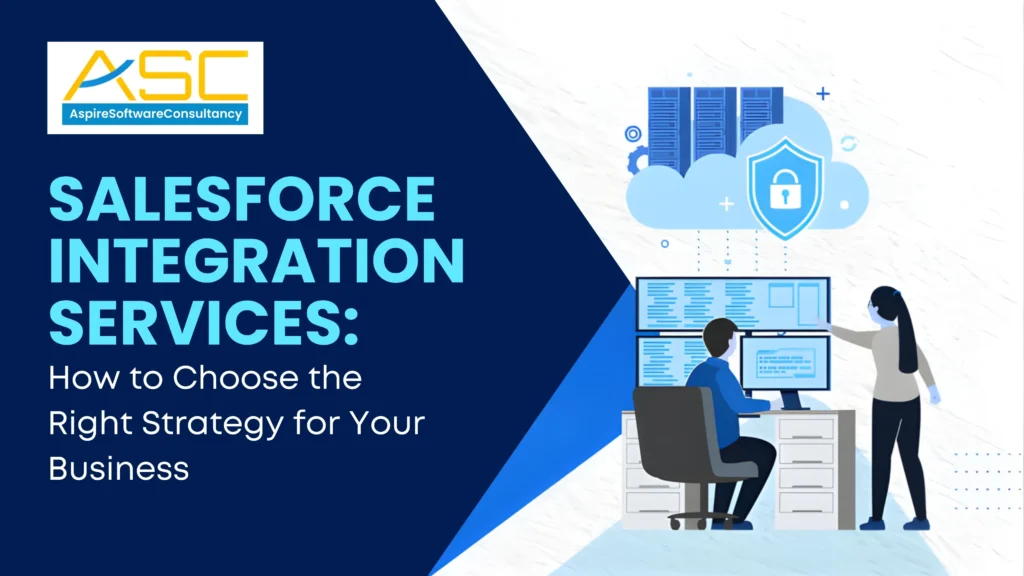
Illustration of Salesforce integration services connecting CRM with business applications for seamless data and workflow automation

Salesforce Integration Services: How to Choose the Right Strategy for Your Business

In today’s fast-paced digital landscape, businesses rely on multiple systems to manage operations, customer relationships, marketing, and sales. However, when these systems operate in silos, they create inefficiencies, data inconsistencies, and missed opportunities. This is where salesforce integration services become essential. At Aspire Software Consultancy, we help organizations streamline their workflows and unlock the full potential of their CRM through smart, scalable integration strategies. Choosing the right approach to integration is not just a technical decision—it’s a strategic move that directly impacts productivity, customer experience, and business growth. Why Salesforce Integration Matters Salesforce is a powerful CRM platform, but its true potential is realized when it seamlessly connects with other business applications such as ERP systems, marketing tools, accounting software, and customer support platforms. With the right salesforce crm integration services, businesses can: Eliminate data silos and ensure real-time data flow Improve decision-making with unified insights Automate workflows and reduce manual effort Enhance customer experience with consistent interactions Increase operational efficiency across departments Without proper integration, even the most advanced CRM can fall short of delivering expected results. Key Types of Salesforce Integration Before selecting a strategy, it’s important to understand the different types of integrations available: 1. Data Integration This focuses on synchronizing data between Salesforce and other systems. It ensures consistency and accuracy across platforms. 2. Process Integration Process integration automates workflows across applications—for example, automatically updating inventory in ERP when a deal is closed in Salesforce. 3. User Interface Integration This enables users to access multiple systems from a single interface, improving productivity and reducing the need to switch between platforms. 4. Real-Time vs Batch Integration Real-time integration ensures instant data updates Batch integration processes data at scheduled intervals Choosing between these depends on your business needs and operational priorities. How to Choose the Right Salesforce Integration Strategy Selecting the right integration strategy requires careful planning and alignment with your business goals. Here are the key factors to consider: 1. Define Your Business Objectives Start by identifying what you want to achieve with integration. Are you aiming to improve customer experience, streamline operations, or enhance reporting? Clear objectives will guide your integration approach. 2. Assess Your Existing Systems Evaluate your current technology stack, including ERP, marketing tools, and third-party applications. Understanding system compatibility is crucial for successful integration. 3. Choose the Right Integration Method There are several methods to integrate Salesforce: API-based integration for real-time data exchange Middleware platforms for complex integrations Custom integration tailored to specific business needs An experienced salesforce development company can help you decide the best approach based on your requirements. 4. Focus on Scalability Your integration strategy should support future growth. As your business expands, your systems should be able to handle increased data volume and complexity. 5. Ensure Data Security and Compliance Data protection is critical. Make sure your integration strategy includes robust security measures and complies with industry regulations. 6. Consider User Experience Integration should simplify workflows, not complicate them. Ensure that the solution enhances usability and improves employee productivity. Common Challenges in Salesforce Integration While integration offers significant benefits, it also comes with challenges: Data inconsistency and duplication Complex system architecture Integration downtime risks High implementation costs Lack of technical expertise Partnering with a reliable IT consulting company can help you overcome these challenges and ensure a smooth integration process. Best Practices for Successful Salesforce Integration To maximize the success of your integration, follow these best practices: Plan Thoroughly Define your integration roadmap, including timelines, resources, and expected outcomes. Use Standard APIs When Possible Standard APIs are more reliable, easier to maintain, and cost-effective. Prioritize Data Quality Clean and structured data is essential for effective integration. Test Before Deployment Conduct thorough testing to identify and resolve issues before going live. Monitor and Optimize Continuously monitor integration performance and make improvements as needed. Why Choose Aspire Software Consultancy At Aspire Software Consultancy, we offer end-to-end salesforce consulting services tailored to your business needs. Our expertise spans across industries, enabling us to deliver scalable and efficient integration solutions. As a trusted software consulting services provider, we specialize in: Custom Salesforce integrations Enterprise-grade solutions Seamless third-party application integration End-to-end support and maintenance Our approach combines technical excellence with business insights, ensuring that your integration strategy aligns with your long-term goals. Conclusion Choosing the right Salesforce integration strategy is critical for maximizing the value of your CRM investment. With the right approach, businesses can streamline operations, improve customer experiences, and drive growth. Aspire Software Consultancy stands as a reliable partner in delivering robust enterprise application development and integration solutions tailored to your unique needs. By leveraging expert guidance and proven methodologies, you can transform your Salesforce ecosystem into a powerful engine for business success. Frequently Asked Questions What are Salesforce integration services? Salesforce integration services connect Salesforce with other business applications to ensure seamless data flow and improved operational efficiency. Why does my business need Salesforce CRM integration services? It helps eliminate data silos, automate workflows, and provide a unified view of customer data, leading to better decision-making. How do I choose the right Salesforce integration strategy? Focus on your business goals, system compatibility, scalability, and security requirements. Consulting experts can help you make the right choice. What is the cost of Salesforce integration? The cost varies depending on complexity, number of systems, and customization requirements. Can Salesforce integrate with legacy systems? Yes, with the right tools and expertise, Salesforce can be integrated with legacy systems using APIs or middleware solutions. Facebook Instagram Youtube Linkedin X-twitter

Salesforce Integration Services: How to Choose the Right Strategy for Your Business Read More »

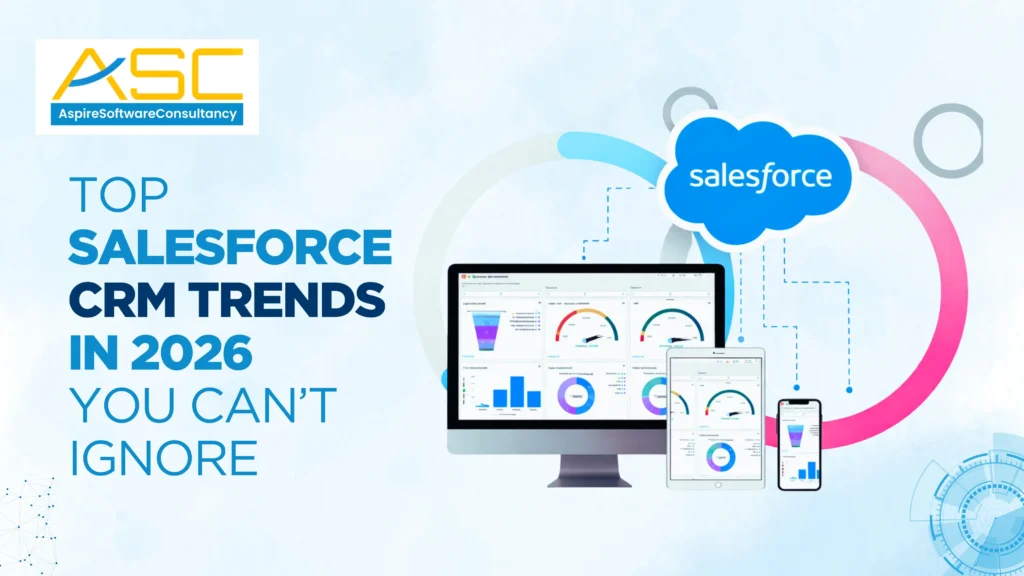
Top Salesforce CRM trends in 2026 including AI-powered CRM, automation, Salesforce integration services, and enterprise application development.

Top Salesforce CRM Trends in 2026 You Can’t Ignore

Customer expectations are evolving faster than ever, and businesses must adapt to stay competitive. In 2026, Salesforce CRM continues to lead digital transformation with advanced AI capabilities, automation, and deeper integrations. For companies looking to scale efficiently, staying updated with the latest Salesforce trends is no longer optional—it’s essential. At Aspire Software Consultancy, we help businesses leverage these innovations through expert salesforce consulting services and customized CRM solutions. Let’s explore the top Salesforce CRM trends shaping 2026. 1. AI-Powered CRM Takes Center Stage Artificial Intelligence is no longer a future concept—it’s a core component of modern CRM systems. Salesforce has significantly enhanced its AI capabilities, enabling businesses to predict customer behavior, automate workflows, and personalize interactions at scale. AI-driven insights allow sales and marketing teams to make smarter decisions in real time. From lead scoring to customer segmentation, AI improves efficiency across departments. Businesses partnering with a reliable Salesforce consulting partner can fully utilize these AI features to streamline operations and boost ROI. 2. Hyper-Personalization at Scale Customers now expect personalized experiences at every touchpoint. Salesforce CRM enables businesses to deliver tailored content, product recommendations, and communication based on real-time data. With advanced analytics and AI integration, companies can create highly targeted campaigns that resonate with their audience. This level of personalization helps improve customer engagement and retention. A trusted Salesforce implementation partner can help design and deploy personalized customer journeys aligned with your business goals. 3. Seamless Integration Across Platforms In 2026, businesses rely on multiple tools and platforms to manage operations. Salesforce integration services are becoming crucial to ensure smooth data flow between systems such as ERP, marketing automation, and eCommerce platforms. Seamless integration eliminates data silos, improves collaboration, and enhances decision-making. Whether it’s integrating third-party applications or legacy systems, having a strong integration strategy is key. Working with a professional salesforce development company ensures secure and efficient integration tailored to your business needs. 4. Low-Code and No-Code Development The demand for faster development cycles has led to the rise of low-code and no-code platforms within Salesforce. Businesses can now build applications, automate workflows, and customize CRM functionalities with minimal coding. This trend empowers non-technical users to contribute to digital transformation, reducing dependency on developers and accelerating project timelines. However, for complex requirements, partnering with a salesforce crm development company ensures scalability and performance without compromising quality. 5. Enhanced Data Security and Compliance With increasing data privacy regulations, businesses must prioritize data security. Salesforce continues to enhance its security features, offering robust data protection, compliance tools, and access controls. Organizations are focusing more on secure data management to build customer trust and avoid regulatory issues. A reliable Salesforce consulting services provider can help implement best practices for data security and ensure compliance with global standards. 6. Industry-Specific CRM Solutions Generic CRM solutions are being replaced by industry-specific Salesforce applications tailored to sectors like healthcare, finance, retail, and manufacturing. These solutions offer pre-built functionalities, reducing implementation time and improving efficiency. Businesses can address unique industry challenges more effectively with customized CRM systems. An experienced Salesforce implementation partner can deliver industry-focused solutions that align with your operational requirements. 7. Automation for Increased Productivity Automation continues to be a major trend in 2026. From sales processes to customer support, Salesforce enables businesses to automate repetitive tasks and focus on strategic activities. Automation improves productivity, reduces human errors, and enhances customer experience. Features like automated workflows, chatbots, and predictive analytics are transforming how businesses operate. By leveraging enterprise application development strategies, companies can integrate automation across their entire ecosystem for maximum efficiency. 8. Real-Time Analytics and Data-Driven Decisions Data is the backbone of modern business strategies. Salesforce provides powerful analytics tools that enable real-time reporting and insights. Businesses can monitor performance, track KPIs, and make informed decisions instantly. Real-time data helps organizations stay agile and respond quickly to market changes. A skilled Salesforce consulting partner can help you design dashboards and reporting systems tailored to your business objectives. 9. Mobile-First CRM Experience With the growing demand for remote work and on-the-go access, mobile CRM is becoming essential. Salesforce offers robust mobile capabilities that allow teams to manage tasks, access data, and communicate with customers from anywhere. Mobile-first strategies improve productivity and ensure that teams remain connected at all times. Partnering with a salesforce development company ensures optimized mobile experiences that align with your workflows. 10. Focus on Customer Experience (CX) Customer experience is now a key differentiator in competitive markets. Salesforce CRM helps businesses deliver seamless and consistent experiences across all channels. From sales to support, every interaction is tracked and optimized to improve customer satisfaction. A comprehensive approach combining Salesforce consulting services and enterprise application development ensures a unified and customer-centric strategy. Why Choose Aspire Software Consultancy? At Aspire Software Consultancy, we specialize in delivering end-to-end Salesforce solutions tailored to your business needs. As a trusted Salesforce consulting partner, we help organizations implement, customize, and optimize CRM systems for long-term success. Our expertise includes: Salesforce implementation and customization Salesforce integration services Enterprise application development Ongoing support and optimization We focus on delivering scalable, secure, and future-ready solutions that drive business growth. Frequently Asked Questions What are the key benefits of Salesforce CRM in 2026? Salesforce CRM offers AI-driven insights, automation, seamless integration, and enhanced customer experience, helping businesses improve efficiency and decision-making. Why should I hire a Salesforce consulting partner? A Salesforce consulting partner ensures proper implementation, customization, and optimization of CRM solutions tailored to your business needs. How do Salesforce integration services help businesses? They connect different systems, eliminate data silos, and enable smooth data flow, improving overall operational efficiency. Is Salesforce suitable for small businesses? Yes, Salesforce offers scalable solutions that can be customized for businesses of all sizes, including startups and SMEs. What is the role of AI in Salesforce CRM? AI helps automate processes, predict customer behavior, and provide actionable insights, enhancing overall business performance. Facebook Instagram Youtube Linkedin X-twitter

Top Salesforce CRM Trends in 2026 You Can’t Ignore Read More »

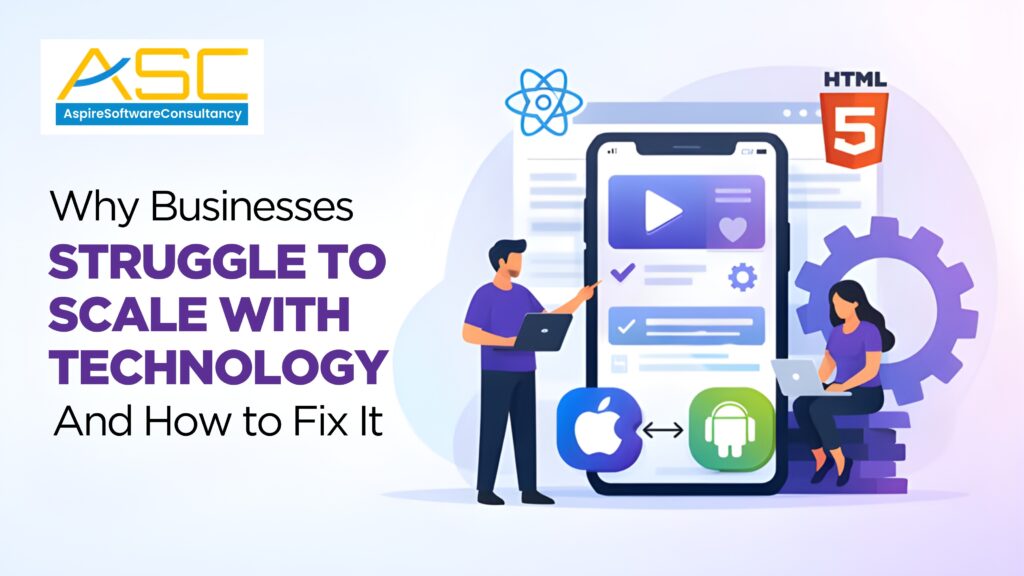
Illustration showing business growth challenges caused by poor technology strategy and how software consulting, system integration, and custom development help scale efficiently.

Why Businesses Struggle to Scale with Technology — And How to Fix It

In today’s digital-first world, technology is often seen as the key driver of business growth. Yet, many organizations find themselves stuck—unable to scale efficiently despite investing heavily in digital tools and platforms. The problem isn’t the lack of technology; it’s how it’s implemented and managed. At Aspire Software Consultancy, we’ve worked with businesses across industries and identified common challenges that prevent scalable growth. In this blog, we’ll explore why businesses struggle to scale with technology and how the right approach—supported by expert software consulting services—can solve these issues. The Real Reasons Businesses Fail to Scale with Technology 1. Lack of a Clear Technology Strategy Many companies adopt tools without a long-term vision. They invest in software based on trends rather than business needs. Without a structured roadmap, technology becomes fragmented, leading to inefficiencies instead of growth. An experienced IT consulting company helps align technology decisions with business goals, ensuring every investment contributes to scalability. 2. Over-Reliance on Off-the-Shelf Solutions Ready-made software can be quick to deploy, but it often lacks flexibility. As businesses grow, these systems struggle to adapt to evolving processes, leading to bottlenecks. This is where a custom software development company plays a crucial role. Tailored solutions are built around your workflows, making them scalable and future-ready. 3. Poor System Integration Businesses often use multiple tools—CRM, ERP, accounting software—but these systems don’t communicate effectively. This leads to data silos, duplication, and operational delays. Implementing enterprise application development and robust integration strategies ensures seamless data flow across systems, improving efficiency and decision-making. 4. Inefficient Use of CRM Platforms Many organizations invest in CRM platforms like Salesforce but fail to utilize their full potential. Without proper setup and integration, CRM systems become underperforming assets. With professional salesforce integration services, businesses can connect their CRM with marketing, sales, and support systems, unlocking real value and scalability. 5. Legacy Systems Holding Back Growth Outdated systems are one of the biggest barriers to scalability. They are slow, difficult to maintain, and incompatible with modern tools. Modernizing applications using dot net development services helps businesses upgrade their infrastructure, improve performance, and support future growth. 6. Lack of Technical Expertise Scaling technology requires specialized skills. Many businesses lack in-house expertise to manage complex systems, leading to poor implementation and missed opportunities. Partnering with a trusted software consulting services provider ensures access to experienced professionals who can guide your digital transformation. How to Fix These Challenges and Scale Successfully 1. Build a Scalable Technology Roadmap Start with a clear strategy aligned with your business goals. Identify gaps, prioritize investments, and plan for future growth. A reliable IT consulting company can help you create a roadmap that balances innovation, cost, and scalability. 2. Invest in Custom Solutions Where It Matters Not every business problem can be solved with generic software. Critical processes often require customization. Working with a custom software development company ensures your systems are tailored, flexible, and built for long-term scalability. 3. Focus on Seamless Integration Integration is key to operational efficiency. Ensure all your systems—CRM, ERP, and third-party tools—are connected. Using enterprise application development, businesses can create a unified ecosystem where data flows seamlessly across departments. 4. Optimize Your CRM Strategy A well-integrated CRM can transform customer experience and drive growth. By leveraging salesforce integration services, businesses can automate workflows, gain deeper insights, and improve customer engagement. 5. Modernize Legacy Systems Replacing or upgrading outdated systems is essential for scalability. Technologies like dot net development services provide robust, secure, and scalable solutions that support modern business needs. 6. Partner with the Right Technology Experts Technology alone doesn’t guarantee success—expertise does. Choosing the right software consulting services provider ensures you have the guidance, tools, and strategies needed to scale effectively. Why Choose Aspire Software Consultancy? At Aspire Software Consultancy, we specialize in helping businesses overcome scaling challenges through: Strategic software consulting services End-to-end enterprise application development Reliable salesforce integration services Scalable dot net development services Tailored solutions as a trusted custom software development company We focus on delivering solutions that are not only efficient today but also scalable for tomorrow. Final Thoughts Scaling a business with technology isn’t just about adopting new tools—it’s about using them strategically. With the right approach, expert guidance, and scalable solutions, businesses can turn technology into a powerful growth engine. If your business is struggling to scale, Aspire Software Consultancy is here to help you transform challenges into opportunities. Frequently Asked Questions Why do businesses struggle to scale with technology? Businesses often lack a clear strategy, use disconnected systems, rely on outdated software, or don’t have the right technical expertise. How can software consulting services help in scaling? Software consulting services provide strategic guidance, helping businesses choose, implement, and optimize technology for long-term growth. Is custom software better than off-the-shelf solutions? Custom software offers greater flexibility and scalability, making it ideal for businesses with unique or evolving requirements. What role does integration play in scalability? Integration ensures seamless communication between systems, reducing inefficiencies and enabling better decision-making. Why is Salesforce integration important? Salesforce integration connects customer data across platforms, improving customer experience and operational efficiency. Facebook Instagram Youtube Linkedin X-twitter

Why Businesses Struggle to Scale with Technology — And How to Fix It Read More »

Scroll to Top