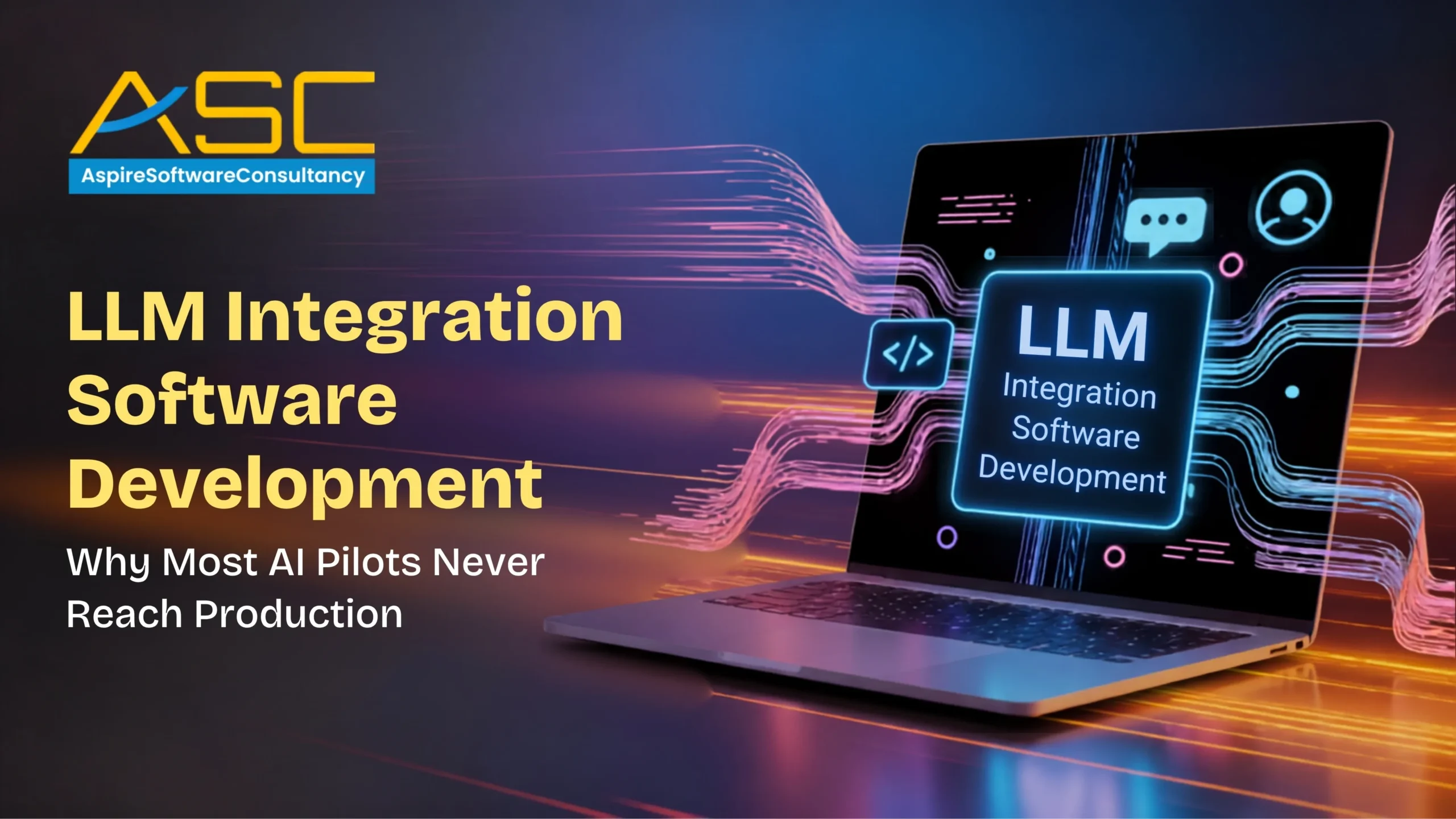
Most AI pilots never reach production. In fact, industry data shows the majority of generative AI projects stall before they create real value. The model usually works fine. However, the problem is the integration layer around it. LLM integration software development is what connects a model to your real business data your CRM, your documents, your internal tools. As a result, this connection layer decides whether your AI project survives past the demo stage.
Why AI Pilots Stall
Teams often build a quick prototype first. It looks impressive in a meeting. Then it hits real data, real users, and real security requirements and it breaks.
For example, a chatbot that performs well on sample questions often fails once it meets messy production data. Similarly, a prototype with no access controls cannot move into a regulated environment without major rework.
The fix is composable AI architecture. Instead of one large model trying to do everything, smaller task-specific models handle individual jobs. They pass structured context between each other. Therefore, each piece of the workflow gets handled by the right tool, not a generalist trying to do it all.
At Aspire Software Consultancy, we build this connective layer first. That’s what separates a working AI assistant from a demo that never ships. To see how this approach compares with traditional software architecture, this overview of legacy system displacement patterns from Martin Fowler is a useful reference point.
What Real LLM Integration Looks Like
Retrieval-Augmented Generation (RAG) development grounds your model in actual business data. Consequently, the AI stops guessing. It pulls real records and cites real sources.
Additionally, standardized connection protocols now make this easier. They let AI systems plug into your internal tools safely. As a result, you get AI copilots for software development that act on real information, not assumptions.
For instance, a sales team using a RAG-powered assistant can ask about a specific account and get an answer pulled directly from the CRM record, not a generic guess. Meanwhile, a support team can use the same approach to surface the right help article instantly, instead of searching manually.
Building for Scale and Security
Enterprise AI integration needs more than a working prototype. It also needs ongoing monitoring. Specifically, teams track model drift, output accuracy, and access permissions the same way they monitor any other production system. This practice is called LLMOps.
Furthermore, security cannot be an afterthought. Our AI and software development services follow this exact discipline from day one. We also build against community security standards, including the OWASP Top 10 for LLM Applications, which outlines the most common risks in LLM-powered systems today.
Choosing the Right Path Forward
Should you build custom LLM solutions or buy an off-the-shelf tool? Interestingly, the model rarely decides this. The surrounding system does.
Ask three questions instead. Can it handle your data securely? Can it scale with real usage? Will it stay maintainable once the initial excitement fades?
Ultimately, Aspire Software Consultancy helps you answer these questions before you build, not after. Our team has worked across industries to turn promising pilots into dependable production systems, and we bring that experience to every engagement. Talk to our team about your use case. Alternatively, browse our case studies to see this approach in action, or learn more about our team and how we work.
Frequently Asked Questions
Most pilots fail because the integration layer is missing or incomplete, not because the model itself is weak. A prototype often works on sample data but breaks once it meets real users, messy data, or strict security requirements. Production-ready systems need proper architecture, access controls, and ongoing monitoring built in from the start.
RAG stands for Retrieval-Augmented Generation. It lets a model pull real records from your own data before generating a response, instead of relying purely on what it learned during training. This reduces incorrect answers and lets the AI cite real sources, which is essential for enterprise use.
Timelines vary based on the complexity of your existing systems and the number of integrations required. A focused pilot can often be scoped in a few weeks, while a fully production-ready system with proper security, monitoring, and scaling usually takes longer. Aspire Software Consultancy can give you a realistic timeline after a short discovery call.
Aspire Software Consultancy starts with the integration layer first, not the model. This means mapping your data sources, security requirements, and target workflows before writing code. The result is an AI system built to scale, rather than a demo that needs to be rebuilt later. Get in touch with our team to discuss your specific use case.