

The manufacturing industry is undergoing a massive transformation driven by Artificial Intelligence (AI). From predictive maintenance to smart factories, AI is enabling manufacturers to improve efficiency, reduce operational costs, and deliver higher-quality products faster than ever before.
Today, manufacturers are integrating AI with technologies like Industrial IoT, robotics, machine learning, and data analytics to create intelligent production systems. According to industry research, AI adoption in manufacturing can increase productivity by up to 63% and reduce operational costs by around 20%.
At Aspire Software Consultancy, we help organizations adopt modern technologies such as AI, machine learning, and intelligent automation to transform their manufacturing processes and build smarter production systems.
In this blog, we explore how AI is transforming the manufacturing industry, including key benefits, real-world use cases, and emerging trends shaping the future of smart manufacturing.
The Rise of AI in Manufacturing
Manufacturing companies generate massive amounts of data from machines, sensors, and production systems. Traditionally, analyzing this data manually was difficult and time-consuming. AI solves this challenge by processing large volumes of data in real time and generating actionable insights.
AI-driven manufacturing systems can:
- Monitor machine performance
- Predict equipment failures
- Detect product defects automatically
- Optimize supply chains
- Improve workforce productivity
As a result, smart factories powered by AI are becoming the foundation of Industry 4.0 and the future Industry 5.0 revolution.
Studies show that over 74% of manufacturing plants worldwide already use AI for automation, demonstrating how quickly the technology is being adopted.
Technology partners like Aspire Software Consultancy support manufacturers in implementing AI-powered solutions that streamline operations and drive digital transformation.
Key Benefits of AI in Manufacturing
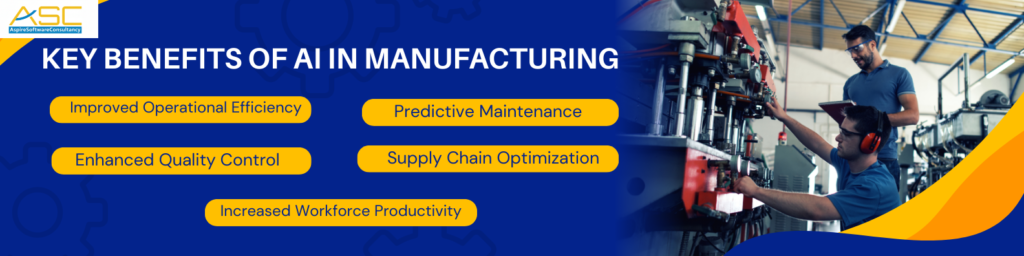
1. Improved Operational Efficiency
AI helps manufacturers optimize production processes by analyzing real-time data from machines and equipment. Intelligent systems can identify inefficiencies and recommend improvements instantly.
For example, AI-driven process optimization can increase overall equipment effectiveness by 12–15%, leading to higher production output.
Benefits include:
- Faster production cycles
- Reduced downtime
- Improved machine utilization
- Better production planning
2. Predictive Maintenance
One of the most valuable applications of AI in manufacturing is predictive maintenance.
Instead of waiting for machines to break down, AI systems analyze sensor data and detect early signs of equipment failure.
This allows manufacturers to:
- Schedule maintenance before breakdowns
- Avoid costly downtime
- Extend equipment lifespan
Research shows AI predictive analytics can forecast equipment failures with 85–90% accuracy and reduce downtime by up to 30%.
Organizations working with technology partners like Aspire Software Consultancy can implement predictive maintenance solutions that help reduce operational risks and maintenance costs.
3. Enhanced Quality Control
Quality control is a critical aspect of manufacturing, and AI significantly improves defect detection.
Computer vision systems powered by AI inspect products during production and identify defects that humans might miss.
AI-based visual inspection systems can achieve up to 99.9% accuracy in defect detection, ensuring higher product quality and reducing waste.
Benefits include:
- Automated defect detection
- Reduced product recalls
- Lower manufacturing waste
- Improved customer satisfaction
4. Supply Chain Optimization
Supply chain disruptions can severely impact manufacturing operations. AI helps companies manage supply chains more effectively by forecasting demand and optimizing inventory levels.
AI-powered supply chain solutions can:
- Predict product demand
- Optimize logistics routes
- Reduce inventory costs
- Improve delivery times
Some studies indicate AI-driven supply chain systems can reduce excess inventory by up to 35%.
5. Increased Workforce Productivity
AI is not replacing human workers—it is augmenting them.
Smart tools like AI assistants, augmented reality guidance, and automation systems help workers perform tasks faster and with greater accuracy.
AI-powered training systems can reduce training time by 30–50% while improving workforce productivity and safety.
Key AI Use Cases in Manufacturing
AI is already being applied across multiple areas of manufacturing operations. Here are some of the most impactful use cases.
1. Predictive Maintenance Systems
Manufacturers use AI algorithms to monitor equipment health and predict potential failures.
Sensors collect real-time data such as:
- Temperature
- Vibration
- Pressure
AI models analyze this data and alert technicians before a breakdown occurs. This approach helps manufacturers avoid expensive production interruptions.
2. AI-Powered Quality Inspection
Computer vision and machine learning systems inspect products during production.
These systems detect:
- Scratches
- Surface defects
- Assembly errors
- Color inconsistencies
Many manufacturers have reduced defects significantly by deploying AI-powered visual inspection systems.
3. Smart Production Scheduling
AI helps manufacturers optimize production schedules by analyzing:
- Machine availability
- Workforce allocation
- Material supply
- Customer demand
Machine learning models can prevent nearly 42% of production line faults by optimizing production planning.
4. Autonomous Robotics and Cobots
AI-powered robots are increasingly being used in modern factories to handle repetitive and hazardous tasks.
Collaborative robots (cobots) work alongside human employees to improve efficiency and safety.
These robots can perform tasks such as:
- Assembly
- Packaging
- Welding
- Material handling
5. AI-Based Demand Forecasting
Demand forecasting is another area where AI provides significant value.
Machine learning models analyze historical sales data, market trends, and seasonal patterns to predict future demand accurately.
AI-enabled demand forecasting can improve forecast accuracy by around 50%, allowing manufacturers to plan production more efficiently.
Future Trends of AI in Manufacturing
AI adoption in manufacturing is expected to grow rapidly in the coming years. Several emerging trends are shaping the future of the industry.
1. Smart Factories
Smart factories integrate AI, IoT, robotics, and cloud computing to create fully connected manufacturing environments.
These factories use real-time data to automatically optimize production processes.
2. Digital Twins
Digital twin technology creates virtual replicas of physical machines and production lines.
Manufacturers can simulate production processes, test improvements, and detect potential problems before implementing changes in real operations.
3. Generative AI in Product Design
Generative AI is transforming product design by automatically generating multiple design options based on engineering requirements.
This technology helps companies accelerate product development and reduce time-to-market.
4. Sustainable Manufacturing
AI also helps manufacturers improve sustainability by optimizing energy consumption and reducing waste.
For example, AI-driven energy optimization systems can significantly reduce industrial carbon emissions and energy costs.
Challenges of AI Adoption in Manufacturing
Despite its benefits, implementing AI in the manufacturing industry comes with challenges.
Common challenges include:
- High implementation costs
- Lack of skilled AI professionals
- Data security concerns
- Integration with legacy systems
However, as technology evolves and AI tools become more accessible, these challenges are gradually decreasing.
Companies partnering with experienced technology providers such as Aspire Software Consultancy can overcome these challenges and successfully implement AI-powered manufacturing solutions.
Conclusion
Artificial Intelligence is revolutionizing the manufacturing industry by enabling smarter, faster, and more efficient production processes. From predictive maintenance and quality control to smart supply chains and autonomous robots, AI is reshaping how factories operate.
Companies that adopt AI-driven manufacturing solutions gain a competitive advantage through improved productivity, reduced costs, and higher product quality.
At Aspire Software Consultancy, we help organizations leverage advanced technologies like AI, machine learning, and automation to build intelligent manufacturing systems and accelerate digital transformation.
As technologies like smart factories, digital twins, and generative AI continue to evolve, the future of manufacturing will become increasingly intelligent and automated.
Organizations that embrace AI today will be better positioned to lead the next wave of industrial innovation.
Frequently asked questions
AI in manufacturing refers to the use of artificial intelligence technologies such as machine learning, computer vision, and data analytics to automate processes, improve efficiency, and optimize production systems.
AI improves manufacturing efficiency by analyzing real-time data from machines and production systems to identify inefficiencies, predict maintenance needs, and optimize workflows.
Some key applications of AI in manufacturing include predictive maintenance, quality inspection using computer vision, demand forecasting, supply chain optimization, and autonomous robotics.
Smart factories are advanced manufacturing environments that use AI, IoT, automation, and data analytics to create connected production systems that can monitor, analyze, and optimize operations in real time.
AI helps manufacturers improve operational efficiency, reduce downtime, enhance product quality, optimize supply chains, and increase overall productivity.