

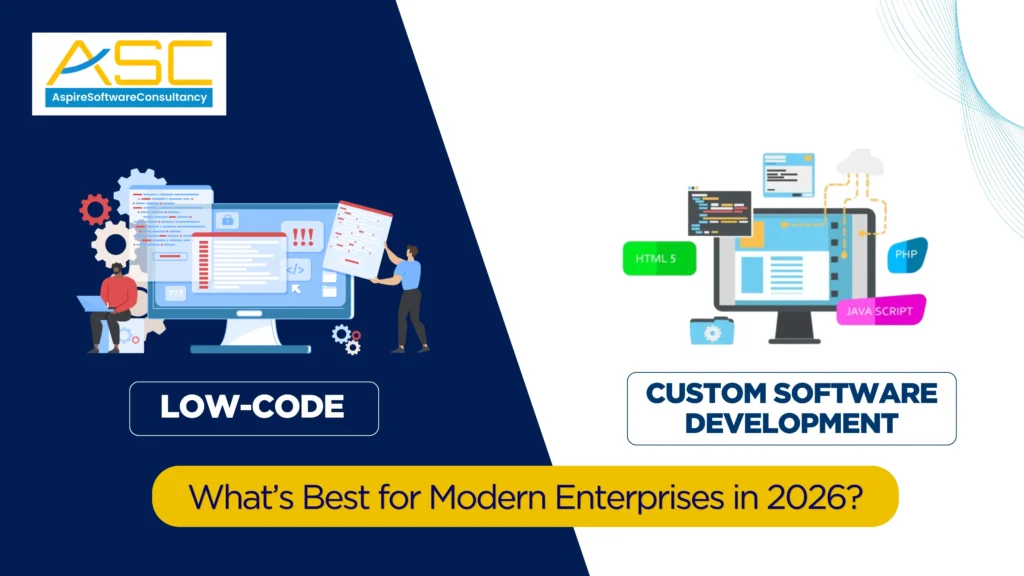
Low Code vs Custom Software Development: What’s Best for Modern Enterprises in 2026?
In 2026, businesses are under constant pressure to innovate faster, improve customer experiences, and streamline operations through technology. As organizations continue accelerating their digital transformation strategies, one important decision stands out: should they choose low code development platforms or invest in fully customized software solutions? Both approaches offer unique advantages, but selecting the right one depends on your business goals, scalability needs, budget, and long term vision. At Aspire Software Consultancy, we help enterprises evaluate the best technology approach through expert software consulting services and scalable development solutions. In this blog, we’ll explore the differences between low code and custom software development, their benefits, limitations, and which option is best suited for modern enterprises in 2026. What Is Low Code Development? Low code development is a software development approach that uses visual interfaces, drag and drop components, and pre built templates to create applications with minimal manual coding. Modern low code development platforms allow businesses to quickly build applications for workflow automation, CRM management, customer portals, reporting dashboards, and more. Popular low code platforms include: Microsoft Power Apps Salesforce Lightning Platform Mendix OutSystems Appian These platforms are gaining popularity because they significantly reduce development time and simplify deployment. What Is Custom Software Development? Custom software development involves designing and building applications specifically tailored to an organization’s business processes and goals. Unlike generic platforms, custom solutions are fully flexible and scalable. A professional custom software development company creates software that aligns with unique operational requirements, integrations, security standards, and future growth plans. Custom development is commonly used for: Enterprise ERP systems Healthcare platforms Banking and fintech applications E commerce platforms AI driven business systems Advanced CRM and ERP integrations At Aspire Software Consultancy, our team specializes in enterprise application development and scalable business software solutions designed for long term success. Key Differences Between Low Code and Custom Development Feature Low Code Development Custom Software Development Development Speed Faster Longer development cycle Flexibility Limited customization Fully customizable Scalability Moderate High scalability Cost Lower initial cost Higher upfront investment Maintenance Platform managed Fully controlled by business Integration Platform dependent Unlimited integration capabilities Security Standardized security Advanced custom security Ownership Vendor/platform controlled Full ownership Benefits of Low Code Development Platforms 1. Faster Development and Deployment One of the biggest advantages of low code solutions is speed. Businesses can launch applications within weeks instead of months. This is ideal for: MVP development Internal business tools Workflow automation Temporary business solutions For enterprises looking to quickly adapt to changing market demands, low code can be highly effective. 2. Reduced Development Costs Low code platforms reduce coding effort, which lowers initial development costs. Organizations with limited budgets can still modernize operations without hiring large engineering teams. This makes low code attractive for startups and mid sized businesses. 3. Easier Business User Participation Many low code platforms allow non technical users to contribute to application development. Business teams can: Create workflows Modify forms Automate processes Build dashboards This improves collaboration between technical and non technical departments. Limitations of Low Code Development While low code platforms offer convenience, they also come with important limitations. Limited Customization Complex business requirements may exceed platform capabilities. Enterprises often face restrictions when trying to implement advanced features. Vendor Dependency Businesses depend heavily on the platform provider for pricing, updates, and support. Scalability Challenges As business operations grow, low code applications may struggle with performance, architecture flexibility, and large scale integrations. Security and Compliance Concerns Industries like healthcare, banking, and insurance often require advanced compliance frameworks that low code platforms may not fully support. Benefits of Custom Software Development 1. Complete Flexibility Custom software is built specifically for your business requirements. A trusted software development consultancy ensures that every feature, workflow, and integration aligns with your operational goals. This flexibility becomes critical for enterprises with complex business processes. 2. Better Scalability for Enterprise Growth Custom applications can scale alongside business growth. Whether you are adding new users, expanding services, or integrating AI capabilities, custom architecture supports long term scalability. This is especially important for large enterprises investing in future ready systems. 3. Advanced Security and Compliance Security remains a top priority in 2026. Custom built solutions provide: Role based access control Advanced encryption Custom compliance frameworks Enterprise grade authentication Secure API integrations A professional custom .NET development company can build secure enterprise solutions using modern Microsoft technologies and cloud infrastructure. 4. Seamless Integration Capabilities Modern enterprises rely on multiple platforms such as Salesforce, ERP systems, HR software, payment gateways, and analytics tools. Custom development enables seamless integrations across all business systems without platform limitations. When Should Businesses Choose Low Code? Low code development works best when: Speed is the top priority Budget is limited The application is relatively simple Internal workflow automation is needed Minimal customization is required Rapid prototyping is important Examples include: Employee management tools Approval workflows Reporting dashboards Customer support portals When Should Businesses Choose Custom Software Development? Custom development is the better option when: Business processes are highly complex Scalability is essential Security and compliance are critical Long term ROI matters Advanced integrations are required Competitive differentiation is important Industries such as finance, healthcare, logistics, manufacturing, and enterprise SaaS often benefit more from custom solutions. The Hybrid Approach: The Future of Enterprise Development In 2026, many enterprises are adopting a hybrid approach that combines low code platforms with custom software development. For example: Low code for internal workflows Custom APIs for advanced integrations Custom AI modules connected to low code systems Enterprise grade backend with low code front end tools This balanced strategy allows businesses to improve speed while maintaining scalability and flexibility. At Aspire Software Consultancy, we help organizations identify the right mix of technologies based on their business objectives. How Aspire Software Consultancy Helps Enterprises As a trusted provider of software consulting services, Aspire Software Consultancy delivers tailored development strategies for modern businesses. Our expertise includes: Enterprise software architecture Salesforce development and integration Custom .NET application development Cloud based enterprise solutions CRM and ERP integrations AI powered
Low Code vs Custom Software Development: What’s Best for Modern Enterprises in 2026? Read More »