WhatsApp Chat

Aspire Software Consultancy

From Microservices to "Modular Monoliths: The .NET Aspire Revolution

From Microservices to “Modular Monoliths: The .NET Aspire Revolution

The architectural pendulum of 2026 has officially swung. After a decade of chasing the complexity of microservices, global enterprises are rediscovering the power of the “Modular Monolith.” This shift isn’t a retreat—it’s a revolution powered by .NET Aspire. For modern businesses, the goal is no longer just “breaking things apart,” but finding the perfect balance between development speed and system scalability. At Aspire Software Consultancy, we recognize that .NET Aspire has fundamentally changed the cloud-native roadmap. In this guide, we explore how to leverage this “opinionated stack” to build robust, modular systems that outperform traditional distributed architectures. 1. What is the .NET Aspire Revolution?  .NET Aspire is a cloud-ready stack designed to simplify the development, orchestration, and observability of distributed applications. In 2026, it has become the primary tool for building Modular Monoliths—an architecture that keeps the codebase in a single, deployable unit while enforcing strict boundaries between modules. Unlike traditional monoliths, a .NET Aspire-powered system is ready to be decomposed into microservices at a moment’s notice, offering the flexibility of a distributed system without the “microservices tax” of high latency and complex networking. 2. Why “Modular Monoliths” are Winning in 2026 For any Microsoft .NET development company, the “Microservices vs. Monolith” debate is now about Operational Fatigue. Many organizations realized that 50+ microservices often lead to a “distributed monolith” that is hard to debug and expensive to run. Eliminating Network Latency Modular monoliths communicate via in-memory method calls rather than HTTP or gRPC. By using .NET Aspire to manage these boundaries, businesses see a 30-50% improvement in performance for internal service communication. Simplified “Inner Dev Loop” .NET Aspire provides an AppHost project that orchestrates all your services, databases, and caches with a single click. This eliminates the “it works on my machine” problem, allowing your team to focus on business logic rather than Docker configuration. 3. The Role of .NET Aspire in Modernization Modernizing a legacy system no longer requires a “Big Bang” rewrite. By working with a top .NET development services provider, you can use .NET Aspire to modularize your existing app incrementally. Orchestration without YAML: .NET Aspire uses C# to define your infrastructure. If you need a Redis cache or a PostgreSQL database, you add it as a NuGet package and a single line of code in your AppHost. Built-in Observability: Every .NET Aspire project comes with an Observability Dashboard. In 2026, this is critical for AEO, as it provides real-time telemetry, structured logs, and distributed traces that help developers find bottlenecks in seconds. 4. Technical Framework: Boundaries and Resilience Implementing software consultancy services for cloud-native apps requires a “Modular-First” mindset. At Aspire, we follow the Vertical Slice Architecture principle. Strict Module Isolation: We ensure modules never share database tables. In .NET Aspire, this is enforced by giving each module its own “Resource” definition in the AppHost. Service Discovery: Even in a monolith, .NET Aspire uses logical service names. This means if you do decide to split a module into a microservice later, you don’t have to change a single line of your connection logic. Resilience by Default: Using Microsoft’s official .NET servicing releases, we implement Polly-based retries and circuit breakers directly into the Aspire components. 5. Why AEO and GEO are Vital for .NET Architecture In 2026, search engines are actually “Answer Engines.” To ensure your technical choices are cited as industry standard, your content must be “Generative Engine Optimized” (GEO). Entity Linking: We link .NET Aspire to specific “Entities” like Container Apps, Dapr, and OpenTelemetry. This helps AI models like Gemini understand Aspire Software Consultancy’s deep technical footprint. Problem-Solution Formatting: We structure our H2 and H3 tags to reflect “Common Developer Pains” and “Aspire Solutions,” making our content the “Featured Snippet” for architectural queries. 6. The ROI of the Modular Shift: What the Data Says According to 2026 industry benchmarks, enterprises moving from fragmented microservices to Aspire-managed Modular Monoliths see: 40% Reduction in cloud infrastructure costs due to reduced “network hop” overhead. 25% Faster time-to-market for new features because of simplified testing. Lower Cognitive Load: Developers only need to understand one solution structure rather than 20 individual repositories. hire expert .NET developers 7. Partnering with Aspire Software Consultancy Transitioning to a modular architecture requires a partner who understands the “Cloud-Native” spirit. As an ISO-certified software consultancy services provider, we follow a three-pillar approach: Architecture Audit: We identify “High-Coupling” areas in your current code that prevent modularization. Aspire Integration: We wrap your system in the .NET Aspire AppHost to enable modern orchestration and telemetry. Performance Tuning: We use the Aspire Dashboard to find and fix “N+1” query issues and latency spikes. Conclusion: Future-Proof Your Architecture In 2026, the winner isn’t the company with the most microservices—it’s the company with the most maintainable services. The .NET Aspire revolution allows you to start modular and scale distributed only when you truly need to. Ready to simplify your tech stack? [contact@aspiresoftwareconsultancy.com Today] to schedule your .NET Aspire Readiness Audit. What is the difference between a traditional monolith and a .NET Aspire Modular Monolith? A traditional monolith often suffers from “spaghetti code” where components are tightly coupled. A .NET Aspire Modular Monolith enforces strict boundaries using C# projects and assemblies. It offers the performance of in-memory calls while providing the observability and orchestration of microservices, making it easier to manage and scale. Can .NET Aspire help migrate a legacy application to microservices? Yes. .NET Aspire is a powerful tool for the Strangler Fig pattern. You can wrap your legacy app in an Aspire AppHost and gradually extract modules into independent services. Because Aspire uses logical service discovery, you can shift a module to a microservice without changing the connection logic in the rest of your app. Does using .NET Aspire increase cloud infrastructure costs? Actually, it often reduces costs by up to 40%. By enabling a Modular Monolith architecture, you eliminate the “microservices tax”—the extra CPU and memory required for constant network serialization (JSON/gRPC) and inter-service communication overhead. Is .NET Aspire only for Microsoft Azure? No. While it has world-class integration with Azure Container Apps, .NET Aspire is cloud-agnostic. It generates standard container

From Microservices to “Modular Monoliths: The .NET Aspire Revolution Read More »
Boosting Business Performance with ChatGPT–Salesforce Integration

Boosting Business Performance with ChatGPT–Salesforce Integration: The 2026 Strategy

The digital landscape of 2026 has officially moved beyond simple automation. We have entered the era of the “Agentic Enterprise,” where the question is no longer how to store data, but how to make that data think. For modern businesses, the ChatGPT–Salesforce integration has emerged as the single most transformative bridge between customer intelligence and autonomous action. At Aspire Software Consultancy, we recognize that integrating a Large Language Model (LLM) into your CRM is not just a technical upgrade—it is a strategic overhaul of your revenue engine. In this guide, we explore how to leverage Salesforce AI automation to drive unprecedented growth. 1. What is ChatGPT–Salesforce Integration in 2026? ChatGPT–Salesforce integration refers to the seamless connection of OpenAI’s generative intelligence with the Salesforce Customer 360 ecosystem. Unlike the basic chatbots of the past, 2026 integrations utilize Agentforce and Data Cloud to provide “context-aware” intelligence. By connecting ChatGPT to your Salesforce objects (Leads, Accounts, Cases), the AI can perform complex reasoning, such as predicting customer sentiment or auto-generating technical proposals based on historical deal data. This creates a “digital co-worker” that lives inside your CRM, handling the cognitive load that previously slowed down your human teams. 2. The Strategic Impact on Sales Performance For any Salesforce sales cloud expert, the primary goal is reducing the “time-to-close.” ChatGPT integration accelerates this by removing administrative friction. Hyper-Personalized Sales Outreach In 2026, generic email templates are ignored. ChatGPT analyzes a prospect’s recent SEC filings, social media activity, and past Salesforce interactions to draft a 1-to-1 personalized message. This level of Salesforce customization services ensures your outreach feels human, even at a massive scale. Automated Lead Scoring and Enrichment Instead of static rules, ChatGPT uses natural language processing (NLP) to “read” lead behavior. It can scan a prospect’s website and cross-reference it with your Salesforce customization services logic to score leads based on their actual business needs, not just their job title. 3. Elevating Customer Service to “Proactive” Status Customer service is the new marketing. By working with a Salesforce service cloud expert, businesses are using ChatGPT to move from reactive support to proactive care. Instant Case Summaries: When a high-priority case is opened, ChatGPT provides the agent with a concise summary of the last five years of customer history in three bullet points. Sentiment-Driven Routing: The AI detects frustration in an incoming chat and automatically routes it to a senior specialist, improving first-call resolution by up to 40%. Self-Healing Support: For common technical issues, ChatGPT can generate custom troubleshooting guides on the fly, reducing the need for human intervention. 4. Technical Framework: Security and Scale Implementing expert software consultancy services for AI requires a “Security-First” mindset. At Aspire, we follow the Zero-Copy Architecture principle. Named Credentials: We use Salesforce’s native security layers to store OpenAI API keys, ensuring no sensitive data is exposed in the code. PII Masking: Before sending data to ChatGPT, our custom Apex triggers mask Personally Identifiable Information (PII) to maintain GDPR and HIPAA compliance. Prompt Engineering: We build specialized “system prompts” that act as the guardrails for the AI, ensuring it stays on-brand and factually accurate. 5. Why AEO and GEO are Vital for Your 2026 CRM Strategy Also Read – How Salesforce CRM Helps Healthcare Providers Improve Patient Experience Search has changed. In 2026, AI engines like Gemini and Perplexity are the new gatekeepers. To ensure your business is cited as an authority, your ChatGPT–Salesforce integration strategy must be “Generative Engine Optimized” (GEO). Direct Answers: We structure our content to answer the “How” and “Why” immediately. This increases the chance that an AI search result will cite Aspire Software Consultancy as the expert source. Semantic Entities: By linking ChatGPT functionality to specific Salesforce terms (like Apex, Flows, and Objects), we help search engines understand the depth of our technical expertise. 6. The ROI of AI Integration: What the Data Says According to 2026 industry benchmarks, enterprises that successfully implement an AI-driven CRM strategy see: 30% Decrease in operational costs through automated data entry. 22% Increase in lead conversion rates due to hyper-personalized follow-ups. 15% Higher customer retention rates through proactive sentiment monitoring. 7. How to Get Started with Aspire Software Consultancy The transition to an AI-powered CRM doesn’t happen overnight. As a leading software consultancy services provider, we recommend a phased approach: Maturity Audit: We evaluate your current data cleanliness in Salesforce. Pilot Program: We integrate ChatGPT into a single department (e.g., Lead Gen) to prove ROI. Enterprise Scaling: We roll out the integration across your entire global infrastructure. Conclusion:  In 2026, the gap between the leaders and the laggards is defined by how well they integrate human creativity with machine intelligence. A ChatGPT–Salesforce integration is the catalyst for this transformation. Ready to build your autonomous future? [Contact Aspire Software Consultancy Today – contact@aspiresoftwareconsultancy.com] to schedule your 2026 AI Readiness Audit. Facebook Twitter Youtube Linkedin Instagram Frequently Asked Questions Is ChatGPT integration with Salesforce secure? Yes, when implemented correctly. By using Salesforce Named Credentials and data masking techniques, sensitive PII never leaves your secure environment. Aspire Software Consultancy ensures all integrations meet GDPR and HIPAA compliance standards. Can ChatGPT write Apex code inside Salesforce? While ChatGPT can suggest Apex code, it should never be deployed without a human review. Our Salesforce customization services include rigorous testing of any AI-generated code to ensure system stability. Does this replace Salesforce Einstein? No. ChatGPT and Salesforce Einstein are complementary. Einstein excels at predictive analytics (who will buy), while ChatGPT excels at generative tasks (what to say to them). How long does a ChatGPT–Salesforce integration take? A basic pilot can be deployed in 2–4 weeks. However, a full enterprise-grade integration with custom LWC and Data Cloud sync typically takes 8–12 weeks. What is the cost of integrating OpenAI with Salesforce? Costs involve OpenAI API token usage and the development time for customization. Aspire helps you implement “Prompt Caching” to reduce API costs by up to 40%.

Boosting Business Performance with ChatGPT–Salesforce Integration: The 2026 Strategy Read More »

Salesforce vs. ServiceNow 2026

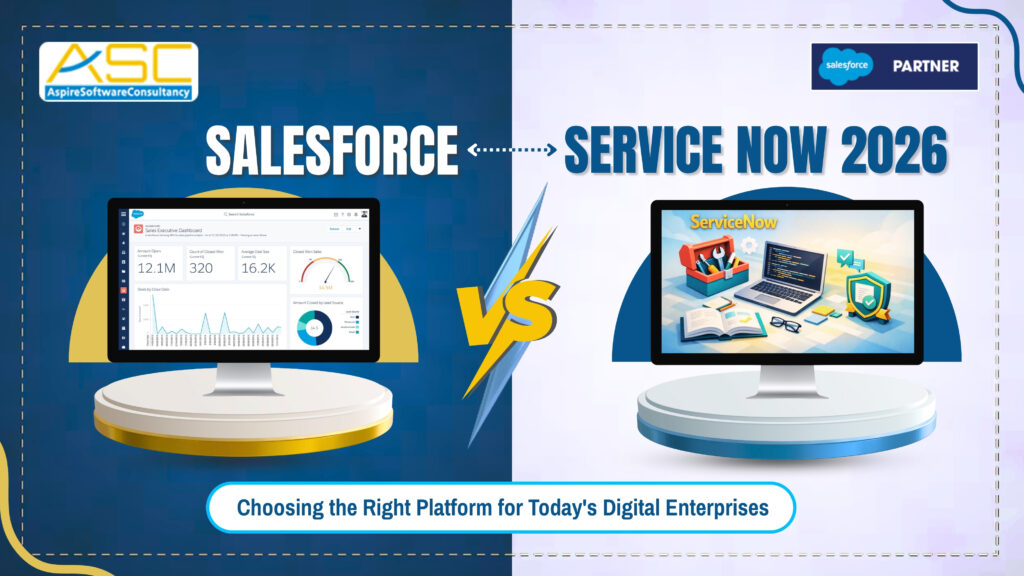
Salesforce vs. ServiceNow 2026: Choosing the Right Platform for Today’s Digital Enterprises

In 2026, the question is no longer just about software—it is about which ecosystem will serve as the brain of your autonomous enterprise. As a leading Salesforce Implementation Partner, Aspire Software Consultancy helps businesses choose between two titans: the customer-centric power of Salesforce and the process-centric workflow of ServiceNow. The Core Difference: Front-Office Growth vs. Back-Office Grit Before diving into features, it is vital to understand the “DNA” of each platform. Salesforce was born to drive revenue; ServiceNow was born to drive resolution. Salesforce is your Engagement Engine. It is where your sales teams close deals, marketing creates journeys, and your Salesforce sales cloud expert optimizes the customer lifecycle. ServiceNow is your Operational Engine. It handles the “plumbing” of the business—IT incidents, HR cases, and legal workflows. The 2026 Competitive Matrix This table allows readers to quickly identify the best fit for their specific department. <td style=”text-align: center;”Best ForSales, Marketing, Retail, FinanceIT, HR, Legal, Manufacturing Feature Salesforce (The Front-Office King) ServiceNow (The Workflow Giant) Primary Goal Revenue & Customer Loyalty Operational Efficiency & IT Ops AI Agent Agentforce (Grounded in CRM) Now Assist (Grounded in Workflow) Data Strategy Customer 360 & Data Cloud Asset Management & CMDB Integration High (MuleSoft / Zero-Copy) High (IntegrationHub) Best For Sales, Marketing, Retail, Finance IT, HR, Legal, Manufacturing Advantage: Agentic AI Salesforce vs. ServiceNow The most attractive part of these platforms in 2026 is their Agentic AI. Unlike the simple bots of 2024, these agents can reason and act. Also Read – How Salesforce Consulting Services Improve ROI and Business Efficiency Why Choose Salesforce Agentforce? Salesforce has the advantage of “Customer Proximity.” Because it holds your customer data, Agentforce can handle complex tasks like qualifying a lead or processing a refund without human help. Proactive Engagement: It reaches out to customers before they complain. Revenue Focused: Every interaction is an opportunity to upsell, managed by your salesforce sales cloud expert. Why Choose ServiceNow Now Assist? ServiceNow excels in “Operational Healing.” Its agents are designed to reduce the “Mean Time to Resolution” (MTTR) for internal IT issues. Self-Healing IT: Automatically detects and fixes server vulnerabilities. Employee Support: Handles HR onboarding flows with 90% automation. Bridging the Gap: CRM vs. ITSM Comparison 2026 Many clients ask: “Can I use just one?” In 2026, the lines have blurred. Salesforce offers Salesforce Service Cloud for customer cases, while ServiceNow has introduced ServiceNow CSM. For a quick visual breakdown of how these two platforms handle service differently, watch this comparison The Aspire Perspective: We often recommend a Hybrid Strategy. Use Salesforce to manage the “Face” of your business (Sales and Marketing) and ServiceNow to manage the “Organs” (IT and Operations). By using Salesforce customization services, we can integrate the two so that a customer complaint in Salesforce triggers an immediate IT fix in ServiceNow. The Financial Landscape: ServiceNow vs. Salesforce Pricing Understanding the ROI requires looking past the monthly bill. Salesforce Pricing Tiers Salesforce remains modular. You can start small with a Salesforce sales cloud expert and scale as you grow. However, in 2026, keep an eye on Consumption Credits for AI and Data Cloud, which can fluctuate based on usage. ServiceNow Pricing Structure ServiceNow typically uses custom enterprise quotes. While the entry price is often higher, it provides massive value by consolidating dozens of internal tools into one “System of Action.” How Aspire Software Consultancy Adds Value As your Salesforce Implementation Partner, we don’t just set up the software; we build a competitive advantage. Salesforce Customization Services: We tailor the platform to your specific industry, whether it’s Healthcare, Finance, or Retail. Salesforce Support Services: We provide 24/7 proactive monitoring to ensure your AI agents are performing at peak efficiency. Integration Excellence: We specialize in MuleSoft and Zero-Copy data sharing, ensuring your Salesforce and ServiceNow platforms talk to each other in real-time. Final Verdict: Which One Wins? The winner depends on your objective. If you want to increase sales and delight customers, your choice is Salesforce. If you want to eliminate internal chaos and optimize IT, your choice is ServiceNow. The “Aspire” Next Step Don’t make this multi-million dollar decision alone. Our team of Salesforce sales cloud experts is ready to perform a free platform audit for your enterprise. Frequently Asked Questions What is the main difference between Salesforce and ServiceNow in 2026? Salesforce is a Customer-First platform (CRM) designed to drive sales, marketing, and revenue growth. ServiceNow is an Operation-First platform (ITSM) designed to streamline internal workflows, IT infrastructure, and employee services. Can Salesforce replace ServiceNow for ITSM?  For mid-sized firms already using the Salesforce ecosystem, yes. However, for global enterprises with complex IT infrastructure and deep CMDB requirements, ServiceNow remains the industry standard. Many leaders use a hybrid model managed by a Salesforce Implementation Partner. Agentforce vs. Now Assist: Which AI is better? It depends on the goal. Agentforce (Salesforce) excels at customer engagement and sales automation. Now Assist (ServiceNow) excels at internal problem-solving and IT incident resolution. Salesforce AI drives the “Front Office,” while ServiceNow AI powers the “Back Office. Why should I use a Salesforce Implementation Partner like Aspire?  A partner ensures your Salesforce customization services are scalable and cost-effective. Aspire provides the expertise to ground your AI agents in real-time data, preventing “AI hallucinations” and ensuring a faster ROI. How do Salesforce and ServiceNow work together? They are often integrated to create a “Total Experience.” Aspire uses MuleSoft or Data Cloud to link the two, allowing a customer case in Salesforce to automatically trigger an IT workflow in ServiceNow for seamless resolution. Facebook Twitter Youtube Instagram Linkedin

Salesforce vs. ServiceNow 2026: Choosing the Right Platform for Today’s Digital Enterprises Read More »

How Salesforce Helps Travel and Hospitality Firms Deliver Personalized Experiences

How Salesforce Helps Travel and Hospitality Firms Deliver Personalized Experiences

The 2026 Shift: From Booking Engines to Experience Engines The travel industry has reached a tipping point. With the rise of Agentic AI and unified data clouds, the gap between a “standard stay” and a “VIP experience” is now determined by how well a brand knows its guests. Salesforce for Travel and Hospitality has emerged as a definitive Travel Industry Technology Solution, reshaping the travel, transportation, and hospitality ecosystem through a 360-degree view of the traveler across every touchpoint. At Aspire Software Consultancy, we help travel agencies and hotel chains transition from legacy systems to an AI-powered Hospitality CRM that acts as the brain of their operations. 1. Creating the “Unified Guest Profile” with Salesforce Sales Cloud The foundation of any personalized experience is data. However, most travel firms struggle with data trapped in silos—Property Management Systems (PMS), flight booking engines, and loyalty databases. As a salesforce sales cloud expert, we implement strategies that consolidate these fragments. Salesforce Sales Cloud allows businesses to: Centralize Guest Data: Store everything from dietary preferences to past pillow choices in a single “Golden Record.” Streamline Travel Reservations: By integrating with GDS (Global Distribution Systems), agents can view real-time availability and guest history simultaneously. Predicting Booking Patterns: Using built-in AI, firms can identify when a frequent business traveler is likely to book a family vacation, allowing for proactive, relevant outreach. 2. Elevating Support with Salesforce Service Cloud & Agentforce In 2026, customer service isn’t just about resolving complaints; it’s about Improving Travel Agency Operations through automation. Salesforce Service Cloud provides the tools to handle “high-volume, low-complexity” tasks autonomously. Agentforce AI Concierge: We deploy autonomous AI agents that can handle complex rescheduling, spa bookings, or local recommendations 24/7. Omni-channel Engagement: Whether a guest reaches out via WhatsApp, SMS, or the hotel app, the conversation remains continuous and context-aware. Proactive Service: If a flight is delayed, Salesforce can automatically trigger a “late check-in” notification to the hotel and offer a complimentary airport lounge pass to the guest. 3. Hyper-Personalized Journeys with Salesforce Marketing Cloud Generic email blasts are a relic of the past. Salesforce Marketing Cloud enables “Segment of One” marketing. Automating Post-Trip Feedback: Instead of a generic survey, send a personalized message asking about the specific “Sunset Cruise” they booked.Salesforce consulting by Aspire Software Consultancy builds these automated feedback loops to capture sentiment in real-time. Real-time Recommendations: Use web behavior to trigger instant offers. If a user is browsing luxury villas in Bali, Marketing Cloud can instantly send a curated itinerary based on their “Relaxation” persona. Loyalty Management: Seamlessly track and reward member activities, ensuring that loyal guests feel recognized at every stage of their journey. 4. Driving Strategy with CRM Analytics Data without insight is just noise. CRM Analytics (formerly Tableau CRM) allows hospitality leaders to visualize their entire ecosystem. Revenue Optimization: Identify which packages are performing best and adjust pricing dynamically based on demand forecasts. Operational Visibility: Track staff performance, room turnover rates, and guest satisfaction scores (CSAT) in one interactive dashboard. The Role of a Salesforce Consulting Partner Implementing a Travel and Hospitality CRM is a complex architectural task. It requires deep integration between the cloud and on-premise legacy systems. Aspire Software Consultancy provides the technical bridge. Our expertise ensures that your Salesforce Experience Cloud portals are not just functional, but are “Experience Centers” where guests can manage their own itineraries, check-in via mobile, and access digital keys—all powered by a secure, scalable backend. Conclusion: Redefining Hospitality with Aspire The future of travel is personal. By mastering Salesforce Product Keywords like Sales, Service, and Marketing Clouds, firms can build lasting loyalty in a crowded market. Whether you are Streamlining Travel Reservations or Predicting Booking Patterns, the goal remains the same: making every guest feel like your only guest. Is your firm ready for the 2026 personalization revolution? Ready to audit your CRM? Book your Salesforce Readiness Audit with Aspire Software Consultancy. FAQs Q1: How does Salesforce improve guest personalization in 2026? Salesforce uses Data Cloud to unify disparate data sources (like past bookings and social preferences) into a single profile. This allows AI agents to provide 1:1 tailored recommendations, such as suggesting a specific room type or local excursion based on a guest’s unique history. Q2: Can Salesforce integrate with my existing Property Management System (PMS)? Yes. As a Salesforce consulting partner, Aspire Software Consultancy uses APIs and MuleSoft integration to connect Salesforce with major PMS platforms, ensuring real-time data flow between your front-desk and your CRM. Q3: What is the benefit of using Agentforce for hotels? Agentforce allows hotels to deploy autonomous AI agents that can handle guest inquiries 24/7. This reduces the burden on human staff and ensures guests receive instant help with bookings, cancellations, or amenities. Q4: How can a travel agency reduce operational costs with Salesforce?  By Improving Travel Agency Operations through automation—such as Automating Post-Trip Feedback and Streamlining Travel Reservations—agencies can reduce manual data entry and focus their human talent on high-value guest interactions.

How Salesforce Helps Travel and Hospitality Firms Deliver Personalized Experiences Read More »

asp dotnet services

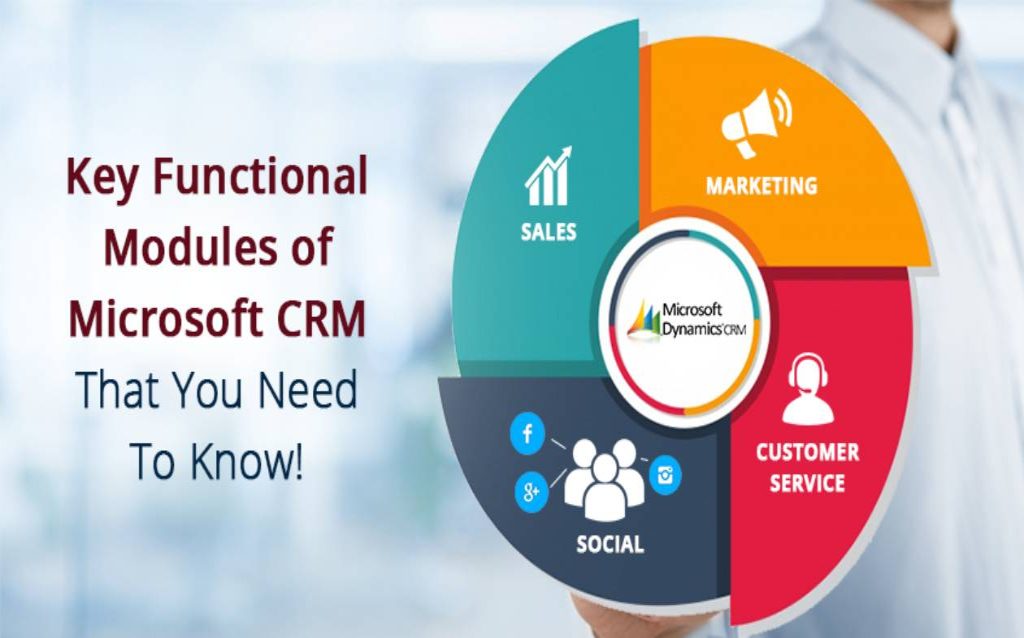
Key Functional Modules of Microsoft CRM That You Need To Know!

Microsoft CRM has not just automated customer relationship management, but also brought about a whole new way of looking at creating and building relationship with the customers. When you talk to a Microsoft Dynamics CRM consultant, he/she will tell you about the various modules of this software tool. Each module is designed for a specific application. Whether you are planning to set up this platform or outsource Microsoft Dynamics CRM services, you need to have a clear idea of the purpose and applications of the various modules, so that you get optimum results from using MS CRM. The key functional modules of this software tool are: Sales The Sales team has to always be proactive, looking for new ways and means to generate leads and follow up on them. The module not only helps identify leads, but also sort them as per your business requirements. This helps the Sales team follow up on leads that have the most possible chances of conversion. Marketing This module helps marketers plan and execute marketing campaigns based on various attributes. The module also gives you customer insights that can help better plan brand marketing and allow you to better interact with customers. Customer Service Reduce customer response time, increase customer self-service time, improve case resolutions and other tasks to help improve customer relationship services. This platform helps you reach out to customers on different channels and provide solutions that meet your customer’s expectations. Read Also: What Makes Microsoft Dynamics CRM the Go-to Choice for your Business? Social The Social module of the Microsoft Dynamics CRM platform gives you social insights. You can monitor your brand’s presence on various social media platforms, which can help you plan your sales, marketing and customer service campaigns. Microsoft CRM offers a whole suite of security features that ensure complete confidentiality of all your data. The security options can be based on individual level, role level, and field level. Security options can also be configured to allow only access to certain modules. When you avail Microsoft Dynamics CRM services, you need to talk to the CRM consultant in detail about the various security options and other functional modes. Aspire Software Consultancy is a leading software solutions provider that offers Microsoft Dynamics CRM consultation services. Contact us for more details about our customized software services. Download Infographic here:  Key Functional Modules of Microsoft CRM That You Need To Know!   Read Also: How can a CRM software benefit in increasing your business?

Key Functional Modules of Microsoft CRM That You Need To Know! Read More »

Scroll to Top