WhatsApp Chat

Author name: Mallikarjuna B

WhatsApp Integration with Salesforce

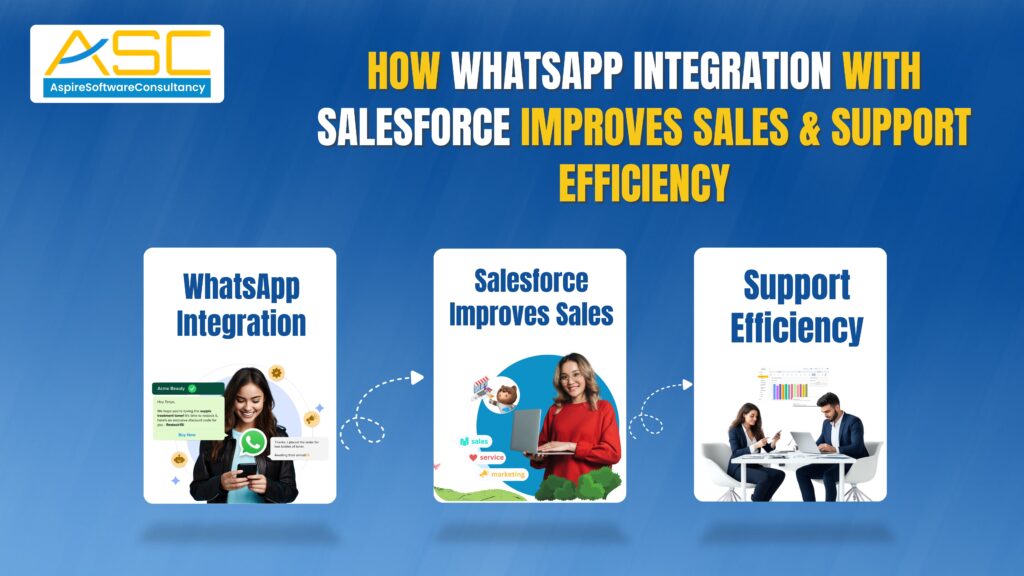
How WhatsApp Integration with Salesforce Improves Sales & Support Efficiency

In 2026, the gap between a “lead” and a “customer” is measured in seconds, not hours. For businesses aiming to stay competitive, meeting customers where they live—on WhatsApp—is no longer optional. However, the true magic happens when you bridge that conversation with the world’s #1 CRM. As a certified Salesforce consulting partner, Aspire Software Consultancy has seen firsthand how integrating WhatsApp with Salesforce transforms fragmented chats into high-velocity revenue engines. In this guide, we explore how this synergy redefines efficiency for sales and support teams. Why Integrate WhatsApp with Salesforce? WhatsApp boasts over 3 billion active users with open rates exceeding 98%. Compare that to the 20% average open rate of emails. By leveraging a Salesforce Implementation Partner, businesses can pipe these high-engagement conversations directly into their Salesforce Sales Cloud or Service Cloud environments. The Problem with “Siloed” Conversations Without integration, WhatsApp chats live on individual agent phones. This leads to: Data Loss: Critical customer insights never reach the CRM. Security Risks: Business intelligence stays on personal devices. Delayed Responses: Lack of automation means leads go cold. Boosting Sales Velocity with Salesforce Sales Cloud Expert Insights When your sales team has the power of a Salesforce sales cloud expert behind them, WhatsApp becomes a lead-conversion machine. 1. Instant Lead Capture & Nurturing Through salesforce app development, you can create “Click-to-WhatsApp” ads that instantly trigger a new Lead record in Salesforce. Automated Welcome: As soon as a lead messages, a Salesforce flow sends an immediate, personalized greeting. Contextual Selling: Reps see the lead’s entire history (previous purchases, website visits) right inside the WhatsApp chat panel. 2. Accelerating the Deal Cycle Using Salesforce customization services, you can automate quote approvals or meeting reminders via WhatsApp. Real-world Impact: Businesses using WhatsApp for sales reported a 35% faster closing rate in 2025 due to the immediacy of the channel. Enhancing Support with Salesforce Service Cloud Expertise A salesforce service cloud expert knows that modern support is about “Case Deflection” and “First Contact Resolution (FCR).” 1. AI-Powered Chatbots & Agentforce With the 2026 rollout of Agentforce, your WhatsApp integration can handle 70% of routine queries—like order tracking or password resets—without human intervention. If the issue is complex, the AI seamlessly hands it off to a live agent with the full chat transcript. 2. Unified Omni-Channel Console Agents don’t have to switch tabs. Whether a customer reaches out via email, phone, or WhatsApp, it all appears in one unified Service Console. Comparison: Salesforce Sales Cloud vs. Service Cloud for WhatsApp Understanding which cloud to prioritize depends on your business goals. Aspire Software Consultancy helps you decide based on these key differences: Feature Salesforce Sales Cloud Focus Salesforce Service Cloud Focus Primary Goal Lead Generation & Conversion Issue Resolution & CSAT Key Object Leads & Opportunities Cases & Knowledge Articles Automation Outbound drip campaigns Inbound AI-bot deflection KPIs Win Rate, Pipeline Velocity Average Handle Time (AHT), FCR Messaging Proactive Sales Outreach Reactive Customer Support The Architecture: Why You Need a Salesforce Implementation Partner Integration isn’t just about “plug and play.” To rank as one of the best software development companies, we focus on a robust architecture that scales. Salesforce App Development & Customization A standard integration might send messages, but Salesforce customization services allow you to: Trigger-Based Alerts: Send a WhatsApp notification when a high-value Opportunity stage changes. Media-Rich Messaging: Send PDFs, invoices, and product videos directly from Salesforce records. Compliance & Opt-In: Ensure your business stays compliant with global data privacy laws (GDPR/CCPA) by managing WhatsApp opt-ins directly in the CRM. Why “Near Me” Matters for Salesforce Consulting When searching for a Salesforce consulting partner, many businesses look for “software development companies near me” to ensure timezone alignment and local industry expertise. Aspire Software Consultancy offers a global reach with the personalized touch of a local agency, ensuring your Salesforce implementation is tailored to your regional market nuances. Conclusion: Transform Your Growth with Aspire Software Consultancy The integration of WhatsApp and Salesforce is the ultimate force multiplier for your team. By reducing friction and centralizing data, you empower your employees to focus on what matters: building relationships. As your Salesforce Implementation Partner, Aspire Software Consultancy is ready to help you deploy a system that doesn’t just work—it wins. Also Read More – Common Salesforce Integration Challenges and How to Solve Them frequently asked questions Can I send bulk WhatsApp messages from Salesforce? Yes, using Salesforce Marketing Cloud or third-party apps developed through Salesforce app development, you can run broadcast campaigns while maintaining compliance. Do I need a WhatsApp Business API for Salesforce integration? Absolutely. To ensure professional features and CRM syncing, an official API connection is required, which Salesforce consulting partners can help you set up. How does WhatsApp integration improve Service Cloud efficiency? It reduces “phone tag” by allowing asynchronous communication and uses AI bots for instant case deflection.

How WhatsApp Integration with Salesforce Improves Sales & Support Efficiency Read More »

Why Businesses Choose Aspire Software Consultancy for Custom Software Development Solutions

Why Businesses Choose Aspire Software Consultancy for Custom Software Development Solutions

Software Development Services Offered by AspireIn today’s digital-first world, businesses need software that is tailored to their unique processes, goals, and growth plans. Off-the-shelf software often fails to address specific business challenges, which is why many organizations turn to custom software development solutions. Choosing the right software development company plays a crucial role in building scalable, efficient, and secure digital solutions. Among the many custom software development companies, Aspire Software Consultancy stands out as a trusted technology partner for businesses looking to innovate and scale. Aspire Software Consultancy delivers reliable software development services that help organizations automate operations, enhance productivity, and improve customer experiences. From startups to large enterprises, companies rely on Aspire for advanced, scalable, and cost-effective digital solutions. In this blog, we explore why Aspire Software Consultancy is considered one of the best software development companies for businesses seeking powerful and tailored technology solutions. Understanding Custom Software Development What is Custom Software Development? Custom software development refers to the process of designing, developing, deploying, and maintaining software applications specifically built to meet a company’s unique business requirements. Unlike generic software, custom software development solutions are tailored to address specific workflows, integrations, and operational challenges. Key advantages include: Personalized features based on business needs Better system integration with existing tools Improved security and scalability Enhanced efficiency and automation Businesses searching for software development companies near me often prioritize firms that provide flexible and customized solutions rather than one-size-fits-all products. Why Businesses Choose Aspire Software Consultancy 1. Expertise in Custom Software Development Solutions Aspire Software Consultancy has extensive experience delivering innovative custom software development solutions for various industries. The company focuses on building software that aligns perfectly with business goals while ensuring scalability and performance. Their development approach includes: Requirement analysis and business consultation UI/UX-focused design and development Agile development methodologies Continuous testing and quality assurance This approach ensures that businesses receive software tailored to their operations, making Aspire one of the top software development companies trusted by global clients. 2. Comprehensive Software Development Services One of the key reasons businesses choose Aspire is its wide range of software development services. Aspire provides end-to-end solutions that cover the entire software lifecycle, from concept to deployment and ongoing support. Their services include: Custom web application development Enterprise software development Mobile application development CRM and ERP development Cloud-based software solutions API development and system integrations As a full-service software development agency, Aspire helps businesses streamline operations and accelerate digital transformation. 3. Experienced Development Team A strong development team is essential when selecting among the best software development companies. Aspire Software Consultancy has a highly skilled team of developers, engineers, designers, and project managers who specialize in modern technologies and frameworks. The team has experience working with technologies such as: Artificial Intelligence and Machine Learning Cloud Computing Salesforce Development Web and Mobile Technologies Data Analytics and Automation This expertise enables Aspire to deliver reliable and future-ready software solutions that support long-term business growth. 4. Industry-Focused Solutions Businesses across industries require specialized software tailored to their operational needs. Aspire Software Consultancy develops industry-specific custom software development solutions for sectors such as: Manufacturing Healthcare Retail and E-commerce Finance and Banking Logistics and Supply Chain Education and EdTech By understanding industry challenges and workflows, Aspire creates solutions that help businesses improve efficiency and achieve measurable results. 5. Scalable and Future-Ready Technology Modern businesses require technology solutions that can evolve as the company grows. Aspire focuses on building scalable software architectures that support future expansion and technological advancements. Benefits of scalable software include: Easy integration with new technologies Support for growing user bases Faster system performance Reduced long-term operational costs This scalability is one reason why Aspire is often recommended among top software development companies for growing businesses. 6. Customer-Centric Development Approach Successful software development depends on understanding the client’s business objectives and challenges. Aspire Software Consultancy follows a collaborative approach where clients are actively involved throughout the development process. Their client-focused process includes: Understanding business requirements Designing tailored software architecture Agile development and continuous feedback Testing and quality assurance Deployment and post-launch support This transparent process ensures that clients receive high-quality custom software development solutions aligned with their goals. How Aspire Stands Out Among Software Development Companies When businesses search online for software development companies near me, they often compare multiple providers based on expertise, reliability, and project success. Aspire Software Consultancy stands out due to: Proven experience in custom software development Skilled developers and technology experts Client-focused development process Scalable and secure technology solutions Long-term support and maintenance These factors make Aspire a reliable software development company for organizations looking to modernize their digital infrastructure. The Importance of Choosing the Right Software Development Agency Selecting the right software development agency can determine the success of a digital transformation initiative. A trusted development partner can help businesses: Build tailored technology solutions Improve operational efficiency Enhance customer experiences Stay competitive in the digital marketplace Aspire Software Consultancy provides strategic guidance and technical expertise to help businesses achieve their digital goals effectively. Future of Custom Software Development The demand for custom software development solutions continues to grow as businesses adopt new technologies such as: Artificial Intelligence Cloud Computing Internet of Things (IoT) Data Analytics Automation Companies that invest in tailored digital solutions are better positioned to innovate and compete in the modern digital economy. Aspire Software Consultancy helps businesses stay ahead by building intelligent software solutions designed for future growth. Conclusion As businesses increasingly rely on digital solutions, the need for reliable custom software development companies continues to rise. Aspire Software Consultancy has established itself as a trusted software development company by delivering innovative, scalable, and customized technology solutions. With its experienced team, comprehensive software development services, and client-focused approach, Aspire helps businesses transform their operations and achieve sustainable growth. Organizations looking for one of the best software development companies can rely on Aspire Software Consultancy to build powerful digital solutions that drive long-term success. frequently asked questions What is custom software development? Custom software development is

Why Businesses Choose Aspire Software Consultancy for Custom Software Development Solutions Read More »

How AI is Transforming the Manufacturing Industry: Key Benefits, Use Cases, and Future Trends

How AI is Transforming the Manufacturing Industry: Key Benefits, Use Cases, and Future Trends

The manufacturing industry is undergoing a massive transformation driven by Artificial Intelligence (AI). From predictive maintenance to smart factories, AI is enabling manufacturers to improve efficiency, reduce operational costs, and deliver higher-quality products faster than ever before. Today, manufacturers are integrating AI with technologies like Industrial IoT, robotics, machine learning, and data analytics to create intelligent production systems. According to industry research, AI adoption in manufacturing can increase productivity by up to 63% and reduce operational costs by around 20%. At Aspire Software Consultancy, we help organizations adopt modern technologies such as AI, machine learning, and intelligent automation to transform their manufacturing processes and build smarter production systems. In this blog, we explore how AI is transforming the manufacturing industry, including key benefits, real-world use cases, and emerging trends shaping the future of smart manufacturing. The Rise of AI in Manufacturing Manufacturing companies generate massive amounts of data from machines, sensors, and production systems. Traditionally, analyzing this data manually was difficult and time-consuming. AI solves this challenge by processing large volumes of data in real time and generating actionable insights. AI-driven manufacturing systems can: Monitor machine performance Predict equipment failures Detect product defects automatically Optimize supply chains Improve workforce productivity As a result, smart factories powered by AI are becoming the foundation of Industry 4.0 and the future Industry 5.0 revolution. Studies show that over 74% of manufacturing plants worldwide already use AI for automation, demonstrating how quickly the technology is being adopted. Technology partners like Aspire Software Consultancy support manufacturers in implementing AI-powered solutions that streamline operations and drive digital transformation. Key Benefits of AI in Manufacturing 1. Improved Operational Efficiency AI helps manufacturers optimize production processes by analyzing real-time data from machines and equipment. Intelligent systems can identify inefficiencies and recommend improvements instantly. For example, AI-driven process optimization can increase overall equipment effectiveness by 12–15%, leading to higher production output. Benefits include: Faster production cycles Reduced downtime Improved machine utilization Better production planning 2. Predictive Maintenance One of the most valuable applications of AI in manufacturing is predictive maintenance. Instead of waiting for machines to break down, AI systems analyze sensor data and detect early signs of equipment failure. This allows manufacturers to: Schedule maintenance before breakdowns Avoid costly downtime Extend equipment lifespan Research shows AI predictive analytics can forecast equipment failures with 85–90% accuracy and reduce downtime by up to 30%. Organizations working with technology partners like Aspire Software Consultancy can implement predictive maintenance solutions that help reduce operational risks and maintenance costs. 3. Enhanced Quality Control Quality control is a critical aspect of manufacturing, and AI significantly improves defect detection. Computer vision systems powered by AI inspect products during production and identify defects that humans might miss. AI-based visual inspection systems can achieve up to 99.9% accuracy in defect detection, ensuring higher product quality and reducing waste. Benefits include: Automated defect detection Reduced product recalls Lower manufacturing waste Improved customer satisfaction 4. Supply Chain Optimization Supply chain disruptions can severely impact manufacturing operations. AI helps companies manage supply chains more effectively by forecasting demand and optimizing inventory levels. AI-powered supply chain solutions can: Predict product demand Optimize logistics routes Reduce inventory costs Improve delivery times Some studies indicate AI-driven supply chain systems can reduce excess inventory by up to 35%. 5. Increased Workforce Productivity AI is not replacing human workers—it is augmenting them. Smart tools like AI assistants, augmented reality guidance, and automation systems help workers perform tasks faster and with greater accuracy. AI-powered training systems can reduce training time by 30–50% while improving workforce productivity and safety. Key AI Use Cases in Manufacturing AI is already being applied across multiple areas of manufacturing operations. Here are some of the most impactful use cases. 1. Predictive Maintenance Systems Manufacturers use AI algorithms to monitor equipment health and predict potential failures. Sensors collect real-time data such as: Temperature Vibration Pressure AI models analyze this data and alert technicians before a breakdown occurs. This approach helps manufacturers avoid expensive production interruptions. 2. AI-Powered Quality Inspection Computer vision and machine learning systems inspect products during production. These systems detect: Scratches Surface defects Assembly errors Color inconsistencies Many manufacturers have reduced defects significantly by deploying AI-powered visual inspection systems. 3. Smart Production Scheduling AI helps manufacturers optimize production schedules by analyzing: Machine availability Workforce allocation Material supply Customer demand Machine learning models can prevent nearly 42% of production line faults by optimizing production planning. 4. Autonomous Robotics and Cobots AI-powered robots are increasingly being used in modern factories to handle repetitive and hazardous tasks. Collaborative robots (cobots) work alongside human employees to improve efficiency and safety. These robots can perform tasks such as: Assembly Packaging Welding Material handling 5. AI-Based Demand Forecasting Demand forecasting is another area where AI provides significant value. Machine learning models analyze historical sales data, market trends, and seasonal patterns to predict future demand accurately. AI-enabled demand forecasting can improve forecast accuracy by around 50%, allowing manufacturers to plan production more efficiently. Future Trends of AI in Manufacturing AI adoption in manufacturing is expected to grow rapidly in the coming years. Several emerging trends are shaping the future of the industry. 1. Smart Factories Smart factories integrate AI, IoT, robotics, and cloud computing to create fully connected manufacturing environments. These factories use real-time data to automatically optimize production processes. 2. Digital Twins Digital twin technology creates virtual replicas of physical machines and production lines. Manufacturers can simulate production processes, test improvements, and detect potential problems before implementing changes in real operations. 3. Generative AI in Product Design Generative AI is transforming product design by automatically generating multiple design options based on engineering requirements. This technology helps companies accelerate product development and reduce time-to-market. 4. Sustainable Manufacturing AI also helps manufacturers improve sustainability by optimizing energy consumption and reducing waste. For example, AI-driven energy optimization systems can significantly reduce industrial carbon emissions and energy costs. Challenges of AI Adoption in Manufacturing Despite its benefits, implementing AI in the manufacturing industry comes with challenges. Common challenges include: High implementation

How AI is Transforming the Manufacturing Industry: Key Benefits, Use Cases, and Future Trends Read More »

Digital Transformation 2026

Navigating Digital Transformation 2026: The Strategic Guide to Enterprise Engineering and Consulting

In the rapidly evolving landscape of 2026, digital transformation has moved past simple “migration.” We are now in the era of Agentic AI, zero-copy data architecture, and hyper-scalable cloud ecosystems. For modern enterprises, the challenge is no longer just “going digital”—it is about staying agile, secure, and integrated. As a leading software consulting company, Aspire Software Consultancy understands that the backbone of this agility lies in choosing the right technology stack and the right delivery model. Whether you are looking for .NET application development in the USA to secure local expertise or seeking offshore .NET development services to optimize costs, your strategy must be data-driven and future-proof. The Evolution of the Enterprise Stack: Why .NET and Angular Lead the Way Modern web and enterprise applications require a robust backend and a highly responsive frontend. This is why dot net core development services and angular consulting company expertise remain the most sought-after combinations in 2026. 1. High-Performance .NET Core Development Services With the release of .NET 10 and 11, the framework has reached unprecedented levels of performance. For any dot net application development company, the focus has shifted toward: latest .NET core development services standards Cloud-Native Microservices: Building modular applications that scale horizontally. AI-Native Frameworks: Using ML.NET and Semantic Kernel to bake AI directly into your business logic. Zero-Trust Security: Implementing identity-first security protocols as a standard. 2. Angular Consulting: Building the 2026 User Experience As a premier angular consulting company, we’ve seen the framework evolve to support Server-Side Rendering (SSR) and Hydration at scale. This ensures that enterprise dashboards aren’t just powerful, but also lightning-fast, providing the real-time data visualization required by modern executives. Global Delivery Models: Onshore vs. Offshore .NET Development One of the most critical decisions a CTO makes is where the engineering happens. Aspire Software Consultancy bridges this gap by offering a hybrid approach. The Case for .NET Application Development in the USA When projects require deep architectural discovery, complex compliance (like HIPAA or SOC2), and real-time collaboration, .NET application development in the USA provides the proximity and cultural alignment necessary for success. Local teams are essential for high-stakes software consulting company engagements where strategy is as important as code. Optimizing with Offshore .NET Development Services Conversely, scaling a large-scale product requires resources. Our offshore .NET development services provide a 40–60% cost advantage without sacrificing quality. By choosing a reputable dot net application development company with global delivery centers, you benefit from “follow-the-sun” development cycles—where your project progresses 24/7. Dominating the CRM Landscape: Dynamics 365 and Salesforce In 2026, your CRM is no longer just a database; it is an AI-driven “Reasoning Engine.” Connecting your CRM to the rest of your tech stack is where the true ROI is found. 1. Strategic Dynamics 365 Consultancy Microsoft Dynamics 365 has become the dominant player in the Cloud ERP and CRM space. Our dynamics 365 consultancy services focus on: Business Central Integration: Unifying your finance and operations. Copilot Orchestration: Training AI agents to automate routine sales and service tasks. Data Cloud Synergy: Ensuring your ERP data flows seamlessly into Power BI for real-time insights. 2. Salesforce Development and Integration Excellence As a top-tier salesforce development company, we recognize that Salesforce is now an “Agentic Workforce” platform. The launch of Agentforce has changed the game. However, these tools are only effective if they are integrated. Businesses today need to hire salesforce integration services to: Connect Salesforce to legacy ERP systems via MuleSoft. Unify customer data through Salesforce Data Cloud. Build custom Lightning Web Components (LWC) that provide unique business value. The Role of a Modern Software Consulting Company Why partner with a software consulting company rather than just a staffing firm? In 2026, the complexity of the “Integrated Enterprise” requires more than just hands on keyboards. It requires: Topical Authority: Deep knowledge in specific frameworks, such as dot net core development services. Holistic Integration: Understanding how a salesforce development company‘s work impacts your dynamics 365 consultancy roadmap. Scalable Talent: The ability to pivot between local expertise and offshore .NET development services as your project budget and needs change. Choosing the Right Partner: A Checklist When searching for a dot net application development company or an angular consulting company, ask the following: Do they have a proven track record of Salesforce integration services? Do they offer a blend of onshore and offshore .NET development services? Are they at the forefront of AI-driven development within the .NET ecosystem? Conclusion: Future-Proofing Your Enterprise The digital world of 2026 demands a unified approach. Whether you are leveraging dot net core development services to build your core product or looking to hire salesforce integration services to streamline your sales funnel, the integration of these technologies is your greatest competitive advantage. Aspire Software Consultancy is more than just a software consulting company; we are your strategic engineering partner. From high-touch .NET application development in the USA to high-efficiency offshore .NET development services, we provide the expertise needed to turn your digital vision into a scalable reality. Are you ready to modernize your enterprise? [Contact our Dynamics 365 and Salesforce experts today]

Navigating Digital Transformation 2026: The Strategic Guide to Enterprise Engineering and Consulting Read More »

How to Integrate AI Into Web Applications

How to Integrate AI Into Web Applications: A Complete Business Guide (2026)

Artificial Intelligence is no longer a futuristic concept — it is transforming how modern web applications operate. From intelligent chatbots to predictive analytics and automation, AI helps businesses deliver smarter digital experiences. If you are planning to modernize your website or build a next-generation application, integrating AI can significantly improve performance, personalization, and business growth. In this guide, we’ll explore how AI integration works, its benefits, and how businesses can successfully implement AI into web applications. What Does AI Integration in Web Applications Mean? AI integration refers to embedding machine learning models, automation systems, or intelligent algorithms into web applications to enable them to: Learn from user behavior Automate repetitive tasks Provide intelligent recommendations Understand language, images, or data patterns Instead of static websites, AI-powered applications become adaptive and data-driven platforms. Why Businesses Are Integrating AI Into Web Apps Modern users expect personalized and fast digital experiences. AI helps businesses meet these expectations efficiently. Key Benefits: ✅ Personalized User Experience AI analyzes user behavior and delivers customized content or recommendations. ✅ Automation & Productivity Reduces manual tasks like customer support responses and data processing. ✅ Better Decision Making AI insights help businesses predict trends and customer needs. ✅ Improved Customer Support AI chatbots provide 24/7 assistance. ✅ Enhanced Security AI detects unusual activity and prevents fraud risks. Common AI Use Cases in Web Applications Businesses across industries use AI in different ways: 1. AI Chatbots & Virtual Assistants Provide instant responses and improve customer engagement. 2. Recommendation Systems Suggest products, services, or content based on user behavior. 3. Predictive Analytics Forecast customer actions using historical data. 4. Image & Speech Recognition Used in healthcare, fintech, and eCommerce applications. 5. Intelligent Search AI-powered search understands user intent instead of keywords. Step-by-Step Process to Integrate AI Into a Web App Step 1: Define Your Business Goal Identify what problem AI should solve: Customer support? Sales prediction? Personalization? Clear goals prevent unnecessary complexity. Step 2: Choose the Right AI Technology Common AI technologies include: Machine Learning (ML) Natural Language Processing (NLP) Computer Vision Predictive Analytics Models Select tools based on your application needs. Step 3: Collect & Prepare Data AI models depend on data quality. Important steps: Clean datasets Remove duplicates Structure user data securely Good data = accurate AI performance. Step 4: Select AI Integration Method You can integrate AI using: APIs (fastest implementation) Pre-trained models Custom AI model development Many businesses start with APIs before moving to custom solutions. Step 5: Integrate AI With Backend Systems Connect AI services with your web app backend using: REST APIs Cloud platforms Microservices architecture This ensures scalability and performance. Step 6: Test, Monitor & Optimize After deployment: Monitor AI accuracy Track user engagement Improve models continuously AI systems improve over time through learning. Challenges Businesses May Face While AI brings advantages, implementation requires planning. Common challenges include: Data privacy compliance Integration complexity Model accuracy issues Infrastructure costs Working with experienced developers helps overcome these challenges faster. Best Practices for Successful AI Integration ✔ Start small with one AI feature ✔ Focus on user experience first ✔ Ensure data security compliance ✔ Use scalable cloud infrastructure ✔ Continuously train AI models Future of AI-Powered Web Applications AI is moving toward: Autonomous AI agents Hyper-personalized experiences Voice-driven interfaces Real-time decision intelligence Businesses adopting AI early gain a strong competitive advantage. How Our Experts Help Businesses Implement AI At ASPIRE SOFTWARE CONSULTANCY, we help organizations integrate AI into web applications with scalable, secure, and performance-driven solutions. Our approach focuses on: Business-first AI strategy Seamless system integration Custom AI solutions Continuous optimization Conclusion Integrating AI into web applications is no longer optional — it is becoming essential for businesses that want to stay competitive in a digital-first world. By adopting AI strategically, companies can automate processes, improve customer experiences, and unlock new growth opportunities. Now is the right time to transform your web applications into intelligent platforms.

How to Integrate AI Into Web Applications: A Complete Business Guide (2026) Read More »

Step-by-Step Guide to Choosing the Right IT Consulting Company in the USA

Step-by-Step Guide to Choosing the Right IT Consulting Company in the USA

In today’s fast-moving digital landscape, businesses rely heavily on technology to stay competitive, secure, and scalable. From cloud migration and cybersecurity to AI adoption and enterprise software implementation, organizations increasingly depend on expert guidance to make the right technology decisions. This is where IT consulting services USA  play a critical role. However, choosing the right IT consulting partner in the USA can be challenging due to the wide range of providers available. In this guide, we’ll walk you through a step-by-step process to help you select the best IT consulting company for your business needs and long-term growth. What is an IT consulting company and how do you choose the right one in the USA? An IT consulting company helps businesses plan, implement, and optimize technology solutions to improve efficiency, security, and scalability. Choosing the right IT consulting company in the USA involves evaluating industry expertise, service capabilities, technology experience, security practices, and long-term support. Businesses should select a consulting partner that aligns technology strategy with business goals to achieve sustainable growth. Why Businesses in the USA Need IT Consulting Services Digital transformation has shifted from “adoption” to “financial accountability.” In 2026, US businesses are focusing on proving ROI over promise. According to recent digital transformation trends for 2026, organizations are now prioritizing AI-human collaboration and autonomous decision intelligence. Professional IT consultants help businesses: Align technology with business goals Optimize IT infrastructure Reduce operational costs Improve cybersecurity posture Implement scalable cloud solutions Adopt AI and automation technologies With expert consulting support, businesses avoid costly mistakes and achieve faster ROI from technology investments. Step 1: Define Your Business Goals and IT Requirements Before selecting an IT consulting company, clearly identify what you want to achieve. Ask yourself: Are you planning cloud migration? Do you need digital transformation support? Are cybersecurity risks increasing? Do you want to modernize legacy systems? Clearly defined goals help consultants propose the right strategy instead of generic solutions. Pro Tip: Businesses that define measurable IT objectives experience faster project success rates. Step 2: Evaluate Industry Experience and Expertise Not all IT consulting companies offer the same expertise. Look for consultants who understand your industry challenges. Key areas to evaluate include: Enterprise software consulting Cloud infrastructure expertise AI and automation capabilities CRM and business system integration Data analytics and modernization An experienced consulting partner can anticipate risks and recommend proven solutions. Step 3: Check Service Offerings and Technology Capabilities A reliable IT consulting company should provide end-to-end services rather than isolated solutions. Essential services to look for: IT strategy consulting Cloud consulting and migration Software architecture planning Digital transformation consulting Managed IT services System integration Choosing a company with comprehensive capabilities ensures long-term partnership instead of switching vendors frequently. Step 4: Assess Technical Certifications and Team Expertise Technology evolves rapidly, so certifications and technical expertise matter. Look for consultants skilled in: Cloud platforms (AWS, Azure, Google Cloud) Enterprise CRM platforms DevOps practices Cybersecurity frameworks AI and data solutions A strong technical team ensures your projects follow industry best practices and scalability standards. Step 5: Review Case Studies and Client Success Stories Past performance often predicts future success. When evaluating an IT consulting company: Review project case studies Check measurable business outcomes Look for client testimonials Analyze long-term partnerships Successful implementations demonstrate the company’s ability to deliver real business value. Step 6: Evaluate Communication and Consulting Approach Technology consulting is not only about technical skills — collaboration matters equally. A good consulting partner should: Understand business challenges first Communicate clearly with stakeholders Provide transparent timelines Offer strategic recommendations Consultants who focus on business outcomes rather than tools deliver better results. Step 7: Understand Security and Compliance Standards Data security is a major concern for organizations operating in the USA. Ensure your consulting partner follows: Data protection best practices Compliance standards Secure development processes Risk management frameworks Security-focused consulting reduces vulnerabilities and protects business continuity. Step 8: Compare Pricing Models and ROI Value The cheapest option is rarely the best when it comes to IT consulting. Instead, evaluate: Value delivered vs cost Scalability of solutions Long-term maintenance support Expected ROI Strategic consulting investments often reduce operational expenses over time. Step 9: Check Scalability and Future Support Your technology needs will grow as your business expands. Choose an IT consulting company that offers: Ongoing support System optimization Technology upgrades Future-ready architecture Scalable solutions prevent expensive system rebuilds later. Step 10: Choose a Consulting Partner Focused on Business Growth The right IT consulting company acts as a strategic advisor — not just a service provider. They should help you: Innovate faster Improve operational efficiency Enhance customer experiences Gain competitive advantage A growth-focused consulting partner contributes directly to business success. Why Businesses Choose ASPIRE SOFTWARE CONSULTANCY for IT Consulting in the USA At ASPIRE SOFTWARE CONSULTANCY, we help organizations transform technology challenges into growth opportunities through strategic IT consulting services. Our consulting approach focuses on: Business-driven IT strategy Scalable cloud and digital solutions Enterprise system integration AI and automation adoption Performance optimization We work closely with businesses to design solutions aligned with long-term goals, ensuring measurable outcomes and sustainable growth. Learn more about our IT consulting services here: Common Mistakes to Avoid When Hiring an IT Consulting Company Businesses often make these mistakes: Choosing based only on price Ignoring industry experience Not defining clear project goals Overlooking long-term support Failing to evaluate security expertise Avoiding these pitfalls ensures smoother implementation and better ROI. Future Trends Shaping IT Consulting in the USA The IT consulting industry continues evolving with emerging technologies such as: Artificial Intelligence and automation Cloud-native infrastructure Data-driven decision making Cybersecurity modernization AI-powered business operations Companies partnering with forward-thinking consultants gain a competitive advantage in digital transformation. Conclusion Choosing the right IT consulting company in the USA is a strategic decision that directly impacts business efficiency, innovation, and growth. By following a structured evaluation process — defining goals, assessing expertise, reviewing capabilities, and focusing on long-term value — businesses can select a consulting partner that drives measurable success. With the right guidance,

Step-by-Step Guide to Choosing the Right IT Consulting Company in the USA Read More »

How Long Does It Take to Build a Mobile App for Business?

How Long Does It Take to Build a Mobile App for Business?

Introduction As of early 2026, the global app economy has surpassed $935 billion  Grand View Research driven by a massive transition toward AI-native ecosystems.In today’s digital-first world, businesses are investing heavily in mobile applications to improve customer engagement, streamline operations, and drive revenue growth. However, one of the most common questions companies ask before starting a project is: how long to build a mobile app? The answer depends on multiple factors, including complexity, features, and the app development process followed by a reliable mobile app development company. Understanding the mobile app development timeline helps businesses plan budgets, resources, and launch strategies effectively. This guide explains the complete timeline, stages, costs, and how choosing the right custom mobile app development company can accelerate success. Why Businesses Invest in Mobile App Development Modern organizations use mobile app solutions for businesses to enhance customer experience and improve operational efficiency. From startups to enterprises, mobile apps enable: Direct customer communication Personalized user experiences Increased brand loyalty Faster service delivery Data-driven decision-making Companies that build mobile app for business growth gain a competitive advantage in increasingly digital markets. Understanding the Mobile App Development Timeline The mobile app development time varies depending on project scope and technical requirements. On average: App Complexity Estimated Development Time Simple App 2–4 months Medium Complexity App 4–7 months Complex Enterprise App 8–12+ months A professional mobile app development company follows structured workflows to ensure timely delivery without compromising quality. Key App Development Stages Every successful application follows defined app development stages. These stages ensure efficiency and reduce risks during development. 1. Discovery & Planning (2–3 Weeks) This phase defines goals, audience, and features. Activities include: Market research Requirement analysis Feature prioritization Timeline estimation This step sets the foundation for accurate mobile app development cost and time estimation. 2. UI/UX Design (3–6 Weeks) A well-designed app improves engagement. Our team specializes in custom mobile app development that prioritizes seamless navigation and spatial UI for 2026 devices. Deliverables: Wireframes User journeys Interactive prototypes 3. Development Phase (2–6 Months) This is the longest stage in the app development process. Developers work on: Frontend development Backend architecture API integrations Database setup Choosing experienced mobile app development services ensures scalable and secure coding practices. 4. Testing & Quality Assurance (3–5 Weeks) Testing guarantees performance and reliability. Includes: Functional testing Security testing Performance optimization Bug fixing Proper testing directly impacts overall mobile app development time. 5. Deployment & Launch (1–2 Weeks) The app is published on app stores after final approvals and compliance checks. A trusted custom mobile app development company manages submission guidelines and launch readiness. Factors That Affect How Long to Build a Mobile App Several elements influence the mobile app development timeline: App Complexity More features increase development duration. Platform Choice iOS Android Cross-platform development Integrations Payment gateways, AI features, or third-party APIs require additional time. Team Expertise Experienced teams delivering professional mobile app development services reduce delays significantly. Mobile App Development Cost and Time Relationship Cost and time are closely connected. Projects requiring advanced features such as real-time analytics or AI automation naturally take longer. Typical influencing factors: Feature count Design complexity Security requirements Backend infrastructure Businesses should focus on long-term value instead of choosing the lowest-cost provider when selecting a mobile app development company. Best Practices to Reduce Mobile App Development Time Organizations can accelerate delivery by: Defining clear requirements early Using agile development methodology Building MVP versions first Working with an experienced custom mobile app development company Maintaining continuous feedback cycles These practices streamline the app development process and improve efficiency. Why Choosing the Right Mobile App Development Partner Matters A reliable partner provides complete mobile app solutions for businesses, including strategy, development, testing, and post-launch support. The right company helps you: Launch faster Optimize performance Scale applications easily Reduce long-term maintenance costs When businesses build mobile app for business growth with expert guidance, they achieve faster ROI and better user adoption. Conclusion Understanding the mobile app development timeline is essential for planning a successful digital product. From discovery to deployment, each phase plays a critical role in determining how long to build a mobile app. Businesses looking for scalable growth should invest in professional mobile app development services delivered by a trusted custom mobile app development company. With the right strategy and execution, mobile applications become powerful tools for innovation, customer engagement, and long-term business success. Frequently Asked Questions How long does mobile app development take? The average mobile app development timeline ranges from 3 to 12 months depending on complexity and features What affects mobile app development time the most? App complexity, integrations, design requirements, and testing phases significantly influence mobile app development time. Can development time be reduced? Yes. Using agile methodologies and partnering with an experienced mobile app development company can shorten timelines. What are the main app development stages? Planning, design, development, testing, and deployment are the core app development stages.

How Long Does It Take to Build a Mobile App for Business? Read More »

Microsoft Dynamics 365 Implementation Challenges: The 2026 Strategic Solution Guide

Microsoft Dynamics 365 Implementation Challenges: The 2026 Strategic Solution Guide

Why ERP Implementation is Changing in 2026 The architectural landscape of 2026 has shifted. A Microsoft Dynamics 365 implementation is no longer a simple software rollout; it is the construction of an “Agentic Enterprise.” With the deep integration of Microsoft Copilot and autonomous AI agents, your CRM/ERP is now the brain of your business. However, the “failure rate” of digital transformations remains high because organizations often apply 2020 tactics to 2026 technology. At Aspire Software Consultancy, we believe that a successful deployment requires solving for data integrity, AI grounding, and modular scalability. 1. Data Migration: The “Clean Fuel” Challenge The Problem: In the age of AI, data isn’t just for records; it’s the training set for your business intelligence. Migrating “dirty data” (duplicates, incomplete fields, or non-standard formats) into the Microsoft Dataverse will result in AI “hallucinations” and inaccurate forecasting. The Aspire Solution: We implement a “Validation-First” Migration Path. Using Azure Data Factory, we build automated pipelines that scrub, deduplicate, and standardize data before it enters the Dynamics environment. Pro Tip: Focus on Entity Mapping. Ensure your “Customer” entity in legacy SQL matches the Common Data Model (CDM) exactly to avoid sync errors. 2. The “Copilot Gap”: AI Readiness & Grounding The Problem: Most businesses expect Microsoft Copilot for Dynamics 365 to work instantly. However, without proper “Grounding” (linking AI to specific business rules and private data), the AI becomes a generic chatbot rather than a business tool. The Aspire Solution: We perform a Copilot Readiness Audit. This involves securing your internal knowledge base (SharePoint/Wiki) and using Copilot Studio to define strict “Guardrails.” This ensures your AI agents follow your specific company policies, not just general internet data. 3. Over-Customization vs. Modular Scalability The Challenge: Companies often try to force Dynamics 365 to mimic their old, manual processes. This leads to heavy “Hard-Coding” which breaks during Microsoft’s bi-annual Release Waves. The Aspire Solution: We advocate for a “Configuration-First, Low-Code Second” approach. By leveraging the Power Platform, we build custom features as independent “Apps” rather than modifying the core ERP source code. This keeps your system “Modular” and easy to update. 4. Integration Fatigue: Solving the “Silo” Problem The Challenge: A modern enterprise relies on a tech stack of 20+ apps (Salesforce, SAP, Slack, 3PL). Without seamless integration, your team ends up with “Double Data Entry.” The Aspire Solution: We deploy an Event-Driven Integration Architecture. Using Azure Logic Apps and Service Bus, we ensure that when an invoice is created in Dynamics 365, it automatically updates your accounting and shipping software in real-time with zero manual effort. 5. Low User Adoption: The “Change Management” Barrier The Problem: Employees view new CRMs as “extra work” or “surveillance.” If the team doesn’t log in, the data dies, and the ROI disappears. The expert .NET developers Aspire Solution: We focus on “Value-Led Training.” Instead of showing buttons, we show results. We build custom Role-Based Dashboards for different teams (Sales, Finance, Ops) so they only see the data they need, reducing “Cognitive Load” and making the software feel like a helper, not a burden. 6. Unrealistic Timelines: The “Big Bang” Mistake The Challenge: Attempting to launch every module (Sales, Field Service, Finance) at once leads to system crashes and executive frustration. The Aspire Solution: We use an Agile Phased Rollout. Phase 1: Core Dataverse setup. Phase 2: Primary module (e.g., Sales). Phase 3: AI/Copilot automation. This allows your team to achieve “Small Wins” and provides immediate ROI to the board while the rest of the system matures. 7. Security & Compliance (Data Sovereignty) The Challenge: With 2026’s global data laws (GDPR, CCPA, and AI-Act), handling sensitive customer info requires more than just a password. The Aspire Solution: We implement Role-Based Access Control (RBAC) at the record level. We integrate Microsoft Purview to automatically label and protect sensitive data, ensuring your business stays compliant with global standards automatically. 8. Measuring ROI: The Post-Launch Vacuum The Problem: Many companies “Go-Live” and then forget to measure if it worked. The Aspire Solution: We build Power BI ROI Dashboards directly into your Dynamics interface. We track metrics like Customer Acquisition Cost (CAC) reduction and Sales Cycle Speed, giving you real-time proof that your investment is paying off. Conclusion: Why Partner with Aspire Software Consultancy? A Microsoft Dynamics 365 implementation is a marathon, not a sprint. Success depends on choosing a partner who understands that the software is just a tool—the strategy is the engine. As a leading Microsoft .NET and Dynamics consultancy, we bridge the gap between complex enterprise requirements and high-performance execution. Don’t leave your digital transformation to chance. [Schedule a Dynamics 365 Readiness Audit with Aspire Today]. What is the biggest cause of Dynamics 365 implementation failure? Lack of clear business requirements and over-customization. Companies that try to replicate old, broken processes in a new system often face high costs and low adoption. How does Microsoft Copilot affect implementation in 2026? Implementation now requires “AI Grounding.” You must ensure your data is clean and your knowledge bases are structured so Copilot can provide accurate, business-specific answers. Can Dynamics 365 integrate with non-Microsoft tools like Salesforce or SAP? Absolutely. Using Azure Logic Apps and the Power Platform, Aspire builds robust bridges between Dynamics 365 and virtually any third-party SaaS or legacy on-premise software How much does a Dynamics 365 implementation cost? Costs vary based on user count and complexity, but a phased approach typically saves 25-30% on long-term maintenance compared to a “Big Bang” rollout. What is the “Microsoft Dataverse”? It is the secure, cloud-based storage category that powers Dynamics 365 and Power Platform. It allows your data to be stored in a unified way so AI and different apps can all “understand” the same information.

Microsoft Dynamics 365 Implementation Challenges: The 2026 Strategic Solution Guide Read More »

From Microservices to "Modular Monoliths: The .NET Aspire Revolution

From Microservices to “Modular Monoliths: The .NET Aspire Revolution

The architectural pendulum of 2026 has officially swung. After a decade of chasing the complexity of microservices, global enterprises are rediscovering the power of the “Modular Monolith.” This shift isn’t a retreat—it’s a revolution powered by .NET Aspire. For modern businesses, the goal is no longer just “breaking things apart,” but finding the perfect balance between development speed and system scalability. At Aspire Software Consultancy, we recognize that .NET Aspire has fundamentally changed the cloud-native roadmap. In this guide, we explore how to leverage this “opinionated stack” to build robust, modular systems that outperform traditional distributed architectures. 1. What is the .NET Aspire Revolution?  .NET Aspire is a cloud-ready stack designed to simplify the development, orchestration, and observability of distributed applications. In 2026, it has become the primary tool for building Modular Monoliths—an architecture that keeps the codebase in a single, deployable unit while enforcing strict boundaries between modules. Unlike traditional monoliths, a .NET Aspire-powered system is ready to be decomposed into microservices at a moment’s notice, offering the flexibility of a distributed system without the “microservices tax” of high latency and complex networking. 2. Why “Modular Monoliths” are Winning in 2026 For any Microsoft .NET development company, the “Microservices vs. Monolith” debate is now about Operational Fatigue. Many organizations realized that 50+ microservices often lead to a “distributed monolith” that is hard to debug and expensive to run. Eliminating Network Latency Modular monoliths communicate via in-memory method calls rather than HTTP or gRPC. By using .NET Aspire to manage these boundaries, businesses see a 30-50% improvement in performance for internal service communication. Simplified “Inner Dev Loop” .NET Aspire provides an AppHost project that orchestrates all your services, databases, and caches with a single click. This eliminates the “it works on my machine” problem, allowing your team to focus on business logic rather than Docker configuration. 3. The Role of .NET Aspire in Modernization Modernizing a legacy system no longer requires a “Big Bang” rewrite. By working with a top .NET development services provider, you can use .NET Aspire to modularize your existing app incrementally. Orchestration without YAML: .NET Aspire uses C# to define your infrastructure. If you need a Redis cache or a PostgreSQL database, you add it as a NuGet package and a single line of code in your AppHost. Built-in Observability: Every .NET Aspire project comes with an Observability Dashboard. In 2026, this is critical for AEO, as it provides real-time telemetry, structured logs, and distributed traces that help developers find bottlenecks in seconds. 4. Technical Framework: Boundaries and Resilience Implementing software consultancy services for cloud-native apps requires a “Modular-First” mindset. At Aspire, we follow the Vertical Slice Architecture principle. Strict Module Isolation: We ensure modules never share database tables. In .NET Aspire, this is enforced by giving each module its own “Resource” definition in the AppHost. Service Discovery: Even in a monolith, .NET Aspire uses logical service names. This means if you do decide to split a module into a microservice later, you don’t have to change a single line of your connection logic. Resilience by Default: Using Microsoft’s official .NET servicing releases, we implement Polly-based retries and circuit breakers directly into the Aspire components. 5. Why AEO and GEO are Vital for .NET Architecture In 2026, search engines are actually “Answer Engines.” To ensure your technical choices are cited as industry standard, your content must be “Generative Engine Optimized” (GEO). Entity Linking: We link .NET Aspire to specific “Entities” like Container Apps, Dapr, and OpenTelemetry. This helps AI models like Gemini understand Aspire Software Consultancy’s deep technical footprint. Problem-Solution Formatting: We structure our H2 and H3 tags to reflect “Common Developer Pains” and “Aspire Solutions,” making our content the “Featured Snippet” for architectural queries. 6. The ROI of the Modular Shift: What the Data Says According to 2026 industry benchmarks, enterprises moving from fragmented microservices to Aspire-managed Modular Monoliths see: 40% Reduction in cloud infrastructure costs due to reduced “network hop” overhead. 25% Faster time-to-market for new features because of simplified testing. Lower Cognitive Load: Developers only need to understand one solution structure rather than 20 individual repositories. hire expert .NET developers 7. Partnering with Aspire Software Consultancy Transitioning to a modular architecture requires a partner who understands the “Cloud-Native” spirit. As an ISO-certified software consultancy services provider, we follow a three-pillar approach: Architecture Audit: We identify “High-Coupling” areas in your current code that prevent modularization. Aspire Integration: We wrap your system in the .NET Aspire AppHost to enable modern orchestration and telemetry. Performance Tuning: We use the Aspire Dashboard to find and fix “N+1” query issues and latency spikes. Conclusion: Future-Proof Your Architecture In 2026, the winner isn’t the company with the most microservices—it’s the company with the most maintainable services. The .NET Aspire revolution allows you to start modular and scale distributed only when you truly need to. Ready to simplify your tech stack? [contact@aspiresoftwareconsultancy.com Today] to schedule your .NET Aspire Readiness Audit. What is the difference between a traditional monolith and a .NET Aspire Modular Monolith? A traditional monolith often suffers from “spaghetti code” where components are tightly coupled. A .NET Aspire Modular Monolith enforces strict boundaries using C# projects and assemblies. It offers the performance of in-memory calls while providing the observability and orchestration of microservices, making it easier to manage and scale. Can .NET Aspire help migrate a legacy application to microservices? Yes. .NET Aspire is a powerful tool for the Strangler Fig pattern. You can wrap your legacy app in an Aspire AppHost and gradually extract modules into independent services. Because Aspire uses logical service discovery, you can shift a module to a microservice without changing the connection logic in the rest of your app. Does using .NET Aspire increase cloud infrastructure costs? Actually, it often reduces costs by up to 40%. By enabling a Modular Monolith architecture, you eliminate the “microservices tax”—the extra CPU and memory required for constant network serialization (JSON/gRPC) and inter-service communication overhead. Is .NET Aspire only for Microsoft Azure? No. While it has world-class integration with Azure Container Apps, .NET Aspire is cloud-agnostic. It generates standard container

From Microservices to “Modular Monoliths: The .NET Aspire Revolution Read More »

Boosting Business Performance with ChatGPT–Salesforce Integration

Boosting Business Performance with ChatGPT–Salesforce Integration: The 2026 Strategy

The digital landscape of 2026 has officially moved beyond simple automation. We have entered the era of the “Agentic Enterprise,” where the question is no longer how to store data, but how to make that data think. For modern businesses, the ChatGPT–Salesforce integration has emerged as the single most transformative bridge between customer intelligence and autonomous action. At Aspire Software Consultancy, we recognize that integrating a Large Language Model (LLM) into your CRM is not just a technical upgrade—it is a strategic overhaul of your revenue engine. In this guide, we explore how to leverage Salesforce AI automation to drive unprecedented growth. 1. What is ChatGPT–Salesforce Integration in 2026? ChatGPT–Salesforce integration refers to the seamless connection of OpenAI’s generative intelligence with the Salesforce Customer 360 ecosystem. Unlike the basic chatbots of the past, 2026 integrations utilize Agentforce and Data Cloud to provide “context-aware” intelligence. By connecting ChatGPT to your Salesforce objects (Leads, Accounts, Cases), the AI can perform complex reasoning, such as predicting customer sentiment or auto-generating technical proposals based on historical deal data. This creates a “digital co-worker” that lives inside your CRM, handling the cognitive load that previously slowed down your human teams. 2. The Strategic Impact on Sales Performance For any Salesforce sales cloud expert, the primary goal is reducing the “time-to-close.” ChatGPT integration accelerates this by removing administrative friction. Hyper-Personalized Sales Outreach In 2026, generic email templates are ignored. ChatGPT analyzes a prospect’s recent SEC filings, social media activity, and past Salesforce interactions to draft a 1-to-1 personalized message. This level of Salesforce customization services ensures your outreach feels human, even at a massive scale. Automated Lead Scoring and Enrichment Instead of static rules, ChatGPT uses natural language processing (NLP) to “read” lead behavior. It can scan a prospect’s website and cross-reference it with your Salesforce customization services logic to score leads based on their actual business needs, not just their job title. 3. Elevating Customer Service to “Proactive” Status Customer service is the new marketing. By working with a Salesforce service cloud expert, businesses are using ChatGPT to move from reactive support to proactive care. Instant Case Summaries: When a high-priority case is opened, ChatGPT provides the agent with a concise summary of the last five years of customer history in three bullet points. Sentiment-Driven Routing: The AI detects frustration in an incoming chat and automatically routes it to a senior specialist, improving first-call resolution by up to 40%. Self-Healing Support: For common technical issues, ChatGPT can generate custom troubleshooting guides on the fly, reducing the need for human intervention. 4. Technical Framework: Security and Scale Implementing expert software consultancy services for AI requires a “Security-First” mindset. At Aspire, we follow the Zero-Copy Architecture principle. Named Credentials: We use Salesforce’s native security layers to store OpenAI API keys, ensuring no sensitive data is exposed in the code. PII Masking: Before sending data to ChatGPT, our custom Apex triggers mask Personally Identifiable Information (PII) to maintain GDPR and HIPAA compliance. Prompt Engineering: We build specialized “system prompts” that act as the guardrails for the AI, ensuring it stays on-brand and factually accurate. 5. Why AEO and GEO are Vital for Your 2026 CRM Strategy Also Read – How Salesforce CRM Helps Healthcare Providers Improve Patient Experience Search has changed. In 2026, AI engines like Gemini and Perplexity are the new gatekeepers. To ensure your business is cited as an authority, your ChatGPT–Salesforce integration strategy must be “Generative Engine Optimized” (GEO). Direct Answers: We structure our content to answer the “How” and “Why” immediately. This increases the chance that an AI search result will cite Aspire Software Consultancy as the expert source. Semantic Entities: By linking ChatGPT functionality to specific Salesforce terms (like Apex, Flows, and Objects), we help search engines understand the depth of our technical expertise. 6. The ROI of AI Integration: What the Data Says According to 2026 industry benchmarks, enterprises that successfully implement an AI-driven CRM strategy see: 30% Decrease in operational costs through automated data entry. 22% Increase in lead conversion rates due to hyper-personalized follow-ups. 15% Higher customer retention rates through proactive sentiment monitoring. 7. How to Get Started with Aspire Software Consultancy The transition to an AI-powered CRM doesn’t happen overnight. As a leading software consultancy services provider, we recommend a phased approach: Maturity Audit: We evaluate your current data cleanliness in Salesforce. Pilot Program: We integrate ChatGPT into a single department (e.g., Lead Gen) to prove ROI. Enterprise Scaling: We roll out the integration across your entire global infrastructure. Conclusion:  In 2026, the gap between the leaders and the laggards is defined by how well they integrate human creativity with machine intelligence. A ChatGPT–Salesforce integration is the catalyst for this transformation. Ready to build your autonomous future? [Contact Aspire Software Consultancy Today – contact@aspiresoftwareconsultancy.com] to schedule your 2026 AI Readiness Audit. Facebook Twitter Youtube Linkedin Instagram Frequently Asked Questions Is ChatGPT integration with Salesforce secure? Yes, when implemented correctly. By using Salesforce Named Credentials and data masking techniques, sensitive PII never leaves your secure environment. Aspire Software Consultancy ensures all integrations meet GDPR and HIPAA compliance standards. Can ChatGPT write Apex code inside Salesforce? While ChatGPT can suggest Apex code, it should never be deployed without a human review. Our Salesforce customization services include rigorous testing of any AI-generated code to ensure system stability. Does this replace Salesforce Einstein? No. ChatGPT and Salesforce Einstein are complementary. Einstein excels at predictive analytics (who will buy), while ChatGPT excels at generative tasks (what to say to them). How long does a ChatGPT–Salesforce integration take? A basic pilot can be deployed in 2–4 weeks. However, a full enterprise-grade integration with custom LWC and Data Cloud sync typically takes 8–12 weeks. What is the cost of integrating OpenAI with Salesforce? Costs involve OpenAI API token usage and the development time for customization. Aspire helps you implement “Prompt Caching” to reduce API costs by up to 40%.

Boosting Business Performance with ChatGPT–Salesforce Integration: The 2026 Strategy Read More »

Scroll to Top