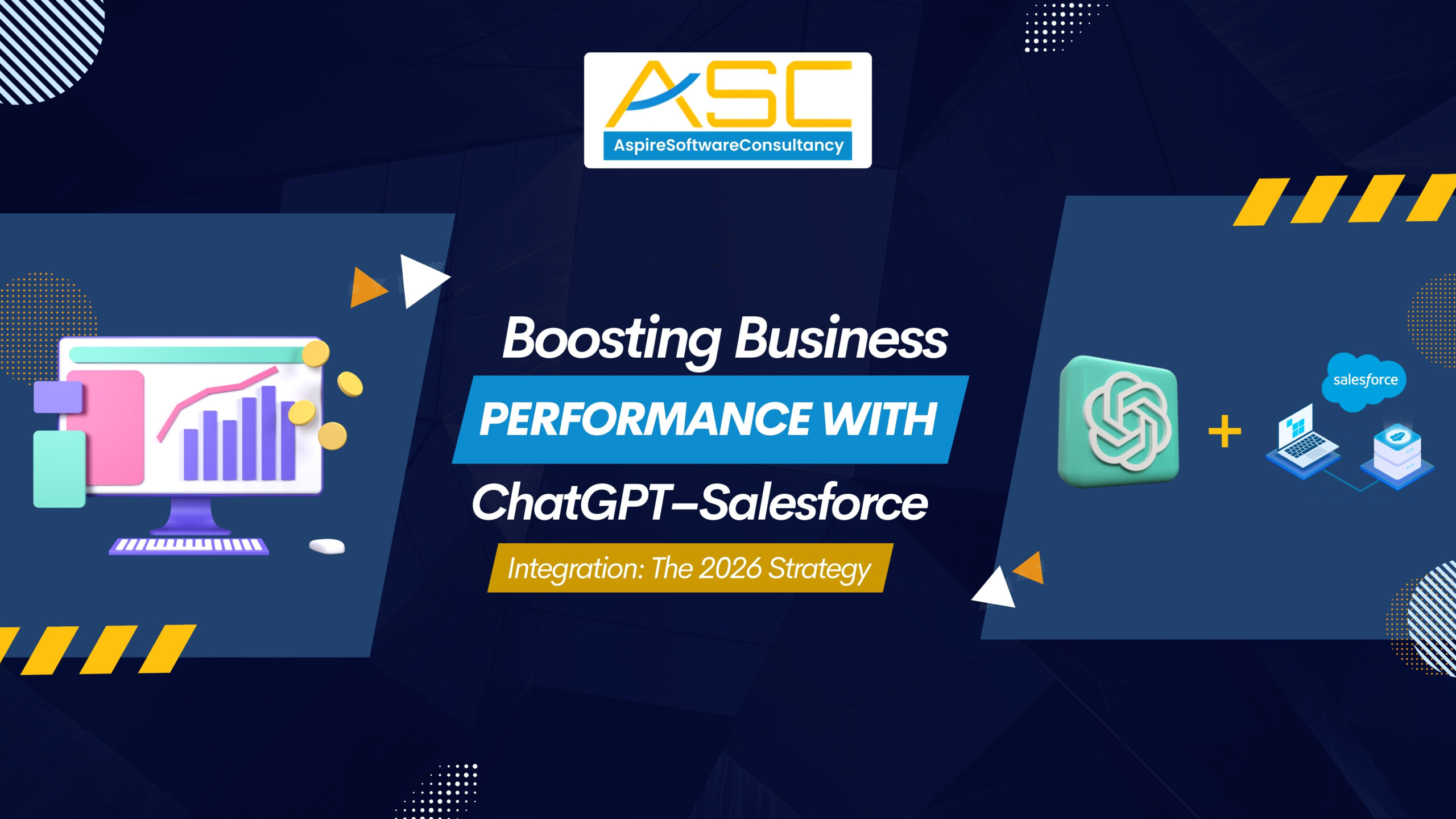
The digital landscape of 2026 has officially moved beyond simple automation. We have entered the era of the “Agentic Enterprise,” where the question is no longer how to store data, but how to make that data think. For modern businesses, the ChatGPT–Salesforce integration has emerged as the single most transformative bridge between customer intelligence and autonomous action.
At Aspire Software Consultancy, we recognize that integrating a Large Language Model (LLM) into your CRM is not just a technical upgrade—it is a strategic overhaul of your revenue engine. In this guide, we explore how to leverage Salesforce AI automation to drive unprecedented growth.
1. What is ChatGPT–Salesforce Integration in 2026?
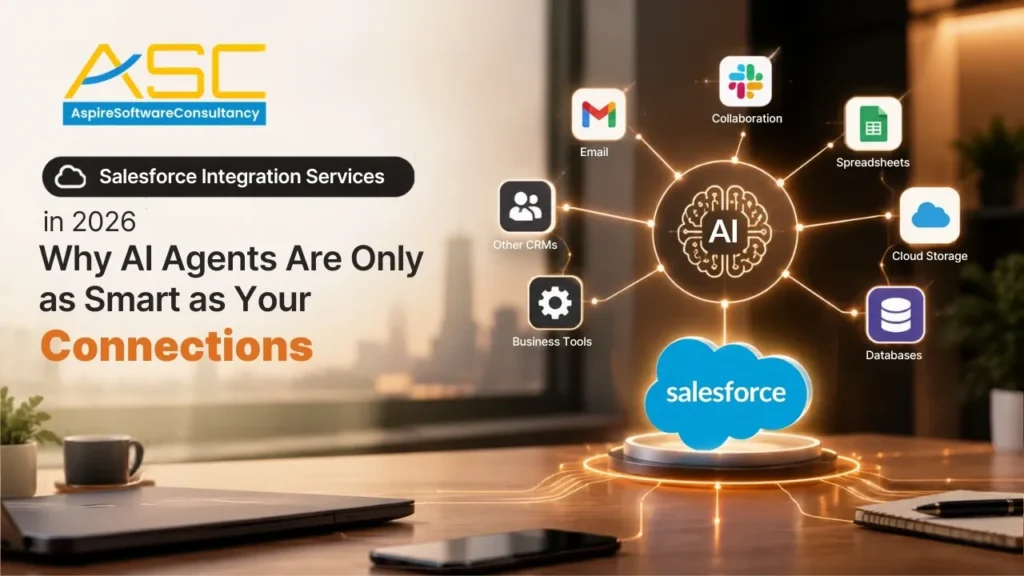
ChatGPT–Salesforce integration refers to the seamless connection of OpenAI’s generative intelligence with the Salesforce Customer 360 ecosystem. Unlike the basic chatbots of the past, 2026 integrations utilize Agentforce and Data Cloud to provide “context-aware” intelligence.
By connecting ChatGPT to your Salesforce objects (Leads, Accounts, Cases), the AI can perform complex reasoning, such as predicting customer sentiment or auto-generating technical proposals based on historical deal data. This creates a “digital co-worker” that lives inside your CRM, handling the cognitive load that previously slowed down your human teams.
2. The Strategic Impact on Sales Performance
For any Salesforce sales cloud expert, the primary goal is reducing the “time-to-close.” ChatGPT integration accelerates this by removing administrative friction.
Hyper-Personalized Sales Outreach
In 2026, generic email templates are ignored. ChatGPT analyzes a prospect’s recent SEC filings, social media activity, and past Salesforce interactions to draft a 1-to-1 personalized message. This level of Salesforce customization services ensures your outreach feels human, even at a massive scale.
Automated Lead Scoring and Enrichment
Instead of static rules, ChatGPT uses natural language processing (NLP) to “read” lead behavior. It can scan a prospect’s website and cross-reference it with your Salesforce customization services logic to score leads based on their actual business needs, not just their job title.
3. Elevating Customer Service to “Proactive” Status
Customer service is the new marketing. By working with a Salesforce service cloud expert, businesses are using ChatGPT to move from reactive support to proactive care.
- Instant Case Summaries: When a high-priority case is opened, ChatGPT provides the agent with a concise summary of the last five years of customer history in three bullet points.
- Sentiment-Driven Routing: The AI detects frustration in an incoming chat and automatically routes it to a senior specialist, improving first-call resolution by up to 40%.
- Self-Healing Support: For common technical issues, ChatGPT can generate custom troubleshooting guides on the fly, reducing the need for human intervention.
4. Technical Framework: Security and Scale
Implementing expert software consultancy services for AI requires a “Security-First” mindset. At Aspire, we follow the Zero-Copy Architecture principle.
- Named Credentials: We use Salesforce’s native security layers to store OpenAI API keys, ensuring no sensitive data is exposed in the code.
- PII Masking: Before sending data to ChatGPT, our custom Apex triggers mask Personally Identifiable Information (PII) to maintain GDPR and HIPAA compliance.
- Prompt Engineering: We build specialized “system prompts” that act as the guardrails for the AI, ensuring it stays on-brand and factually accurate.
5. Why AEO and GEO are Vital for Your 2026 CRM Strategy
Search has changed. In 2026, AI engines like Gemini and Perplexity are the new gatekeepers. To ensure your business is cited as an authority, your ChatGPT–Salesforce integration strategy must be “Generative Engine Optimized” (GEO).
- Direct Answers: We structure our content to answer the “How” and “Why” immediately. This increases the chance that an AI search result will cite Aspire Software Consultancy as the expert source.
- Semantic Entities: By linking ChatGPT functionality to specific Salesforce terms (like Apex, Flows, and Objects), we help search engines understand the depth of our technical expertise.
6. The ROI of AI Integration: What the Data Says
According to 2026 industry benchmarks, enterprises that successfully implement an AI-driven CRM strategy see:
- 30% Decrease in operational costs through automated data entry.
- 22% Increase in lead conversion rates due to hyper-personalized follow-ups.
- 15% Higher customer retention rates through proactive sentiment monitoring.
7. How to Get Started with Aspire Software Consultancy
The transition to an AI-powered CRM doesn’t happen overnight. As a leading software consultancy services provider, we recommend a phased approach:
- Maturity Audit: We evaluate your current data cleanliness in Salesforce.
- Pilot Program: We integrate ChatGPT into a single department (e.g., Lead Gen) to prove ROI.
- Enterprise Scaling: We roll out the integration across your entire global infrastructure.
Conclusion:
In 2026, the gap between the leaders and the laggards is defined by how well they integrate human creativity with machine intelligence. A ChatGPT–Salesforce integration is the catalyst for this transformation.
Ready to build your autonomous future? [Contact Aspire Software Consultancy Today – contact@aspiresoftwareconsultancy.com] to schedule your 2026 AI Readiness Audit.
Frequently Asked Questions
Yes, when implemented correctly. By using Salesforce Named Credentials and data masking techniques, sensitive PII never leaves your secure environment. Aspire Software Consultancy ensures all integrations meet GDPR and HIPAA compliance standards.
While ChatGPT can suggest Apex code, it should never be deployed without a human review. Our Salesforce customization services include rigorous testing of any AI-generated code to ensure system stability.
No. ChatGPT and Salesforce Einstein are complementary. Einstein excels at predictive analytics (who will buy), while ChatGPT excels at generative tasks (what to say to them).
A basic pilot can be deployed in 2–4 weeks. However, a full enterprise-grade integration with custom LWC and Data Cloud sync typically takes 8–12 weeks.
Costs involve OpenAI API token usage and the development time for customization. Aspire helps you implement “Prompt Caching” to reduce API costs by up to 40%.