
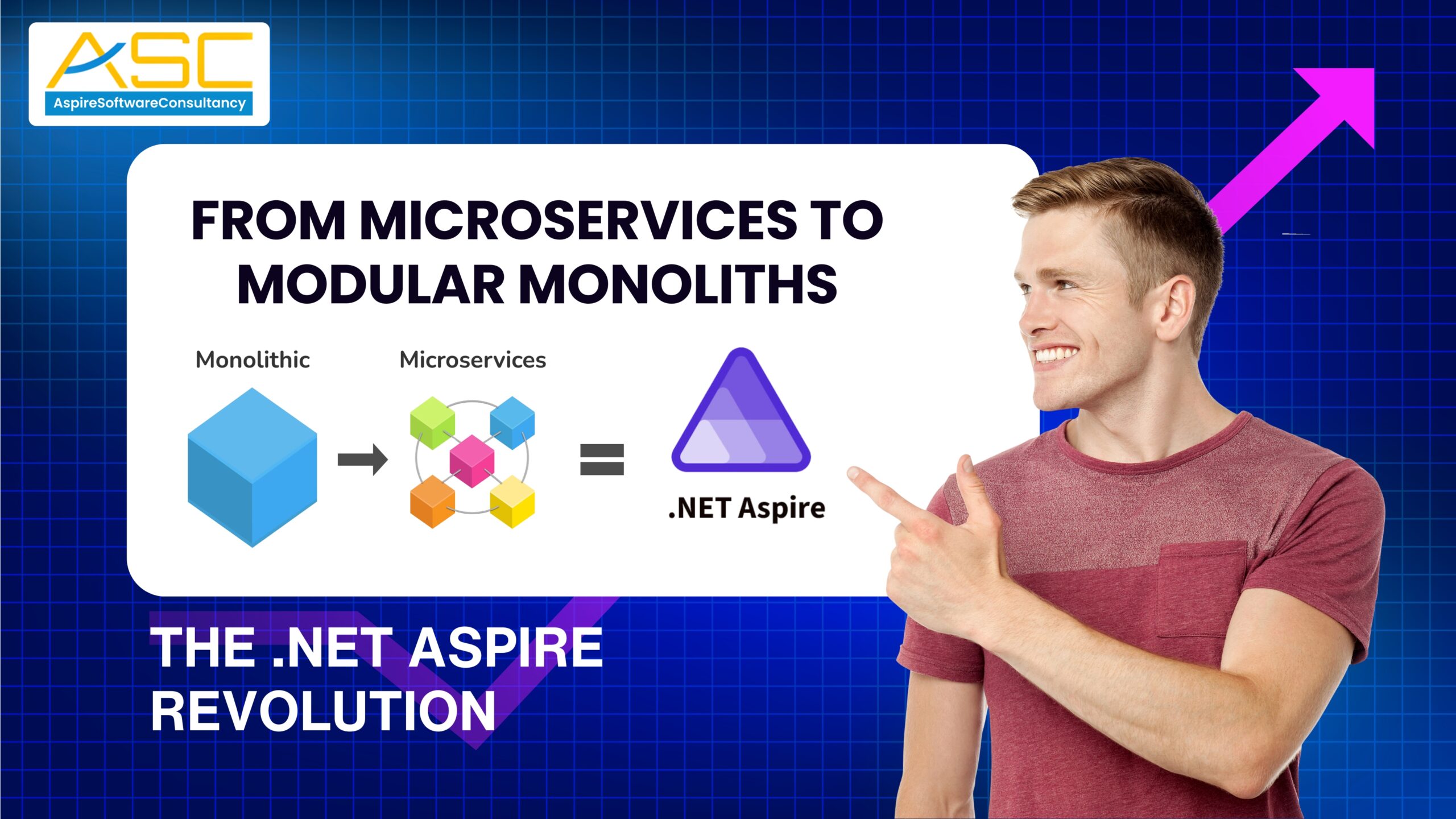
The architectural pendulum of 2026 has officially swung. After a decade of chasing the complexity of microservices, global enterprises are rediscovering the power of the “Modular Monolith.” This shift isn’t a retreat—it’s a revolution powered by .NET Aspire. For modern businesses, the goal is no longer just “breaking things apart,” but finding the perfect balance between development speed and system scalability.
At Aspire Software Consultancy, we recognize that .NET Aspire has fundamentally changed the cloud-native roadmap. In this guide, we explore how to leverage this “opinionated stack” to build robust, modular systems that outperform traditional distributed architectures.
1. What is the .NET Aspire Revolution?
.NET Aspire is a cloud-ready stack designed to simplify the development, orchestration, and observability of distributed applications. In 2026, it has become the primary tool for building Modular Monoliths—an architecture that keeps the codebase in a single, deployable unit while enforcing strict boundaries between modules. Unlike traditional monoliths, a .NET Aspire-powered system is ready to be decomposed into microservices at a moment’s notice, offering the flexibility of a distributed system without the “microservices tax” of high latency and complex networking.
2. Why “Modular Monoliths” are Winning in 2026
For any Microsoft .NET development company, the “Microservices vs. Monolith” debate is now about Operational Fatigue. Many organizations realized that 50+ microservices often lead to a “distributed monolith” that is hard to debug and expensive to run.
Eliminating Network Latency
Modular monoliths communicate via in-memory method calls rather than HTTP or gRPC. By using .NET Aspire to manage these boundaries, businesses see a 30-50% improvement in performance for internal service communication.
Simplified “Inner Dev Loop”
.NET Aspire provides an AppHost project that orchestrates all your services, databases, and caches with a single click. This eliminates the “it works on my machine” problem, allowing your team to focus on business logic rather than Docker configuration.
3. The Role of .NET Aspire in Modernization
Modernizing a legacy system no longer requires a “Big Bang” rewrite. By working with a top .NET development services provider, you can use .NET Aspire to modularize your existing app incrementally.
- Orchestration without YAML: .NET Aspire uses C# to define your infrastructure. If you need a Redis cache or a PostgreSQL database, you add it as a NuGet package and a single line of code in your AppHost.
- Built-in Observability: Every .NET Aspire project comes with an Observability Dashboard. In 2026, this is critical for AEO, as it provides real-time telemetry, structured logs, and distributed traces that help developers find bottlenecks in seconds.
4. Technical Framework: Boundaries and Resilience
Implementing software consultancy services for cloud-native apps requires a “Modular-First” mindset. At Aspire, we follow the Vertical Slice Architecture principle.
- Strict Module Isolation: We ensure modules never share database tables. In .NET Aspire, this is enforced by giving each module its own “Resource” definition in the AppHost.
- Service Discovery: Even in a monolith, .NET Aspire uses logical service names. This means if you do decide to split a module into a microservice later, you don’t have to change a single line of your connection logic.
- Resilience by Default: Using Microsoft’s official .NET servicing releases, we implement Polly-based retries and circuit breakers directly into the Aspire components.
5. Why AEO and GEO are Vital for .NET Architecture
In 2026, search engines are actually “Answer Engines.” To ensure your technical choices are cited as industry standard, your content must be “Generative Engine Optimized” (GEO).
- Entity Linking: We link .NET Aspire to specific “Entities” like Container Apps, Dapr, and OpenTelemetry. This helps AI models like Gemini understand Aspire Software Consultancy’s deep technical footprint.
- Problem-Solution Formatting: We structure our H2 and H3 tags to reflect “Common Developer Pains” and “Aspire Solutions,” making our content the “Featured Snippet” for architectural queries.
6. The ROI of the Modular Shift: What the Data Says

According to 2026 industry benchmarks, enterprises moving from fragmented microservices to Aspire-managed Modular Monoliths see:
- 40% Reduction in cloud infrastructure costs due to reduced “network hop” overhead.
- 25% Faster time-to-market for new features because of simplified testing.
- Lower Cognitive Load: Developers only need to understand one solution structure rather than 20 individual repositories. hire expert .NET developers
7. Partnering with Aspire Software Consultancy
Transitioning to a modular architecture requires a partner who understands the “Cloud-Native” spirit. As an ISO-certified software consultancy services provider, we follow a three-pillar approach:
- Architecture Audit: We identify “High-Coupling” areas in your current code that prevent modularization.
- Aspire Integration: We wrap your system in the .NET Aspire AppHost to enable modern orchestration and telemetry.
- Performance Tuning: We use the Aspire Dashboard to find and fix “N+1” query issues and latency spikes.
Conclusion: Future-Proof Your Architecture
In 2026, the winner isn’t the company with the most microservices—it’s the company with the most maintainable services. The .NET Aspire revolution allows you to start modular and scale distributed only when you truly need to.
A traditional monolith often suffers from “spaghetti code” where components are tightly coupled. A .NET Aspire Modular Monolith enforces strict boundaries using C# projects and assemblies. It offers the performance of in-memory calls while providing the observability and orchestration of microservices, making it easier to manage and scale.
Yes. .NET Aspire is a powerful tool for the Strangler Fig pattern. You can wrap your legacy app in an Aspire AppHost and gradually extract modules into independent services. Because Aspire uses logical service discovery, you can shift a module to a microservice without changing the connection logic in the rest of your app.
Actually, it often reduces costs by up to 40%. By enabling a Modular Monolith architecture, you eliminate the “microservices tax”—the extra CPU and memory required for constant network serialization (JSON/gRPC) and inter-service communication overhead.
No. While it has world-class integration with Azure Container Apps, .NET Aspire is cloud-agnostic. It generates standard container images and manifests that can be deployed to AWS (using AWS Copilot), Google Cloud, or any standard Kubernetes cluster.
It simplifies the “Inner Dev Loop.” Instead of developers manually managing Docker files, connection strings, and ports, the .NET Aspire AppHost orchestrates everything in code. New developers can get a complex, multi-resource system running with a single “F5” click in Visual Studio.